
Reimagining Education in Insular Territories: Pedagogical Innovation and Social Sustainability in the Aeolian Archipelago
 10.21463/jmic.2025.14.2.07
Abstract
This paper explores social innovation in island education, emphasizing how insular territories can transcend perceptions of disadvantage to become dynamic spaces for educational experimentation. Using the Italian Minor Island School Network (SIMI) as a case study, the research examines six schools across the Aeolian Islands — Alicudi, Filicudi, Stromboli, Panarea, Salina, and Lipari — that provide preschool, primary, and lower secondary education while navigating challenges of remoteness and limited resources. Island schools serve as unique environments for pedagogical innovation, integrating place-based education that connects learning with local culture and ecosystems. The study employs a qualitative approach, combining a literature review with stakeholder interviews, to analyze the interplay between schools, communities, and territories. The findings reveal how these institutions not only ensure educational continuity but also foster lifelong learning, resilience, and community cohesion in the face of depopulation. Drawing on theories of place-based education and educational resilience, the study argues that island schools exemplify adaptability and creativity. Their autonomy facilitates innovative policy implementation, positioning them as laboratories for educational reform and contributing to sustainable, inclusive learning environments that sustain insular communities’ identity and vitality.
Keywords
network of schools, Italy, case study, educational innovation, relationality
1. Introduction
Islands, by their nature, face distinct challenges related to geographical isolation, which affects not only physical access to services but also the educational sustainability. Insular communities encounter unique constraints, such as spatial remoteness and limited connectivity, economic dependence on finite resources, and external pressures such as tourism and migration (Gillis, 2004). This isolation raises deeper questions about how learning and community resilience can be preserved in these unique settings. Limited access to higher education and vocational training, combined with the tendency for students to leave school early for service-sector jobs (Haase, Maier, 2021), reflect systemic issues of depopulation and the erosion of local social fabric. For island territories, the challenge is not only to provide education but also to retain students and ensure community cohesion (Baldacchino, 2013; Kim, Lee, 2021). Young people leave for educational purposes and rarely return after graduation. As a result, the value of local resources is not exploited.
In the context of the Mediterranean basin, island territories provide a particularly compelling field of investigation for understanding how to ensure access to education. This article examines social innovation in island education, focusing on how insular territories can move beyond being viewed as ‘disadvantaged’ and instead become ‘special areas’ for educational experimentation (Ratter, 2018). Moreover, the article explores the intersection of insularity and education, investigating how minor island schools navigate systemic constraints while promoting local knowledge, sustainability, and community engagement. Through a case study of the Aeolian Islands, the research highlights the role of place-based education in fostering resilience, aligning with broader discussions on ‘islandness’ and educational sustainability (Pugh, 2018; Yin, 2018).
The education of new generations and cooperation among local stakeholders are two key factors that must be analysed and strengthened in island territories. Italy has approximately sixty minor islands, classified as less developed regions and recognized as distinct territories under EU legislation. Their insularity and distance from the mainland create unique developmental challenges shaped by local resources and territorial characteristics. According to Eurostat classification, islands are categorized as NUTS 3-level insular regions, which may consist of multiple islands rather than a single insular territory. However, some islands fall within NUTS 3 regions that also include mainland areas, meaning they are not classified as insular regions but rather as insular units. The inhabitants of islands within these NUTS 3 regions account for 4.6% of the total EU population (Haase, Maier, 2021).
Addressing the specific challenges of island regions requires targeted policies that acknowledge their distinct socio-economic and geographical conditions. Strengthening educational opportunities and fostering local cooperation can play a critical role in promoting sustainable development and enhancing the resilience of these insular communities.
This study draws on theories of place-based education and educational resilience to argue that island schools can serve as models of adaptability and creativity (Howley et al., 2011). The autonomy of these territories allows for the swift implementation of innovative policies, transforming islands into experimental spaces for educational reform (Stratford et al., 2023). The finding highlights how these island schools not only ensure educational continuity but also promote lifelong learning, enhancing resilience in the face of depopulation.
At the heart of this study is the concept of insular places, which contribute significantly to the development of a multi-actor, inclusive and cross-sectoral approach that connects education system transformation with the practical needs and demands of all people, including those from groups resident in the islands. A progressive sense of place facilitates a ‘reading for difference’ (Gibson-Graham, 2008) and the recognition of the dynamic relationships between different places and geographical scales.
2. Reflecting on the island territories
The island territories, particularly the smaller ones, possess unique and invaluable natural and environmental characteristics, as well as rich traditions and historical heritage rooted in their local communities. These territories enhance the therapeutic potential of the sea and nature, as confirmed by multiple studies (Gesler, 1993; Finlay et al., 2015), which highlight how blue and green landscapes exhibit a therapeutic component that fosters holistic connections between nature, the self, and physical, social, and mental well-being. Moreover, the issue of insularity and the characteristics of the territories surrounded by the sea has been addressed in numerous recent studies, which confirm the presence of territorial disparity, structural disadvantages, fragile businesses, and therefore an economy often unbalanced towards the internal market and not very competitive.
At the same time, these territories create unique and valuable conditions, such as the enhancement of landscapes and a natural heritage of extraordinary importance, with the aim of protecting, preserving, and passing it on to future generations through a multifunctional approach to development.
While tourism offers islands a pathway to economic prosperity, benefiting both residents and visitors, its impacts must be carefully managed to balance development with sustainability. Effective governance, community participation, and responsible tourism policies are essential in mitigating conflicts and ensuring long-term benefits for all stakeholders (Cardillo et al., 2021).
Moreover, the concept of ‘islandness’, as explored by McCall (1994), Baldacchino (2008), and Pugh (2013, 2016), challenges static notions of insularity and dependency, islands, far from being isolated, are dynamic spaces of relational connectivity that integrate land, sea, and community, and can learn from one another. Scholars such as Stratford (2003), and Steinberg and Peters (2015) argue that the aquatic boundaries of islands are porous and traversable, fostering material, social, and political interactions. Hence the need for attention to the economic and social development of these territories, as they are often characterized by natural, structural and/or demographic handicaps as a result of their insularity. However, tourism activity in island destinations is an opportunity for development and benefits both the local population and its visitors — compatibly with the balance of ecosystems. In addition, the relationships between tourism and identity in the islands have been emphasized (Bozeztka, 2013). But islands are complex territories (Baldacchino, 2013, 2015; Dell’Agnese, 2019) that address challenges and fragility primarily environmental (Capocchi et al., 2019), also of other nature related to the education and training of young people and residents.
Current educational narratives on minor islands seem often to adopt a deficit-oriented perspective, emphasizing challenges such as limited resources, geographic isolation, and high teacher turnover. These constraints, while significant, are predominantly presented as barriers rather than as catalysts for innovation and adaptability. This trend has resulted in a limited understanding of how such environments can foster resilience, creativity, and sustainable practices.
However, mainstream educational research seldom incorporates these relational frameworks, often overlooking islands as unique socio-cultural and ecological laboratories.
Moreover, the relational turn (Pugh, 2018) highlights the fluid interactions between local and global forces, yet dominant narratives still marginalize islands as peripheral. His marginalization disregards their potential as hubs for educational innovation, sustainability, and cultural preservation. Many islands—including the Aeolian Islands—exemplify the transformative possibilities of place-based and decolonial approaches to education. A place-based approach clarifies the interdependency between environmental, social, and economic aspects of sustainable development (Barron et al., 2020). In this context, it is pertinent to conceptualize place as a relational construct that operates across multiple scales and social dimensions rather than as a purely territorial entity. The significance of place is increasingly recognized in the context of implementing sustainability objectives. Moreover, a progressive understanding of place can integrate a territorial perspective into the concept of co-benefits, reinforcing socio-cultural, economic, and environmental linkages across different geographic contexts, including urban and rural setting.
3. Education in island contexts
Island studies, or nissology, explores the unique socio-cultural, economic, and ecological dimensions of island life (McCall, 1994). Central to this field is ‘islandness’, which frames islands not as peripheral spaces but as distinct environments where identity, culture, and place are deeply intertwined (Baldacchino, 2006; Hay, 2006). This perspective challenges mainland-centric views, emphasizing how insularity shapes all aspects of life, including education (Connell, 2003; Grydehøj, 2017).
Grydehøj and Kelman (2017) describe islands as “social laboratories” where cultural traditions and community values are preserved and transmitted. Education plays a crucial role in sustaining these identities, fostering ecological stewardship, and enhancing community resilience (Selby, Kagawa, 2018). Schools in small and remote islands face systemic difficulties, including teacher shortages, insufficient digital infrastructure, and geographical isolation (Baldacchino, 2018; Cannella et al., 2020). However, rather than being seen as peripheral, these islands are increasingly recognized as centers of educational innovation, where place-based learning, community engagement, and digital transformation intersect to create resilient schooling models (Parigi et al., 2020; Kelman, 2021).
Policy frameworks, such as article 174 of the Treaty on the Functioning of the European Union, acknowledge the unique needs of insular regions, advocating for targeted investments to counterbalance socio-economic disparities. However, governance structures impact how education addresses island-specific challenges. Small Island States, such as those in the Pacific and Caribbean, have the autonomy to integrate local culture and environmental knowledge into curricula (Crossley, Sprague, 2014). In contrast, minor islands under centralized governance — such as Italy’s smaller islands — often follow standardized national curricula, limiting their ability to reflect local cultural and ecological realities (Gillis, 2004).
Despite these constraints, some island communities have adopted place-based education strategies. Conkling (2007) argues that tailored curricula can counteract insularity by fostering a strong sense of place, while McCall (1994) advocates for ecological education to prepare students as stewards of their fragile island environments.
4. Place-based education in minor Islands: a framework for sustainability, cultural identity, and community engagement
Place-Based Education (PBE) has emerged as a transformative approach to learning, particularly within minor island contexts, where the environment, culture, and community dynamics deeply shape educational needs. This pedagogical framework emphasizes learning that is directly tied to the local setting, encouraging students to engage with their immediate surroundings in ways that are meaningful, sustainable, and culturally relevant (Burgess et al., 2022). Unlike traditional and standardized education models PBE situates learning within the ecological and socio-cultural fabric of specific locations, making education more relevant, impactful, and engaging (Smith, 2002).
In minor island contexts, where access to external resources is limited, PBE enhances academic engagement by drawing on local knowledge and traditions. It fosters environmental awareness and cultural continuity, equipping students with the tools to understand and address sustainability issues within their own communities (Smith, 2002; Howley et al., 2011). Island schools that apply this model have reported stronger student participation, deeper place attachment, and increased intergenerational cooperation (Howley et al., 2011).
A key aspect of PBE is its role in fostering environmental stewardship, a crucial consideration for island communities that are particularly vulnerable to ecological threats such as climate change, coastal erosion, and biodiversity loss (Kopnina, 2020). Studies have found that PBE enhances students’ ecological literacy by engaging them in hands-on environmental projects, such as marine conservation, sustainable fisheries management, and habitat restoration (Bowra et al., 2021). By actively participating in these initiatives, students develop a sense of responsibility toward their natural surroundings, equipping them with the knowledge and skills necessary to contribute to long-term environmental sustainability. Furthermore, this mode of learning has been linked to increased environmental activism among youth in island communities, reinforcing the idea that education can serve as a catalyst for local ecological preservation efforts (Smith, 2002).
In addition to environmental sustainability, PBE is instrumental in strengthening cultural identity and continuity, particularly within indigenous and small island communities where globalization and migration pose significant threats to traditional knowledge systems (Bowra et al., 2021; Cooley, 2022). For example, many island schools operate under centralized national education policies that prioritize standardized learning outcomes, often at the expense of localized and contextually relevant educational practices (Howley et al., 2011). This creates a tension between meeting national academic benchmarks and fostering place-specific knowledge that is meaningful to students’ lives and communities. Additionally, teacher training remains a significant barrier, as educators often receive little preparation in how to integrate place-based methodologies into their teaching practices. Without adequate support, the effectiveness of PBE can be limited, and teachers may struggle to balance curriculum demands with experiential and community-driven learning opportunities.
To address these challenges, educational policymakers must prioritize the integration of PBE within national and regional frameworks, ensuring that minor island schools receive the resources and flexibility needed to implement place-based approaches effectively. Investments in teacher training programs, curriculum development, and community partnerships are essential to sustaining and scaling PBE initiatives. Additionally, leveraging digital tools and remote learning technologies can help bridge the gap between localized education and broader academic networks, allowing island students to access a wider range of learning opportunities while still grounding their education in local contexts (Cooley, 2022).
Ultimately, PBE represents a powerful tool for fostering sustainable, culturally relevant, and engaging education in minor island contexts. By anchoring learning in the lived realities of students, it not only enhances academic achievement but also promotes environmental stewardship, cultural resilience, and community development. As research continues to support the effectiveness of PBE in these settings, there is a growing need for educational systems to recognize and support the role of place-based learning in shaping more sustainable and equitable futures for island communities (Smith, 2002; Howley et al., 2011).
5. The Case Study: Education in the Aeolian Islands
The methodological approach adopted in this study is designed to explore the educational dynamics of the Aeolian Islands within the broader context of minor island schooling in Italy. Given the socio-geographical particularities of the archipelago and the strategic role of the Italian Minor Island School Network (SIMI), a qualitative research design has been chosen to capture the complex interplay of educational policies, community engagement, and pedagogical innovations. The research methodology is grounded in case study analysis (Yin, 2018), as the Aeolian educational model provides a representative example of resilience and adaptation in insular learning environments. A review of policy documents, including the Piano Triennale dell’Offerta Formativa (PTOF, 2022-2025), the Rapporto di Autovalutazione della Scuola (RAV), Ministry of Education, University and Research (MIUR) reports, and National Institute for Documentation, Innovation and Educational Research (INDIRE) studies, contextualizes the educational strategies in minor island schools (Creswell, Poth, 2016). The PTOF outlines long-term educational objectives and institutional priorities, while the RAV provides a self-evaluation framework that allows schools to assess their performance and needs. These documents are instrumental in understanding the evolving educational landscape in minor islands and the policy-driven responses to systemic challenges. The approach is place-based because spatial identity takes on importance as a set of positive interactions and connections. In fact, developing interventions for educational system transformation can be reached co-benefits between social, environmental and economic objectives, linkages between land and sea including all actors, resources and their knowledge and connectivity’s between education and other relevant questions of the insular territories. In addition to the documentary analysis, the study involved semi-structured interviews with five key stakeholders, including school leaders, administrators, and representatives of local associations involved in educational initiatives across the Aeolian archipelago. These participants were selected based on their direct engagement with island schools and their roles in shaping educational responses to local challenges. The interviews explored a range of themes, including: the role of schools in promoting resilience in insular contexts; the integration of environmental and digital education; the connection between schools and local community initiatives; and the challenges and opportunities of working in geographically isolated settings. Sample questions included: “In what ways, and under what conditions, can new generations contribute to local resilience strategies in the island territory?”; “How do existing knowledge and skills in environmental sustainability, linked to digital tools, help these territories?”; “How do schools promote sustainability within inclusive communities in the Aeolian context?”. Interviews were transcribed and thematically analyzed to identify patterns and divergences across different islands and stakeholder perspectives. This qualitative approach enables a grounded understanding of how educational innovation is locally interpreted and enacted.
5.1 The context
The study area corresponds to the territory of the Aeolian archipelago. There are seven main islands that make up the archipelago, and they can be divided into three groups, depending on their geographical position: the islands of Ponente, Alicudi and Filicudi, the islands of the North-East, Stromboli and Panarea, the central islands, with a South-North direction, Vulcano, Lipari and Salina (Fig. 1). Renowned for its cultural, historical, scientific, and humanistic significance (D.M., 2001, art. 1), the Aeolian archipelago has garnered considerable academic interest while also providing visitors with a diverse experiential landscape (Baldacchino, 2015; Volo, 2017).
Situated along the inner margin of the Calabro-Peloritan Arc, the archipelago was designated a UNESCO World Heritage Site in 2000 for its natural value. However, the UNESCO Site of the Aeolian Islands to date is devoid of a managing body and has not activated a coherent programming with appropriate conservation and enhancement purposes (Vettore et al., 2024).
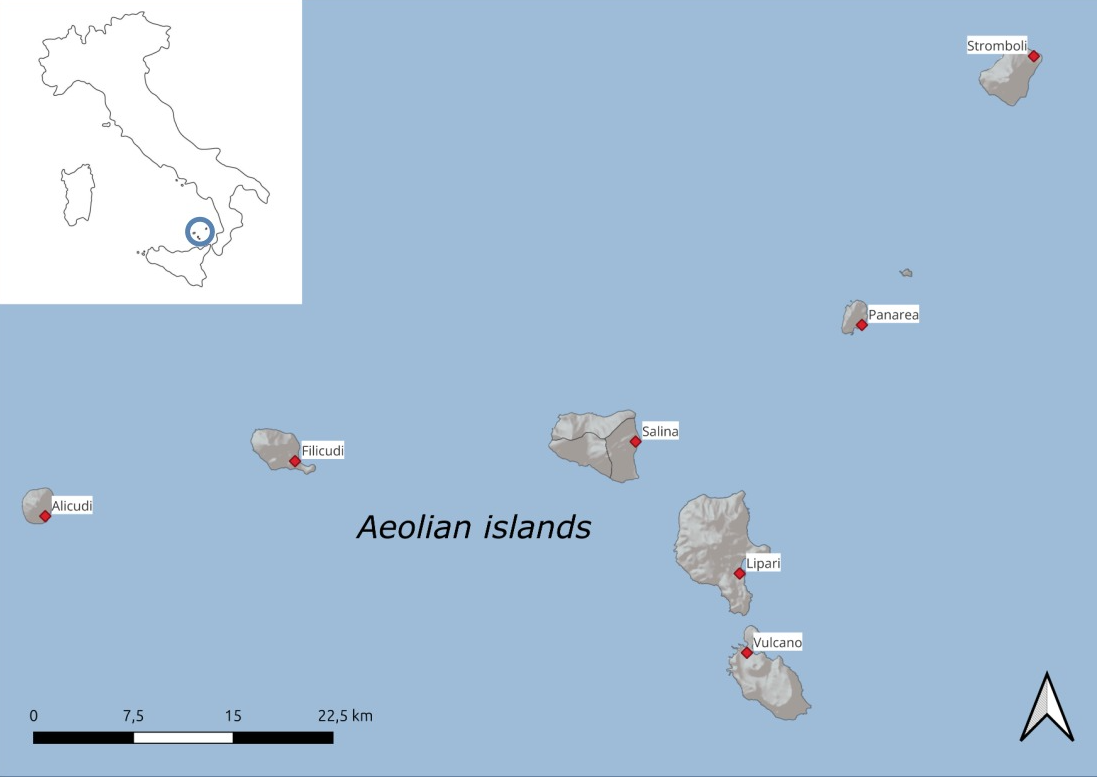
It encompasses a total surface area of 117 km², featuring underwater reliefs — some of volcanic origin — arranged in a semi-annular structure extending approximately 200 km in linear development (tab. 1). Administratively, the islands belong to the Metropolitan city of Messina within the Sicilian region, in the South of Italy. The territory is significantly shaped by intense volcanic activity, which has influenced not only its environmental components but also the morphological, social, and economic evolution of the islands (Calanchi et al., 1996).
| Denomination | Municipality | Area (Km2) |
Altitude min-max |
Features* |
|---|---|---|---|---|
| Lipari Island | Lipari | 37.6 | 0 – 924 | IA |
| Vulcano Island | 21 | 0 – 500 | IA | |
| Stromboli and Strombolicchio Islands | 12.6 | 0 – 926 | IA – ID | |
| Filicudi Island | 9.5 | 0 – 775 | IA | |
| Alicudi Island | 5.2 | 0 – 675 | IA | |
| Panarea Island and nearby rocks | 3.3 | 0 – 421 | IA – ID | |
| Salina Island | S. Marina Salina | 27 | 0 – 962 | IA |
| Malfa | 0 – 860 | IA | ||
| Leni | 0 – 962 | IA |
Source: PGU, 2008
The striking coastal landscapes, sandy shores on some islands, extensive vineyards, and the characteristic warm-temperate Mediterranean climate contribute to a distinctive natural setting. Furthermore, human settlements interwoven with historical and cultural heritage reinforce the territorial identity, fostering strategies for sustainable economic development (Nicolosi et al., 2018). For the Aeolian Islands, after the end of the Second World War, a new page of history opened and thanks to the choice to shoot films, with protagonists of excellence, which drew the attention of great national and foreign tourist currents to the archipelago. Archaeological excavations began and in the same pavilions previously used by the confined, the Aeolian Archaeological Museum was born. The insular condition of the Aeolian Islands, marked by their geographic separation from the mainland, offers a strategic advantage in regulating urban expansion. This geographic isolation has helped prioritize sustainable and productive land use while preserving the landscape’s scenic beauty as an additional natural asset to be appreciated and safeguarded. At the same time, the economic disadvantages that weigh on the economy can be traced back to three main categories, transport costs, distribution costs and production costs. Also, the islands’ natural heritage is exposed to several threats, including over tourism, and this induced a severe anthropization (Vettore et al., 2024).
5.2 The Italian Minor Island School Network (SIMI)
While minor island’ geographical isolation and environmental uniqueness have contributed to their distinct identity and sustainable land use, these same characteristics also present significant challenges in public service provision, infrastructure, and mobility. Among these, education stands as a crucial factor, shaping both community resilience and long-term socio-economic sustainability. The dispersed nature of the archipelago, coupled with seasonal population shifts and economic dependencies, creates unique barriers to educational accessibility and continuity, requiring specialized policies.
In response to these challenges, the Italian Minor Island School Network (SIMI) was established in 2021, with the aim to redefine the role of education in insular contexts, ensuring that island schools’ function not only as learning environments but also as civic centers fostering social cohesion and local development (SIMI, 2022). More than just a network of institutions, SIMI acts as an official representative of island schools, engaging directly with institutional stakeholders such as INDIRE, MIUR, and Regional Education offices (USR) to advocate for policy recognition.
SIMI’s primary goal is to advocate for a special law that formally recognizes the unique needs of minor island schools. This legal framework would establish provisions for sustaining teacher recruitment, improving school infrastructure, and securing long-term financial support for educational development. In tandem, the network prioritizes the enhancement of digital infrastructure, recognizing that distance learning plays a crucial role in overcoming the physical barriers that separate students and educators. Investments in Innovation Techonology (IT) resources, digital laboratories, and broadband connectivity aim to support hybrid and online learning models, ensuring that students can continue their education even when adverse weather conditions disrupt transportation.
Beyond national funding, SIMI also seeks to secure a dedicated European Union financial stream for minor island schools, ensuring that these institutions can access international exchange programs, teacher training initiatives, and infrastructure development funds. Additionally, recognition of distance learning for educators and administrative staff is a key focus, allowing teachers in minor island territories to engage in professional development remotely, reducing the logistical challenges associated with continuing education and training. Finally, SIMI advocates for preferential policies for school infrastructure, calling for targeted renovation and modernization projects that would allow minor island schools to meet contemporary safety, accessibility, and sustainability standards (SIMI, 2022).
5.3. Education in the Aeolian Islands: A model of resilience and innovation
The educational system in the Aeolian Islands operates within a unique and complex socio-geographical environment, where schools are dispersed across six islands: Lipari, Salina, Alicudi, Filicudi, Stromboli, and Panarea. This fragmented system, which accommodates around 700 students and is supported by approximately 100 teachers and 27 administrative staff, faces ongoing challenges related to teacher retention, infrastructure, and accessibility (PTOF, 2022-2025). Nevertheless, Aeolian schools have developed adaptive strategies to enhance the quality and continuity of education through digital learning, community engagement, and place-based education.
Specially, one of the most pressing issues for Aeolian schools is the high turnover rate of teachers, particularly in smaller islands such as Alicudi, Filicudi, and Stromboli, where educators often come from the mainland and work on short-term contracts. The percentage of teachers who are permanent residents is approximately 50%, meaning that half of the teaching staff rotates regularly, creating instability in instructional continuity. In fact, the teacher retention and pedagogical continuity is an aim to achieve. To addresses this challenge, the Aeolian school system has implemented a time bank system, allowing teachers to redistribute their working hours among colleagues to ensure educational continuity. Moreover, initiatives to train teachers in digital learning methodologies, sustainability-focused pedagogy, and intercultural education have been introduced to better equip educators with the necessary tools to work in an insular environment.
In addition, technology and digital learning in aeolian schools is relevant. Given the transportation difficulties and seasonal disruptions caused by adverse weather conditions, Aeolian schools have increasingly turned to digital learning to maintain consistent educational delivery. One interviewed reported that through videoconferencing tools, cloud-based learning platforms, and virtual classrooms, students can continue their studies remotely when access to physical classrooms is limited. Additionally, partnerships with social organizations such as Attiva Stromboli (www.attivastromboli.net) have strengthened IT support and expanded access to digital learning resources. These efforts align with broader trends in European island education, where technology serves as a bridge to mitigate geographical isolation (INDIRE, 2022).
The Aeolian school system has also embraced the flipped classroom model, allowing students to engage with instructional content online before class, thereby maximizing interactive learning time when physically present in school. This approach has been particularly beneficial in subjects requiring hands-on activities, such as marine science and environmental education. In fact, the Aeolian educational framework strongly integrates place-based learning methodologies, which leverage the islands’ natural and cultural landscapes as interactive learning spaces. One significant initiative is the Mare Vivo project (www.marevivo.it ), which incorporates marine biology, biodiversity conservation, and climate awareness into the curriculum. By engaging directly with their island environment, students gain firsthand knowledge of sustainable fishing practices, marine ecosystem preservation, and the impact of climate change on island communities. Similarly, Salina’s transition to renewable energy has influenced local educational content, embedding sustainability principles into school curricula. Students learn about solar energy systems, water conservation, and waste management, reinforcing environmental stewardship as a core component of their education.
Community engagement plays a central role in the Aeolian education system. Schools have fostered strong relationships with local artisans, cultural organizations, and environmental groups, integrating intergenerational learning into formal education. For instance, the Network of School Representatives in Lipari organizes adult education programs, intergenerational projects, and cultural events, reinforcing schools as community hubs. This model not only strengthens social cohesion but also helps preserve local traditions, crafts, and historical narratives, ensuring that students maintain a deep connection to their island heritage.
In Filicudi, an innovative linguistic immersion program has been introduced, where native English-speaking educators work with students to enhance their foreign language skills. This initiative addresses gaps in language education, which can be a challenge in remote island schools due to the limited availability of specialized teachers.
Recognizing the need for greater connectivity between island schools, the Aeolian education system has implemented inter-island collaboration programs, where students and teachers participate in joint academic projects, shared digital lessons, and collaborative cultural initiatives. For example, through the SIMI network, Aeolian schools share resources, organize joint workshops, and facilitate teacher exchanges. These initiatives foster a sense of educational continuity and shared identity across the archipelago, ensuring that students from smaller islands do not feel isolated in their academic journeys. Additionally, Aeolian schools have participated in Erasmus+ programs, providing students and educators opportunities to engage in international exchanges, thereby broadening their academic and cultural perspectives beyond their insular environment.
Despite the many successes of the Aeolian school system, it continues to grapple with several structural and demographic challenges that threaten its long-term sustainability. One of the most pressing issues, as reported by one interviewed, is the declining student population, as many young families have chosen to migrate to mainland Italy in search of greater economic opportunities. This demographic shift has led to a steady reduction in school enrolments, particularly in the smaller islands of Alicudi and Filicudi, where maintaining viable class sizes has become increasingly difficult. At the same time, infrastructure and resource constraints persist, with some schools lacking modern facilities and up-to-date equipment, directly impacting both the quality of education and the ability to retain teachers in these remote locations. The precarious nature of teaching contracts, combined with the logistical difficulties of island life, has made it challenging to ensure pedagogical continuity, especially in islands where teachers do not permanently reside.
Additionally, Aeolian schools must navigate the delicate balance between adhering to national curriculum requirements and integrating place-based and sustainability-focused education that reflects the unique environmental and cultural realities of the islands. While experiential learning centred on marine ecology, climate awareness, and renewable energy has become a key feature of the educational model, schools must still meet national academic standards, requiring careful curriculum planning and innovative pedagogical approaches. Moving forward, the resilience and long-term viability of Aeolian education will depend on targeted investments in teacher training, digital infrastructure, and sustainable education models that cater to the specific needs of island communities. Strengthening partnerships with universities, research institutions, and international organizations could provide essential support, fostering the development of innovative educational programs tailored to the insular context and ensuring that Aeolian schools remain both academically rigorous and deeply rooted in the unique identity of their territories.
These examples illustrate not only how island schools adapt to logistical constraints, but also how they actively redefine education through a place-based, sustainability-oriented lens. The data suggest that such adaptations are not mere responses to isolation but represent intentional strategies of innovation, turning geographic limitations into opportunities for transformative learning. This interpretive lens allows us to understand Aeolian schools not simply as reactive institutions, but as proactive agents of educational change in marginal territories.
6. Conclusions
The Aeolian school system represents a compelling model of resilience and innovation, demonstrating how minor island communities can navigate the challenges of geographical isolation, teacher retention, and infrastructure limitations through digital learning, environmental education, and strong community involvement. By integrating technology-driven solutions, intergenerational collaboration, and place-based methodologies, Aeolian schools seem to have successfully turned structural constraints into opportunities for educational innovation, fostering a learning environment that remains both locally rooted and globally connected. While digital education has allowed students and educators to overcome physical barriers, ensuring continuity in learning even during adverse weather conditions, place-based education has reinforced ecological awareness and cultural identity, making the islands themselves an integral part of the learning experience. Furthermore, strong community engagement has solidified the role of schools as anchors of social and educational sustainability, proving that local governance, collective participation, and shared resources are key to maintaining quality education in remote territories (Douglas, 2006).
However, ensuring the long-term sustainability of this model requires further policy innovation and structural investments. Future educational strategies should prioritize, securing sustainable funding, and fostering international educational networks to support teacher retention, modernize infrastructure, and enhance learning experiences.
The Aeolian model illustrates how minor islands can transition from being perceived as peripheral and isolated to becoming centers of pedagogical experimentation, sustainability, and cultural preservation. By repositioning minor islands within global educational discourse, this study underscored their potential to pioneer adaptive strategies, challenge the isolation paradigm, and advance inclusive, sustainable educational practices. In this context, insular territories can become catalysts for policy innovation, offering unique insights into how education can respond to environmental, economic, and demographic shifts. Engaging in a broader network of island education systems allows these schools to transcend their geographical constraints, positioning educators and students as active contributors rather than passive recipients of educational policy.
With this vision, Aeolian schools do not simply adapt to insular challenges but rather redefine the possibilities of island education, demonstrating that peripheral regions can be central in shaping the future of global educational paradigms. The inter-insular dialogue promoted by these educational strategies not only strengthens knowledge-sharing and resource distribution but also fosters adaptable models that can be applied to other island communities seeking to balance tradition and innovation in education.
References
- Baldacchino, G., 2006. Islands, island studies, island studies journal. Island Studies Journal, 1-18.
- Baldacchino, G., 2013. Island Landscapes and European Culture: An «Island Studies» Perspective. Journal of Marine and Island Cultures 2: 13-19.
- Baldacchino, G. (Eds.), 2015. Archipelago Tourism Policies and Practices, Ashgate, Farnham.
- Barron, E.S., Hartman, L., Hagemann, F., 2020. From Place to Emplacement: The Scalar Politics of Sustainability. Local Environment 25 (6): 447-462.
- Bowra, A., Mashford‐Pringle, A., Poland, B., 2021. Indigenous learning on Turtle Island: A review of the literature on land‐based learning. The Canadian Geographer/Le Géographe Canadien 65(2): 132-140.
- Bozeztka, B., 2013. Wolin Island, tourism and conceptions of identity. Journal of Marine and Island Cultures 2: 1-12.
- Burgess, C., Thorpe, K., Egan, S., Harwood, V. 2022. Towards a conceptual framework for Country-centred teaching and learning. Teachers and Teaching 28(8): 925-942.
- Cannella, G., Garzia, M., Mangione, G.R.J., Repetto, M., 2020. Piccole Scuole: mondi sommersi, una storia a più voci. Formazione & insegnamento 18(1): 8-15.
- Calanchi, N., Rossi, P.I., Sanmarchi, F., Tranne, C.A., 1996. Guida escursionistico vulcanologica dele Isole Eolie. Centro Studi e Ricerche di Storia e Problemi Eoliani, Union Printing S.p.A, Viterbo.
- Capocchi, A., Vallone, C., Pierotti, M., Amaduzzi, A., 2019. Overtourism: A literature review to assess implications and future perspectives. Sustainability 11(12): 3303-3315.
- Cardillo, M.C., Cavallo, F.L., Gallia, A., Malatesta, S., 2021. Isole, turismo e ambiente: tra conflitti, modelli e opportunità. Geotema 67: 3-7.
- Cooley, T. C., 2022. Place-based education as liberatory praxis. The Vermont Connection, 43(1): 57-75
- Connell, J., 2003. Island dreaming: The contemplation of Polynesian paradise. Journal of Historical Geography 29(4): 554-581.
- Conkling, P., 2007. On islanders and islandness. Geographical Review 97(2): 191-201.
- Creswell, J.W., Poth, C.N., 2018. Qualitative inquiry and research design: Choosing among five approaches, fourth ed. Sage, Los Angeles.
- Crossley, M., Sprague, T., 2014. Education for sustainable development: Implications for small island developing states (SIDS). International Journal of Educational Development 35: 86-95.
- Dell’Agnese, E., 2019. Islands within Islands? The Maldivian resort, between segregation and integration. Tourism Geographies 21(5): 749-765.
- D.M., Decreto ministeriale, 2001. Piano territoriale paesistico dell’arcipelago delle Isole Eolie. https://www2.regione.sicilia.it/beniculturali/dirbenicult/normativa/decretiecircolaribca/D23febbraio2001.htm, accessed 10.1.2025.
- Douglas, C.H., 2006. Small island states and territories: sustainable development issues and strategies–challenges for changing islands in a changing world. Sustainable Development, 14(2): 75-80.
- Finlay, J., Franke, T., McKay, H., Sims-Gould, J., 2015. Therapeutic landscapes and wellbeing in later life: Impacts of blue and green spaces for older adults. Health & Place 34: 97-106.
- Gesler, W., 1993. Therapeutic landscapes: theory and a case study of Epidauros, Greece. Environment and Planning D 11: 171-189.
- Gibson-Graham, J.K., 2008. Diverse Economies: Performative Practices for “Other” Worlds. Progress in Human Geography 32 (5): 613–632.
- Gillis, J. R. 2004. Islands of the mind: How the human imagination created the Atlantic world. Palgrave Macmillan, New York.
- Grydehøj, A., 2017. A future of island studies. Island Studies Journal 12 (1): 3-16.
- Grydehøj, A., Kelman, I., 2017. The eco‐island trap: Climate change mitigation and conspicuous sustainability. Area 49(1): 106-113.
- Hay, P. 2006. A phenomenology of islands. Island Studies Journal 1:19-42.
- Haase, D., Maier, A., 2021. Research for REGI Committee — Islands of the European Union: State of play and future challenges. European Parliament, Policy Department for Structural and Cohesion Policies, Brussels.
- Howley, A., Howley, M., Camper, C., Perko, H., 2011. Place-based education at island community school. The Journal of Environmental Education 42(4): 216-236.
- INDIRE, National Institute for Documentation, Innovation and Educational Research, 2022, https://www.indire.it/en/.
- PTOF, Piano Triennale dell’Offerta formativa 2022-2025, Istituto Comprensivo Statale Isole Eolie, https://www.iclipari1.edu.it/documento/ptof-2022-2025/, accessed, 1.02.2025.
- Kim, J., Lee, H.J., 2021. Educational Problems and Improvement on Ulleungdo Islands in Korea. Journal of Marine and Island Cultures 10: 196-205.
- Kopnina, H., 2020. Education for the future? Critical evaluation of education for sustainable development goals. The Journal of Environmental Education 51(4): 280-291.
- McCall, G., 1994. Nissology: A proposal for consideration. Journal of the Pacific Society 63-64(17): 93-106.
- Nicolosi, A., Laganà, V.R., Cortese, L., Privitera, D. 2018. Using the Network and MCA on Tourist
- Attractions. The Case of Aeolian Islands, Italy. Sustainability 10: 41-69.
- Parigi, L., De Santis, F., Bartolini, R., Iommi, T. 2020. I Quaderni delle Piccole Scuole. Documentare l’esperienza educativa nelle scuole dei territori isolati. Formazione & insegnamento, 18(1): 43-57
- PDG, Piano di Gestione Unesco Isole Eolie, 2000, https://www2.regione.sicilia.it/beniculturali/dirbenicult/PdGEolie/indice%20testo%20PdG%20Eolie.pdf.
- Pugh, J., 2013. Island movements: thinking with the archipelago. Island Studies Journal 8(1): 9-24.
- Pugh, J., 2016. The relational turn in island geographies: bringing together island, sea and ship relations and the case of the Landship. Social & Cultural Geography 17(8): 1040-1059.
- Pugh, J., 2018. Relationality and Island Studies in the Anthropocene. Island Studies Journal 13(2): 93-110.
- Ratter, B., 2018. Geography of Small Islands. Outpost of Globalization, Springer, Cham.
- Selby, D., Kagawa, F., 2018. Archipelagos of learning: environmental education on islands. Environmental Conservation 45(2): 137-146.
- SIMI, Italian Minor Island School Network, 2022, https://arcipelagodiarcipelaghi.it/rete-simi/ .
- Smith, G.A., 2002. Place-based education: Learning to be where we are. Phi Delta Kappan 83 (8): 584-594.
- Stephens, M.S.M., Martínez-San Miguel, Y. (Eds.), 2020. Contemporary archipelagic thinking: Toward new comparative methodologies and disciplinary formations, Rowman & Littlefield, London.
- Stratford, E., Baldacchino, G., McMahon, E., 2023. Rethinking island methodologies, Rowman & Littlefield, London.
- Vettore, F., Romagnoli, C., Lo Cascio, P., 2024. Challenges and Uncertainties Continue for the Aeolian Islands’ World Heritage Site, in Doempke, S., Athale, S., Diao, Z., World Heritage Watch: World Heritage Watch Report 2024, Berlin, pp. 181-184.
- Volo, S., 2017. Eudaimonic well-being of islanders: Does tourism contribute? The case of the Aeolian
- Archipelago. Journal of Destination Marketing Management 6: 465-476.
- Yin, R.K., 2018. Case study research and applications: Design and methods (6th ed.), Sage publications, New York.