
Home Garden Plant Diversity and Local Knowledge of Plant Species Supporting Biocultural Resilience in a Coastal Village of Northeastern Bali
 10.21463/jmic.2025.14.3.15
Abstract
Home gardens in the coastal–island landscape of northeastern Bali play a vital role in sustaining local livelihoods, biodiversity, and traditional ecological knowledge. This study analyzed the diversity and cultural significance of home garden plants in Dukuh Village, a coastal community situated on the northeastern slope of Mount Agung, Bali. Field surveys and semi-structured interviews (n = 9) were conducted in three hamlets differing in elevation and proximity to the coast. A total of 115 plant species across 47 families were recorded, including many species with multiple livelihoods and ritual uses. Ritual plants such as Cocos nucifera (used for offerings and temple decorations), Cordyline fruticosa (used in purification rituals), and Plumeria sp. (used for daily offerings) demonstrate the integration of home gardens with Balinese Hindu practices. Multipurpose species such as Gliricidia sepium and Indigofera sp. are used for livestock forage during the dry season, supporting household resilience amid changing climate conditions. Home gardens thus complement coastal livelihoods, including cashew and lontar palm cultivation, as well as small-scale tourism, while reinforcing cultural identity through the use of traditional plants. Despite the small sample size, the findings highlight how home gardens function as socio-ecological systems that link biodiversity, livelihood security, and biocultural knowledge in island communities.
Keywords
biocultural diversity, climate adaptation, coastal livelihoods, home gardens, Balinese Hindu rituals, traditional knowledge
1. Introduction
Balinese life society is inseparable from its local wisdom. The Nyegara Gunung philosophy is a local wisdom related to conservation activities used in Bali. This activity aims to integrate conservation from upstream (mountains) to downstream (sea). This philosophy serves as the primary foundation for the social forestry program in Dukuh Village, Karangasem. This concept is implemented concretely through collaboration between Dukuh Village (mountains) and Tulamben Village (coastal). Through the Nyegara Gunung approach, forest management in Dukuh Village (upstream) is integrated with marine ecosystem management in Tulamben Village (downstream), to create a healthy and sustainable ecosystem from mountains to sea (Anonim, 2022).
Dukuh Village, located in Kubu District, Karangasem Regency, has a unique geographical location in a mountainous region and forms part of the upstream ecosystem. Dukuh Village, located upstream of Tulamben near Mount Agung, is an arid area during the dry season, so the majority of the community has to buy water for their daily needs (Mahardika et al, 2022).
Forest conservation in Dukuh Village is crucial for maintaining water availability, which also impacts the marine ecosystem in Tulamben. This concept ensures that upstream conservation actions will benefit downstream areas. The social forestry program in Dukuh Village goes beyond physical forest management by planting various tree species to restore biodiversity and the ecological function of forests previously damaged by fires and logging. It also integrates the cultural and philosophical values of Nyegara Gunung (mountain state) to create holistic and sustainable conservation (Anonim, 2022).
Besides forests, a common land use in Dukuh Village settlements is home gardens, which have the potential to preserve biodiversity and maintain hydrology in the upstream area. However, information regarding plant species and their role in community life remains limited.
Home gardens are the open spaces around the house, which are also defined as an agroforestry system that is rich in various species of perennial and annual crops with a multisrata vertical structure and often combined with livestock (Kaswanto et al., 2016). Home garden (or pekarangan in Indonesia) is the oldest land use system management. This system is considered to have significant implications for local livelihoods, biodiversity conservation, and sustainable development because of the diversity of flora and fauna (Luo et al., 2024). Home gardens have been used throughout the world as an important additional source of food to improve household food security and nutritional diversity (Saediman et al., 2021). In Bali, particularly in Dukuh Village located on the northeastern coastal slope of Mount Agung, these gardens play a vital role in linking upland agriculture with coastal livelihoods. The village lies within a coastal–island transition zone, where people depend on terrestrial and marine resources. Many households combine farming with cashew, lontar palm, and small-scale tourism or trade along the nearby coast.
Climate change is a change of climate attributed directly or indirectly to human activity that alters the composition of the global atmosphere and natural climate variability observed in comparable time periods. Climate change causes floods, droughts, heat waves, cyclones, wildfires, and rising sea levels (Field et al., 2014). Climate change impacts on livestock will include effects on forage and feed, direct impacts of changes in temperature and water availability on animals, and indirect effects via livestock disease (Porter et al., 2014). In Balinese culture, home gardens reflect traditional ecological knowledge grounded in the Hindu philosophy of Tri Hita Karana—harmonious relationships among humans, nature, and the divine. Species selection is not only determined by ecological suitability but also by religious and cultural significance. Understanding the plant diversity and cultural use of home gardens in this coastal context is essential for developing climate-adaptive, culturally rooted conservation strategies.
This study aims to (1) document home garden plant diversity, (2) analyze their functional and cultural uses, and (3) examine their contribution to coastal and island livelihoods under changing climate conditions. This study helps policymakers scientifically understand the dynamics of home garden plants and related local knowledge, especially the potency of home gardens, to ensure their livelihood is maintained due to climate change. This study fills a research gap by investigating home garden plants in Dukuh villages.
2. Methods
2.1 Study area
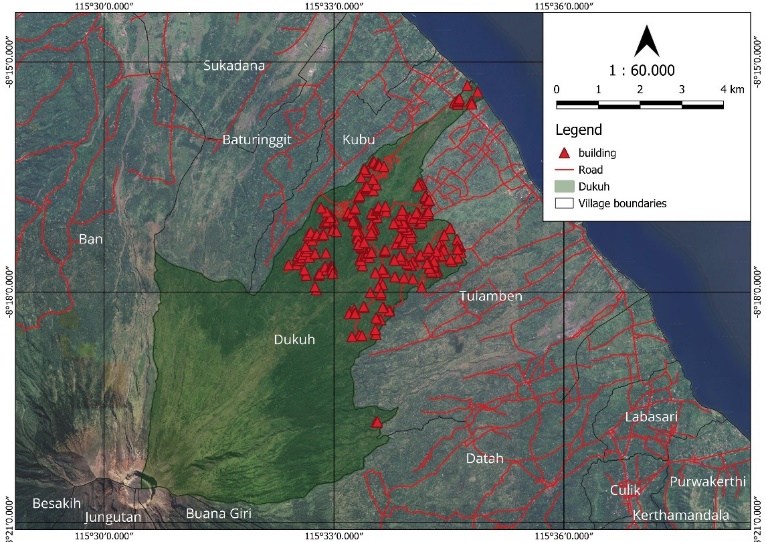
The research was conducted in Dukuh Village, Karangasem Regency, northeastern Bali (256–660 m a.s.l.), during December 2022 (Figure 1). The area lies on the volcanic slope of Mount Agung, about 5 km from the coast, and is characterized by a dryland ecosystem with limited freshwater availability. The elevation ranges from 256-660 m asl, with an average annual temperature of 26.91 °C. The total area of Dukuh Village is 234.72 km² and has a resident population of approximately 88.631 people. Most inhabitants belong to the Balinese Hindu community. We selected three hamlets: Buana Kusuma, Bahel, and Pandan Sari. Buana Kusuma and Pandan Sari hamlets are located near the forest, while Bahel is in the middle of the village.
2.2 Field survey
Nine home gardens were selected purposively to represent different elevations and distances from the coast. Each site contained two 20 × 20 m plots (Appendix 1). Plant species were recorded and identified, while local names and uses were confirmed through semi-structured interviews with adult household members (n = 9). The limited sample size reflects logistical constraints and the focus on accessible and well-maintained gardens.
2.3 Data analysis
The plants that have been identified are then tabulated, including families, vernacular names, habitus, number of individuals, and Summed Dominant Ratio (SDR). The dominant plant species were analyzed using the index of SDR (Chen et al., 2014; Rahayu et al., 2023; Whitney et al., 2018):
SDR (%) = \( \frac{RD + RF}{2} \)
SDR = summed dominance ratio,
RD (%) = relative density (sum of individuals of a plant species/sum of all individuals of all plant species) x 100%
RF (%) = relative frequency (frequency of certain plant species/ total frequency of all plant species) x 100%
The plant diversity index and dominance ratio were calculated in this study. The Shannon-Wienner diversity index was utilized to analyze plant diversity:
H’ = \( \sum_{i=1}^{s} pi \ln(pi) \)
H’ = Shannon-Wienner diversity index, pi = proportion of the number of individuals of a plant species (ni/N), ni = abundance of a plant species, N = total abundance of all plant species. Results of Shannon-Wienner diversity index calculation should be categorized below (Odum & Barrett, 2009), with a classification of biodiversity: High (H’>3), medium (1≤ H’≤3) and low (H’<1).
Dominance is analyzed using Simpson’s Dominance Index:
C = \(\sum (pi)^2\)
C = Simpson dominance index, pi = proportion of the number of individuals of a plant species (ni/N). If the dominance index value (C) is close to 0, it means there are no dominant species, but if the dominance index value (C) is close to 1, it means there are dominant species. (Odum & Barrett, 2009)
The Use Value (UV) assesses the usage and abundance index of a species. The calculation formula for the Use value is expressed as follows (Hoffman and Gallaher, 2007; Phillips and Gentry, 1993):
UVs = \( ({\sum \mathrm{UV} \space \mathrm{is}}) / (\mathrm{ni})\)
UVs = Sum the informant used values for a species and divide by the total number of informants.
ni = total number of informants interviewed for species s.
The research results included plant identification, SDR calculation, diversity index, dominant index value, categories of plant function and comparison between plants in home garden and local knowledge were then analyzed descriptively.
3. Results and discussion
3.1 Home garden plants diversity
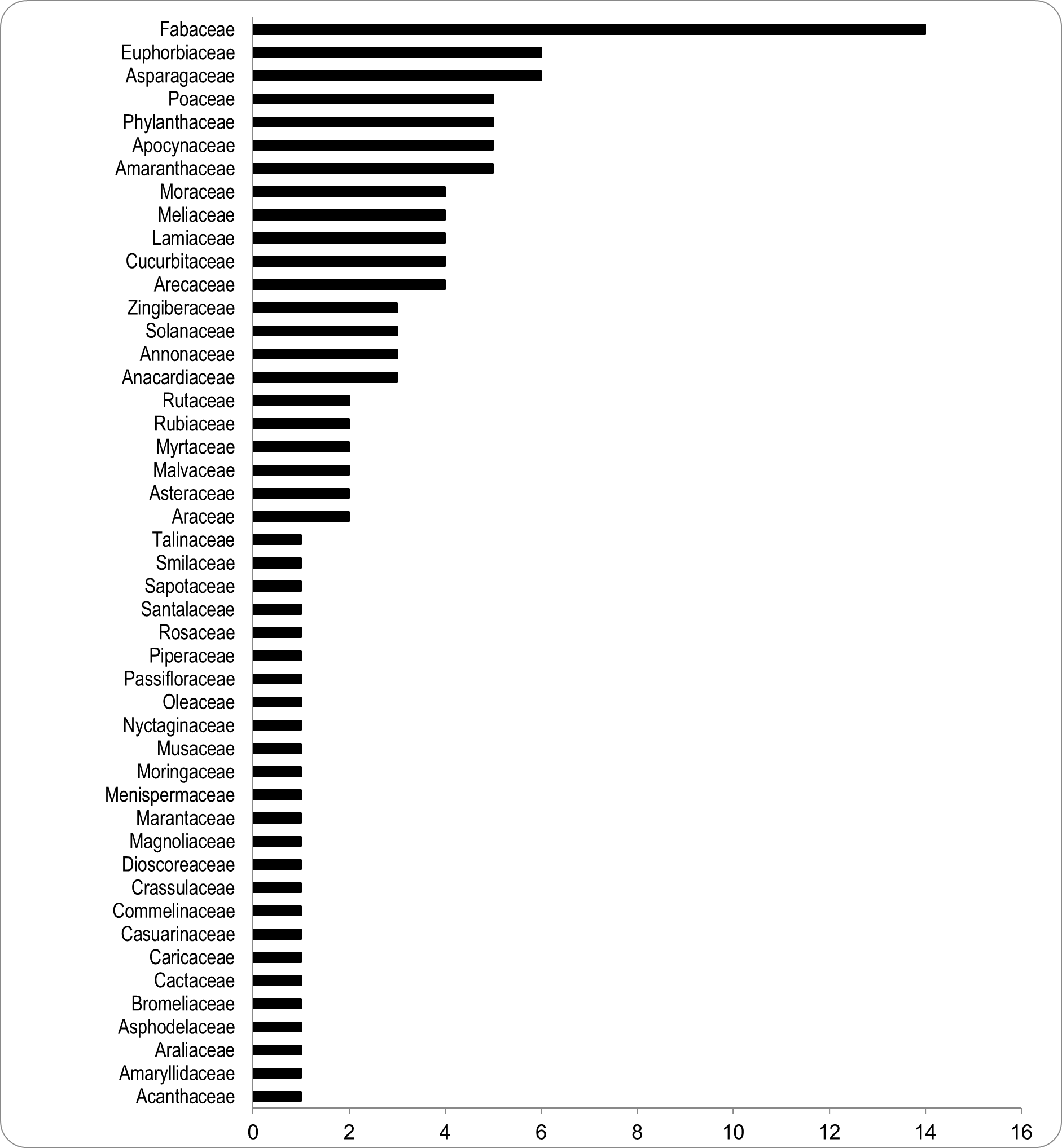
The survey recorded 115 plant species (Appendix 1), encompassing 47 families (Figure 2). This number is greater than the number of plant species growing in other villages in Indonesia, such as in the Samin Sub-Das, Central Java, with 88 species (Muliawati et al., 2018), in the Kemukiman Lueng Putu, Bandar Baru District, Pidie Jaya Regency with 79 species (Zufahmi et al., 2020), in Singai Bakar Village, Bajuin District, Tanah Laut Regency, South Kalimantan Province, 54 species (Husnawaty et al., 2022) and 79 species of plants were found in the home garden of the Antibar Village community, Mempawah Timur District, Mempawah Regency, West Kalimantan (Andriansyah et al., 2015). The environmental conditions, personal needs, local traditions, and environmental conditions, as well as their very local nature, influence the composition of home garden plants (Hadi et al., 2016). Besides, the gardens adjacent to houses provide life necessities or commercial products with knowledge passed down from generation to generation (Pilgrim et al., 2018).
The common plant families discovered in these home gardens include Fabaceae (14 species), Euphorbiaceae (6 species), Amaranthaceae (5 species), Apocynaceae (5 species), and Poaceae (5 species). Many species of Fabaceae are also used for fodder, which is suitable for the occupation of the respondent as a breeder, such as Dalbergia latifolia (sonokeling), Gliricidia sepium (gamal), and Leucaena leucocephala (lamtoro). Besides that, Fabaceae also has the ability to fix nitrogen, which enhances the soil fertility in the regosol soil in Dukuh village. This result follows (Luo et al., 2024), who mention that Fabaceae plants play a vital role in providing food to assist local communities in addressing food insecurity.
Based on our survey, tree plants constituted 35.65% of total plant habitus, followed by herbaceous (31.30%), shrub (25.22%), and climber (8.7%). This shows that the home garden consists of multistrata. The choice of trees may be influenced by economic value. Woody plants have served as income for families in Central Ethiopia (Mammo & Dereje, 2025), while the choices of trees and shrubs in China are also economically important because of the provision of shade and shelter for housing purposes (Luo et al., 2024).
3.2 Homegarden Plants Diversity Index
Based on the analysis of the Shannon-Winner diversity index (H’), home garden plant diversity in Dukuh villages is in the high diversity category (H’=3.75). This shows the potency of home gardens to support community livelihoods and fulfill food needs. High species diversity can provide many uses for humans and support biodiversity (Ponton, 2021). Furthermore, the home garden is a means to meet Sustainable Development Goals 1 and 2 on no poverty and zero hunger, respectively (Abdoellah et al., 2020).
Although the soil fertility level is relatively low, it has been proven to support fulfilling community needs with high species diversity. The soil in Dukuh Village is Regosol, which is formed from volcanic material originating from the eruption of Mount Agung. It has a sandy soil texture and many macro pores that affect water storage and soil nutrients because they are easily leaching. Soil solum is also shallow (<50 cm), limiting the development of perennial plant roots.
3.3 Homegarden Plants Dominance Ratio
The Summed Dominant Ratio (SDR) is the sum of relative frequency and relative dominance. High SDR are plants that have a high frequency or can be recorded in many samples and have a higher number of individuals in the research location samples (Rahayu et al., 2023). Based on SDR analysis, the highest (SDR> 3,00) were found most commonly in the home garden of Dukuh village, consisting of Anacardium occidentale (cashew) (11.45), Amaranthus sp (spinach) (4.99), Musa sp (banana) (4.18), Mangifera indica (mango) (3,40), Cocos nucifera (coconut) (3.23), and Plumeria sp (frangipani) (3.03). Cashews and mangoes are highly prevalent because they are economically important plants that support livelihood. In contrast, bananas, coconuts, and frangipani are usually planted to support daily ceremony needs.
3.4 Local Knowledge of Dukuh village inhabitants towards Plants
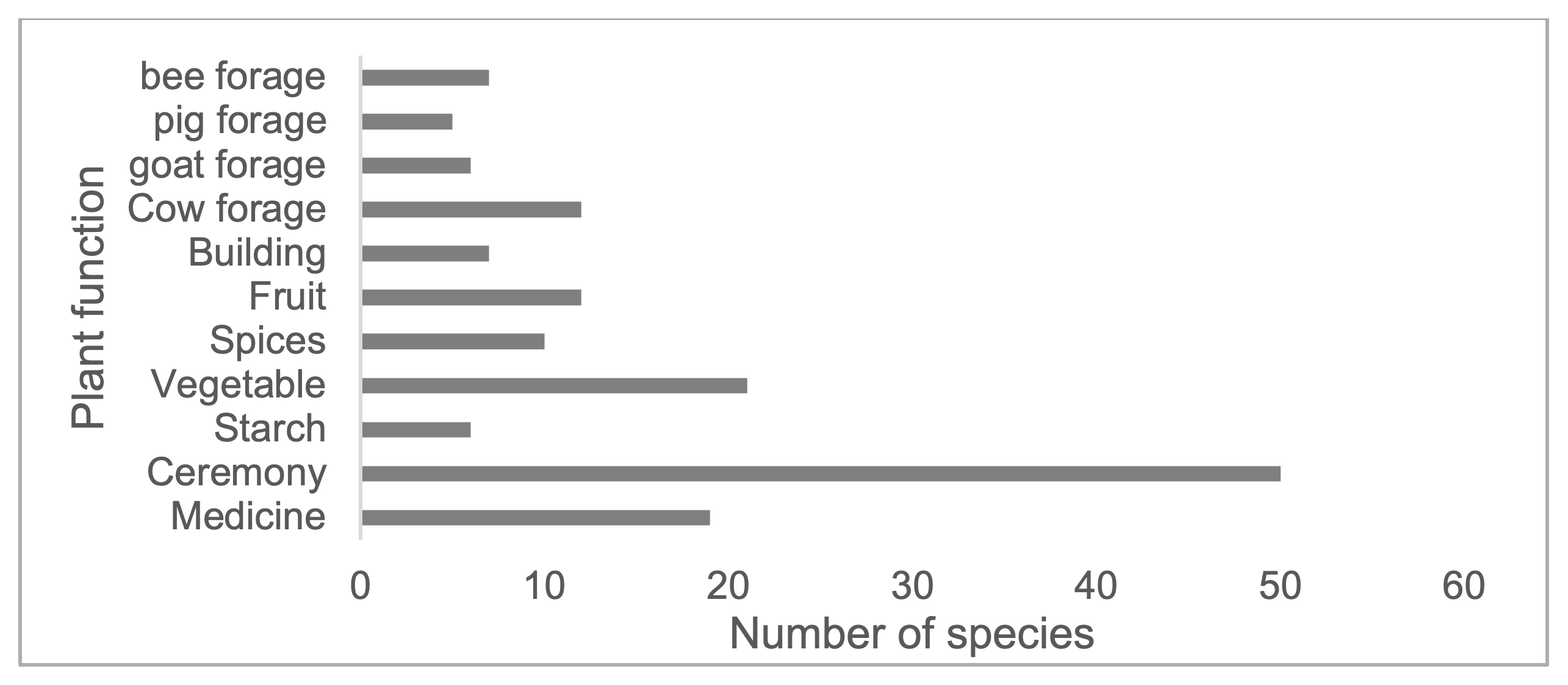
Based on the results of interviews with the community in Dukuh village, there are 100 species of plants recorded, consisting of 19 species for medicine, 50 species for Hindu ceremonial plants, 6 species as starch food, 21 species for vegetables, 10 species for spices, 11 species for fruit, 7 species for building material, 12 species for cow forage, 6 species for goat forage, 5 species for pig forage and 7 species for bee forage. The Dukuh village community has more information on the use of ceremonial plants and vegetable plants in their daily life (Figure 3). This selection is presumably influenced by the religion/ belief of the community, which is the majority Hindu, and personal preference to choose vegetables to support their daily needs.
In daily Hindu religious ceremonies, people offer canang (woven trays made of lontar or coconut leaves filled with flowers, incense, holy water, and rarapan—simple offerings in the form of food or drink). These canang are then placed in sacred places, such as a pelinggih (a shrine), or in the house terrace. After that, the canang is sprinkled with holy water (tirta) and diayap (a movement of the fingers while reciting a mantra). Although no specific plant species are required, flowering plants are most commonly used, including Cananga odorata, Plumeria sp., Michelia alba, Gardenia jasminoides, Erythrina sp., Nerium oleander, and Nymphaea sp. The Balinese Hindu community believes that colors symbolize their Gods. Yellow flowers symbolize Mahadeva, black symbolizes Lord Vishnu, white symbolizes Lord Shiva, and red symbolizes Lord Brahma (Ristanto et al., 2020). In addition to daily ceremonial needs, flowers are used for other religious ceremonies, such as prayer, making tirta, preparing water for Kumkuman (fragrant water), and decoration for sacred dances (Darma et al., 2021). The other plant parts used in Hindu-Balinese religious rituals, such as leaves, tubers, stems, bark, fruits, and seeds, are also utilized as complementary materials in Hindu-Balinese ritual offerings. The plants used in Hindu religious ceremonies in the home garden are listed in Appendix 1.
Meanwhile, the highest use value based on the interview is Cocos nucifera (3.9 %), Musa paradisiaca/ pisang sabe (3.9 %), Artocarpus heterophylla/ jackfruit (2.6%), Azadirachta indica/ intaran (2.6%), and Santalum album/ cendana (2.6%). These plants have the highest use value because they also have more than one plant function (multipurpose plants) (Appendix 2). Cocos nucifera (coconut) has various functions, including medicinal uses, ceremonial purposes, spices, construction materials, pig feed, and bee forage. Musa paradisiaca (pisang sabe) has a function as medicine, a ceremony, a vegetable, a fruit, cattle forage, and pig forage. Santalum album (cendana) has the function as a vegetable, cattle forage, goat forage, pig forage, and Artocarphus heterophyllus (jackfruit) has the function as a vegetable, fruit, and building, cattle forage. The crop combinations found in home gardens are strongly influenced by the specific needs and preferences of the household, as well as nutritional complementarity with other major food sources, alongside ecological and socioeconomic factors (Abdoellah et al., 2020).
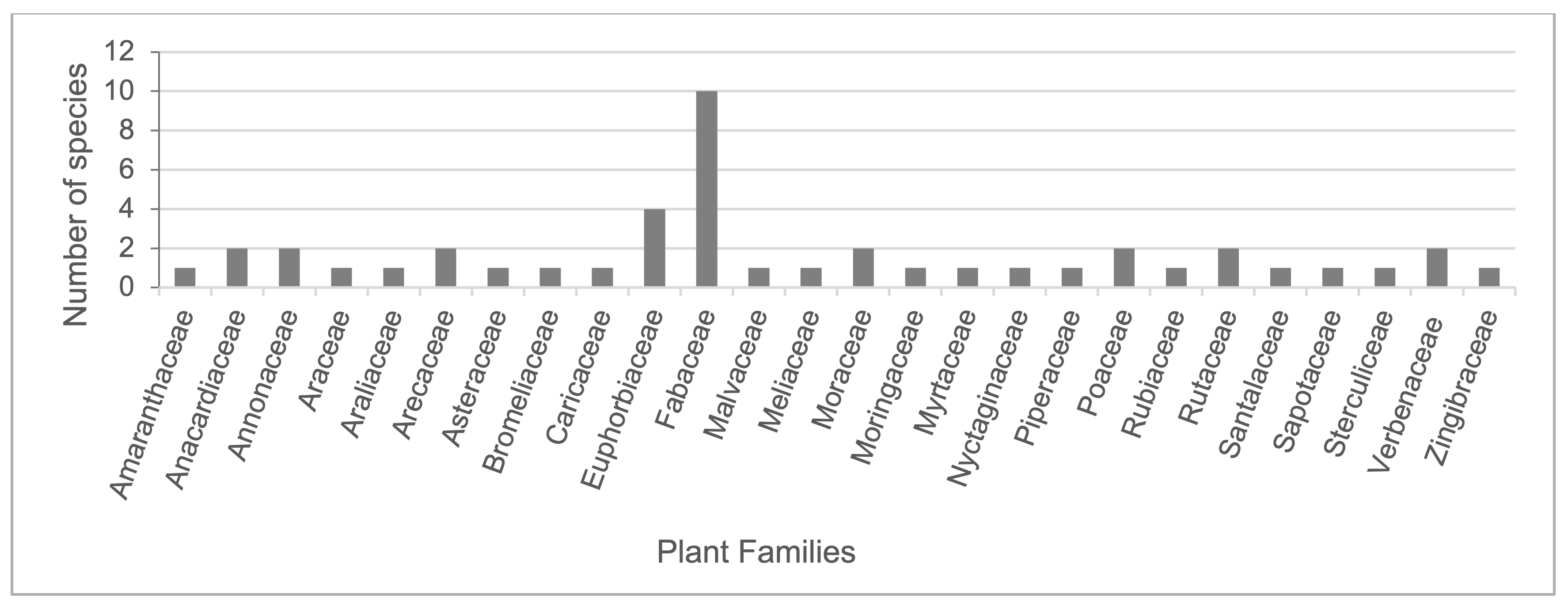
Based on local knowledge, the largest proportion of plant species belongs to the Fabaceae family, comprising 10 species, followed by the Euphorbiaceae family, which includes four plant species (Figure 4). Several species of Fabaceae are grown because they have more than one function. The function of vegetables such as undis (Cajanus cajan), komak (Lablab purpureus), red beans (Phaseolus vulgaris), tuwi (Sesbania grandiflora) and asam (Tamarindus indica). The function of ceremony plants such as kemerakan (Caesalpinia pulcherrima), dadap (Erythrina subumbrans), red beans (Phaseolus vulgaris) and the function as forage cattle such as sonokeling (Dalbergia latifolia), gamal (Gliricida sepium), and lamtoro (Leucaena leucocephala).
3.5 Analysis of differences in local knowledge with the species found in the home garden
Based on the results of interviews and plant inventory, it was found that there was a difference in the number and function of plants, as determined by local community knowledge, compared to those found in the home garden (Table 1). From the results of the interviews, as many as 100 species of plants are known to the public. Meanwhile, from the inventory results in the community's home garden, the home garden collected 115 plant species. However, not all species of plants in the home garden are known to have potential by the community, and not all the species of plants whose potential is known by the community are planted in the home garden. Only about 39% or as many as 45 plant species in the home garden have the potential to be known and utilized by the community of Dukuh village. It is estimated that 45 plant species are deliberately planted to help meet their daily needs. The factor that influences this is presumably related to the total area of the home garden and the preference of plant selection from the community (dietary requirement, economic value, or religion/ beliefs).
| The criteria | The number of plants from the interview (species) | The number of plants found in the home garden (species) |
|---|---|---|
| The number of plant species | 100 | 45 |
| Plant function | ||
| Vegetable | 21 | 12 |
| Fruit | 11 | 4 |
| Spice | 10 | 3 |
| Starch | 6 | 2 |
| Medicine | 19 | 7 |
| Livestock forage | 30 | 15 |
| Building | 7 | 7 |
| Hindu ceremony | 50 | 23 |
Furthermore, the religious/ cultural beliefs, customs, and taboos of the villagers influence the composition/ diversity of home gardens (Kumar & Nair, 2004). Presumably, the area of the home garden also determines the type of plants.
3.6 Impact of Climate Change on the Community Livelihoods
Almost everyone in Dukuh village depends on a life that interacts directly with nature. The two main plantation commodities of the Dukuh village community are cashew (Anacardium occidentale) and lontar (Borassus flabellifer). During the dry season, the community harvests the fruits of their garden crops, including cashews (Anacardium occidentale), lontar (Borassus flabellifer), and mangoes (Mangifera spp.). Meanwhile, during the rainy season, the community initiates activities for rainfed farmers, such as planting pumpkin, beans, and tuber crops. Some of these agricultural commodities are sold and partly used to meet the needs of people’s own households. The community also planted a small part of their home garden with cattle forage, such as elephant grass (Cenchrus purpureus), gamal (Gliricida sepium), Indigofera (Indigofera sp.), and sonokeling (Dalbergia latifolia). Some livestock the community raises include cows, goats, pigs, and chickens. In the rainy season, when there is still a stock of water from the rain, people can still harvest forage cattle. However, during the rainy season, people usually purchase forage outside Dukuh village to supplement their cattle's needs. Livestock products such as goats and cows are sold during the Islamic ceremony (Eid al-Adha). Meanwhile, pigs and chickens are usually only sold when there is an urgent need. Some are also used in Balinese Hindu ceremonies.
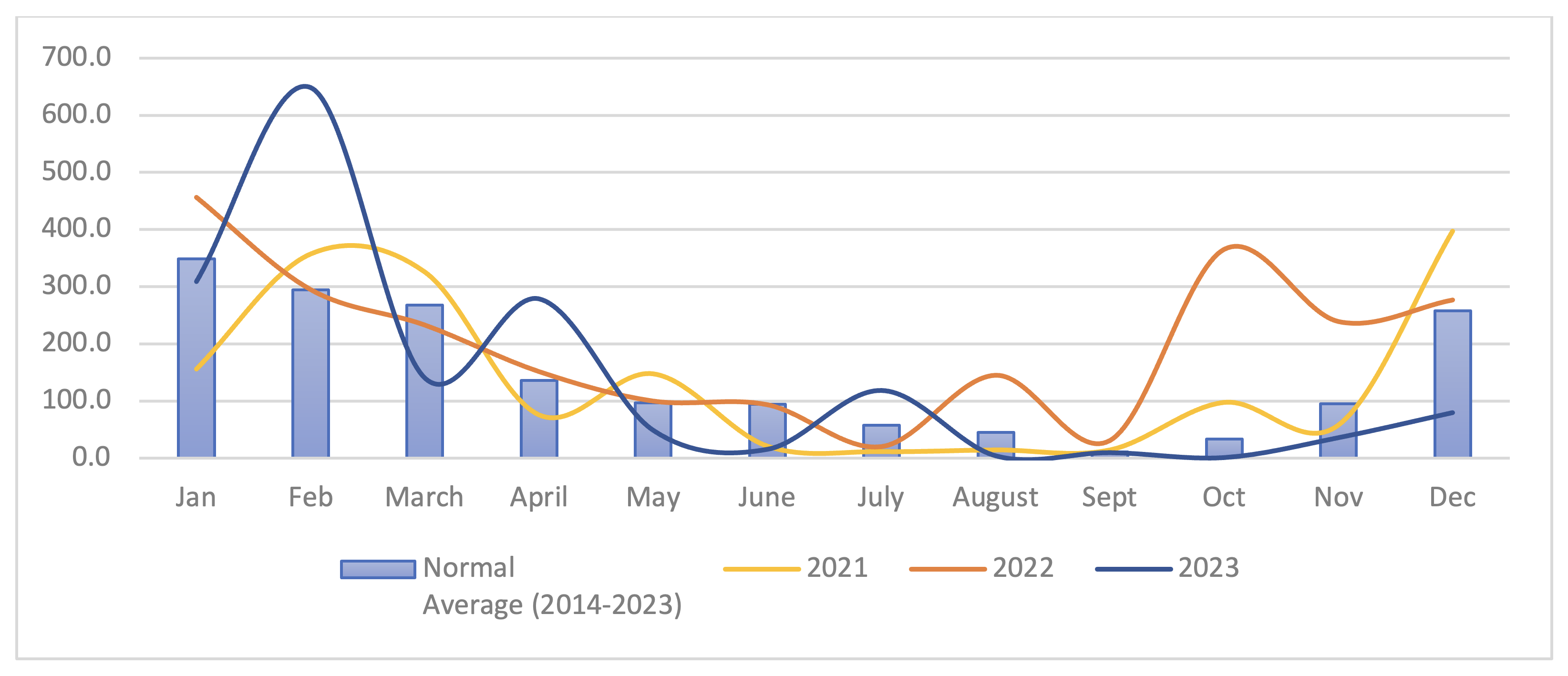
In 2021, the dry month (with no rain) lasted for four months, from June to September. In 2022, there were fluctuations in rain, during which the originally dry months experienced rain. Meanwhile, in 2023, the rain distribution pattern is similar to that of 2021, but it only entered the dry season in August (Figure 2). According to respondents, the rain causes the quality of the seeds to be poor (the color of the seeds becomes darker and smaller), and the production becomes low because the flowers fall off and cause them to fail to become fruit. Almost all respondents stated that the climate in Dukuh Village has shifted, causing a significant decrease in their main commodity, cashew production.
3.7 Homegarden Management Strategy to Climate Change
The Hindu community in Bali has a unique character that is the identity of the Hindu community in Bali (Suwena, 2018). The concept of Tri Hita Karana gives the mandate to maintain a harmonious relationship, namely between humans and God; humans and humans; and humans and nature. Along with the division of the Tri Mandala space, there are three main areas: the Main Mandala, where humans interact with God; the Madia Mandala, where humans interact with humans; and the Nista Mandala, where humans interact with the environment. Its existence is universal and easy to recognize and understand (Raka et al., 2017). This is done consciously to ensure that local knowledge is passed down to the next generation, including plants used in Hindu ceremonies in Bali (Surata et al., 2015).
Conservation is a very urgent necessity to develop the spirit or personality of a participatory community. A form of work that cannot be carried out alone. The activities include maintenance following the situation and conditions of the local village (Samedi, 2021). Conservation efforts are prioritized for plants with high utility index values and suitable habitats. A previous study found that the sustainability of home garden management can be achieved by involving the local community, implementing education programs, providing economic incentives, and offering training to increase land productivity (Hakim et al., 2018). Conservation priorities are based on types that support food security, have high utilization value, and are suitable for the climate conditions of Dukuh Village. Some alternative food crops that meet these criteria, such as corn, peanuts, soybeans, and sorghum, can survive with little water. During the long dry season, the people of Dukuh Village face difficulty obtaining forage stocks for their livestock. So far, the community has relied only on fodder from Gamal (Gliricidia sepium) leaves, Sonokeling (Dalbergia latifolia), and elephant grass (Cenchrus purpureus) that they plant around the garden.
During the dry season, Gamal (Gliricida sepium) and Sonokeling (Dalbergia latifolia) trees shed their leaves, while the availability of alternative feeds, such as those from elephant grass, is also very limited. So far, the community has only relied on fodder from Gamal (Gliricida sepium) leaves, Sonokeling (Dalbergia latifolia), and elephant grass (Cenchrus purpureus) that they plant around the garden. Previous research has revealed that planting silvopastoral-oriented fodder plants, when planned properly and appropriately, can be a viable solution (Chaudhry et al., 2011). Programs that can be carried out include developing community capacity to survive drought by creating innovations in fodder sources. This can also create a source of high-quality grass, shrub, and fodder tree seeds that are sustainable for future rehabilitation. We recommend some plants as fodder sources, such as Indigofera and Brachiaria humidicola (also known as coroivia grass), as an alternative forage substitute during the dry season to improve the welfare of farmers, as they do not need to buy feed for their livestock. The nutrient content in Indigofera leaves has been qualified as fodder and green concentrate for ruminants and could be substituted for poultry (Antari et al., 2022; Nadir et al., 2024). The plant is also tolerant of drought and waterlogging and is resistant to salinity. Recent research indicates that the growth of Indigofera sp. is very good during the rainy season, with no significant difference in growth compared to the dry season (Arniaty et al., 2015). Brachiaria humidicola grass is also one of the superior types of grass, as it has a high production rate and is preferred by livestock. Brachiaria humidicola grass is a plant resistant to seasonal changes, tolerant of poor irrigation, and heavy grazing (Hernandez et al., 2017; Loi et al., 2019; Maia et al., 2014). Therefore, these two plants are suitable for development as cattle forage alternatives in Dukuh Village. The research focused on selecting and managing drought-tolerant plants, as well as livestock nutritional needs during the dry season, and other methods to reduce environmental degradation must also continue to be carried out.
The support of the Indonesian Conservation Foundation (KI) in helping to obtain management rights for the Dukuh village forest also indirectly contributes to supporting community income. The community can also utilize the village forest to plant fodder crops, provided they are not allowed to cut down existing trees. Thus, the Dukuh community can focus on planting their home garden with plants to support food security, while meeting the needs for fodder can be achieved by renting land in the village forest.
Home garden management efforts can still be optimized for economic, social, and ecological functions if they are associated with existing potential. Capacity-building collaboration between communities and scientific practitioners is essential to enable the exchange of traditional wisdom and modern scientific methods (Mallick et al., 2024). Several innovations in agricultural methods include applying more varied cultivation techniques such as hydroponics, aeroponics, and vertical culture. In addition, cultivation activities with a wider variety of plants can continue to be optimized as an effort to diversify various local resource-based materials. Local community knowledge regarding plant functions was obtained only from older respondents, so it needs to be improved again to ensure the existence and sustainability of local knowledge of the Dukuh Village community. The formation of associations involving the younger generation can be done so that existing local knowledge remains sustainable with support from the local government. This effort is oriented towards long-term goals, namely, to create a more independent community that meets subsistence needs in the future as a form of self-sufficiency resilience at the household level.
4. Conclusions
Home gardens in Dukuh Village represent a biocultural adaptation linking biodiversity, traditional ecological knowledge, and coastal livelihoods. The integration of ritual plants, food crops, and forage species ensures livelihood continuity and reinforces Balinese Hindu cultural identity. Despite the small sample size, this study demonstrates how island communities use home gardens to sustain food security, ritual practices, and ecological balance amid climate change.
Acknowledgments
The author would like to thank I Dewa Putu Darma for the suggestions and input in our research, I Made Iwan Dewantama and I Wayan Mahardika from Yayasan Konservasi Indonesia (KI), who facilitated the implementation of the research in Dukuh Village, I Wayan Soma Adi, I Ngurah Arka, and Pak Darma for their assistance and guidance in the research in the field. This work was done with the help of people from three hamlets of Dukuh Village.
References
- Abdoellah, O.S., Schneider, M., Nugraha, L.M., Suparman, Y., Voletta, C. T., Withaningsih, S., Parikesit, Heptiyanggit, A., Hakim, L., 2020. Homegarden commercialization: Extent, household characteristics, and effect on food security and food sovereignty in Rural Indonesia. Sustain. Sci. 15(3): 797–815. https://doi.org/10.1007/s11625-020-00788-9
- Andriansyah, S.N., Lovadi, I., Linda, R., 2015. Keanekaragaman jenis tanaman pekarangan di Desa Antibar Kecamatan Mempawah Timur Kabupaten Mempawah. J. Protobiont 4(1): 226–235.
- Anonim. 2020. Sosialisasi PAIR di HUtan Desa Dukuh. http://nyegaragunung.net/id/sosialisasi-pair-di-hutan-desa-dukuh/ Accessed on 12 Januari 2023.
- Antari, R., Anggraeny, Y.N., Putri, A.S., Sukmasari, P.K., Mariyono, N.H.K., Aprilliza, M.N., 2022. Nutritive and antinutritive contents of Indigofera zollingeriana: Its potency for cattle feed in Indonesia. Livest. Res. Rural Dev. 34(2).
- Arniaty, S., Rizmi, A., Ubaitussalihat, 2015. Resistance is planted in plant Indigofera sp. critical land on dry season as source of animal feed ruminant. J. Ilmiah Peternak. 23(2): 44–47.
- Chaudhry, P., Bohra, N.K., Choudhary, K.R., 2011. Conserving biodiversity of community forests and rangelands of a hot arid region of India. Land Use Policy 28(3): 506–513. https://doi.org/10.1016/j.landusepol.2010.10.005
- Chen, Y.-C., Wu, C.-F., Lin, S.-H., 2014. Mechanisms of forest restoration in landslide treatment areas. Sustainability 6(10), 6766–6780. https://doi.org/10.3390/su6106766.
- Darma, I.D.P., Sutomo, S., Hanum, S. F., Iryadi, R., Rahayu, A., 2021. Flowers and Value of Conservation in The Culture of Hindu Community in Bali. Biosaintifika: Journal of Biology & Biology Education, 13(1), 34-40. https://doi.org/10.15294/biosaintifika.v13i1.27054
- Hadi, E.E.W., Widyastuti, S.M., Wahyuono, S., 2016. Diversity and utilization of understorey in agroforestry system of Menoreh Hill, Kulon Progo Regency. J. Manusia Lingkung. 23(2): 206. https://doi.org/10.22146/jml.18792.
- Hakim, L., Pamungkas, N.R., Wicaksono, K.P., Soemarno, S., 2018. The conservation of Osingnese traditional home garden agroforestry in Banyuwangi, East Java, Indonesia. Agrivita J. Agric. Sci. 40(3). https://doi.org/10.17503/agrivita.v40i3.1605.
- Hernandez, A.C., Garay, A.H., Canul, A.J.C., Pedroza, S.I.M., Vera, S.R., Garcia, A.R.R., Rios, J.V., 2017. Components of the yield and nutritional value of Brachiaria humidicola cv Chetumal to different grazing strategies. Rev. Mex.Cienc. Agríc. 8(3): 599–610.
- Husnawaty, N.A., Peran, S.B., Fithria, A., 2022. Composition and diversity of plants on garden of Sungai Bakar Village in around the Social Forestry Program. J. Sylva Scienteae 5(4): 539. https://doi.org/10.20527/jss.v5i4.6138
- Field, C.B., Barros, V.R., Dokken, D.J., Mach, K.J., Mastrandrea, M.D., Bilir, T.E., Chatterjee, M., Ebi, K.L., Estrada, Y.O., Genova, R.C., Girma, B., Kissel, E.S., Levy, A.N., MacCracken, S., Mastrandrea, P.R., White, L.L., 2014. Climate Change 2014: Impacts, Adaptation, and Vulnerability Working Group II Contribution to the Fifth Assessment Report of the Intergovernmental Panel on Climate Change. Cambridge University Press, Cambridge.
- Kaswanto, Filqisthi, T.A., Choliq, M.B.S. 2016. Revitalization of rural landscape homegarden “Pekarangan” as landscape services provider to improve community welfare. J. Lanskap Indon. 8(1): 50–60.
- Kumar, B.M., Nair, P.K.R., 2004. The enigma of tropical homegardens. Agrofor. Syst., 61: 135–152.
- Loi, B.V., Mui, N.T., Giang, T.V., Thanh, P., Ba, N.X., 2019. Yield and nutritional value of Brachiaria humidicola grass planted in Thua Thien Hue Province, Vietnam. Int. J. Res. Agric. Sciences, 6(2): 40–45.
- Luo, J., Li, Q., He, J., Yan, J., Zhang, S., Chang, X., Wu, T., 2024. Local knowledge of homegarden plants in Miao ethnic communities in Laershan region, Xiangxi area, China. J. Ethnobiol. Ethnomed. 20(1): 37. https://doi.org/10.1186/s13002-024-00676-x.
- Mahardika, I. W., Santoso, H., & Somadi, I. (2022). Flora Hutan Desa Dukuh. Yayasan Konservasi Indonesia.
- Maia, G.A., de Pinho Costa, K.A., de Costa Severiano, E.D., Epifanio, P.S., Neto, J.F., Ribeiro, M.G., Fernandes, P.B., Silva, J.F.G., Gonçalves, W.G., 2014. Yield and chemical composition of Brachiaria forage grasses in the offseason after corn harvest. Am.J. Plant Sci. 05(07): 933–941. https://doi.org/10.4236/ajps.2014.57106.
- Mallick, M., Singh, P.K., Pandey, R., 2024. Harvesting resilience: Tribal home-gardens as socio-ecological solutions for climate change adaptation and sustainable development in a protected area. J. Clean. Prod. 445: 141174. https://doi.org/10.1016/j.jclepro.2024.141174.
- Mammo, S., Dereje, Y., 2025. Woody species diversity of homegarden agroforestry and their contribution to livelihoods improvement in Dendi District, Central Ethiopia. Agrofor. Syst. 99(3): 59. https://doi.org/10.1007/s10457-025-01157-0.
- Muliawati, E.S., Budiastuti, M.T.S., Suprayogo, D., Sutrisno, J., 2018. Agrobiodiversity in the rural home gardens as the food reserve for climate change adaptation (case study: Samin sub-watershed, Central Java, Indonesia). Bulg. J. Agric. Sci. 24(5): 759–767.
- Nadir, Syahrir, S., Munasirah, A.L., Warni, I., Sari, N., Satriani, Sulistiawati, A., Anugrah, M. P., 2024. Exploration of nutritional value of Indigofera shoot leaves based on different ages. Int. J. Chem. Biochem. Sci. 25(19). https://doi.org/10.62877/91-IJCBS-24-25-19-91.
- Pilgrim, E.S., Osborne, J., Winter, M., 2018. Evaluating the multiple benefits of multi-layered agroforestry systems. Int. J. Agric. Manag. 7(2).
- Ponton, K., 2021. The Role of Forest Gardens and Forest Gardeners in the UK’s Agroecological Transition [School of Natural Sciences]. Bangor University, Wales.
- Porter, J.R., Xie, L., Challinor, A.J., Cochrane, K., Howden, S.M., Iqbal, M.M., Lobell, D.B., Travasso, M.I., 2014. Food security and food production systems, in: Intergovernmental Panel on Climate Change (IPCC), Climate Change 2014 – Impacts, Adaptation and Vulnerability: Part A: Global and Sectoral Aspects: Working Group II Contribution to the IPCC Fifth Assessment Report. Cambridge University Press, Cambridge, pp. 485–534. https://doi.org/10.1017/CBO9781107415379.012.
- Rahayu, S.M., Hakim, L., Batoro, J., Sukenti, K., 2023. Plants diversity of Sasak Tribe homegarden in villages around Mandalika, Lombok Island, Indonesia. J. Mar. Island Cult. 12(3). https://doi.org/10.21463/jmic.2023.12.3.21.
- Raka, A.A.G., Parwata, I.W., Gunawarman, A.A.G.R., 2017. Bali in the perspective of culture and tourism. Pustaka Larasan, Denpasar.
- Ristanto, R. H., Suryanda, A., Rismayati, A. I., Rimadana, A., Datau, R., 2020. Etnobotani: tumbuhan ritual keagamaan hindu-bali. JPBIO (Jurnal Pendidikan Biologi), 5(1), 96–105. https://doi.org/10.31932/jpbio.v5i1.642
- Saediman, H., Gafaruddin, A., Hidrawati, H., Salam, I., Ulimaz, A., Rianse, I. S., Sarinah, S., Taridala, S.A.A., 2021. The contribution of home food gardening program to household food security in Indonesia: A review. WSEAS Trans. Environ. Dev. 17: 795–809. https://doi.org/10.37394/232015.2021.17.75.
- Samedi, S., 2021. Konservasi keanekaragaman hayati di Indonesia: rekomendasi perbaikan undang-undang konservasi. J. Hukum Lingkung. Indon. 2(2): 1–28. https://doi.org/10.38011/jhli.v2i2.23.
- Surata, I.K., Gata, I.W., Sudiana, I.M., 2015. Studi etnobotanik tanaman upacara Hindu Bali sebagai upaya pelestarian kearifan lokal. J. Kajian Bali 5(2): 265-284.
- Suwena, I.W., 2018. Dinamika kebudayaan Bali: Suatu kajian kebudayaan sebagai proses. Sunari Penjor: J. Anthropol. 2(2): 89–101.
- Whitney, C.W., Luedeling, E., Tabuti, J.R.S., Nyamukuru, A., Hensel, O., Gebauer, J., Kehlenbeck, K., 2018. Crop diversity in homegardens of southwest Uganda and its importance for rural livelihoods. Agric. Hum. Values 35(2): 399–424. https://doi.org/10.1007/s10460-017-9835-3.
- Zufahmi, Dewi, E., Maulinda, 2020. Keanekaragaman jenis tumbuhan pekarangan yang terdapat di kemukiman Lueng Putu Kecamatan Bandar Baru Kabupaten Pidie Jaya. J. Agroristek 3(2): 44–50. https://doi.org/10.47647/jar.v3i2.258.
Appendices
Appendix 1. Plant species at the home garden in Dukuh village, Karangasem
| No | Scientific name / vernacular name | Family | Number of individuals | Habitus | H’ | C | RF | RD | SDR (%) |
|---|---|---|---|---|---|---|---|---|---|
| 1 | Acalypha wilkesiana Mull. Arg | Euphorbiaceae | 2 | shrub | 0.013 | 5E-06 | 0.61 | 0.22 | 0.41 |
| 2 | Accacia mangium Willd. | Fabaceae | 1 | Tree | 0.007 | 1E-06 | 0.31 | 0.11 | 0.21 |
| 3 | Agave sisalana Perrine | Agavaceae | 23 | herbaceous | 0.091 | 6E-04 | 1.53 | 2.47 | 2.00 |
| 4 | Allamanda cathartica L. | Apocynaceae | 7 | shrub | 0.037 | 6E-05 | 1.23 | 0.75 | 0.99 |
| 5 | Aloe vera (L.) Burm.f./ lidah buaya | Asphodelaceae | 3 | herbaceous | 0.019 | 1E-05 | 0.31 | 0.32 | 0.31 |
| 6 | Alternanthera cultivar | Amaranthaceae | 1 | herbaceous | 0.007 | 1E-06 | 0.31 | 0.11 | 0.21 |
| 7 | Alternanthera sp./ krokot | Amaranthaceae | 1 | herbaceous | 0.007 | 1E-06 | 0.31 | 0.11 | 0.21 |
| 8 | Amaranthus sp/ bayam hijau | Amaranthaceae | 90 | herbaceous | 0.226 | 0.009 | 0.31 | 9.68 | 4.99 |
| 9 | Amaranthus sp/ bayam merah | Amaranthaceae | 1 | herbaceous | 0.007 | 1E-06 | 0.31 | 0.11 | 0.21 |
| 10 | Amaryllis sp. | Amaryllidacaeae | 4 | herbaceous | 0.023 | 2E-05 | 0.61 | 0.43 | 0.52 |
| 11 | Amorphophallus muelleri Blume/ porang | Araceae | 14 | herbaceous | 0.063 | 2E-04 | 0.31 | 1.51 | 0.91 |
| 12 | Anacardium occidentale L/ mete | Anacardiaceae | 153 | tree | 0.297 | 0.027 | 6.44 | 16.45 | 11.45 |
| 13 | Ananas comosus (L.) Merr./ nanas | bromeliaceae | 45 | herbaceous | 0.147 | 0.002 | 1.23 | 4.84 | 3.03 |
| 14 | Annona muricata L./ sirsak | Annonaceae | 1 | tree | 0.007 | 1E-06 | 0.31 | 0.11 | 0.21 |
| 15 | Annona squamosa L./ srikaya | Annonaceae | 2 | tree | 0.013 | 5E-06 | 0.61 | 0.22 | 0.41 |
| 16 | Antidesma bunius (L.) Spreng./ buni | Phyllanthaceae | 1 | Tree | 0.007 | 1E-06 | 0.31 | 0.11 | 0.21 |
| 17 | Artemisia scoparia Waldst. & Kit. | Asteraceae | 19 | herbaceous | 0.079 | 4E-04 | 0.61 | 2.04 | 1.33 |
| 18 | Artocarpus heterophyllus Lam/ jackfruit | Moraceae | 4 | Tree | 0.023 | 2E-05 | 0.92 | 0.43 | 0.68 |
| 19 | Azadirachta indica A.Juss/ mindi | Meliaceae | 14 | tree | 0.063 | 2E-04 | 1.53 | 1.51 | 1.52 |
| 20 | Bambusa vulgaris Schrad. ex J.C.Wendl/ bambu ampel | Poaceae | 2 | tree | 0.013 | 5E-06 | 0.31 | 0.22 | 0.26 |
| 21 | Bauhinia purpurea L. | Fabaceae | 1 | Tree | 0.007 | 1E-06 | 0.31 | 0.11 | 0.21 |
| 22 | Benincasa hispida (Thunb.) Cogn./ timun bligo | cucurbitaceae | 4 | climber | 0.023 | 2E-05 | 0.92 | 0.43 | 0.68 |
| 23 | Borassus flabellifer L./ lontar | Arecaceae | 11 | tree | 0.052 | 1E-04 | 2.76 | 1.18 | 1.97 |
| 24 | Bougainvillea sp. | Nyctaginaceae | 2 | shrub | 0.013 | 5E-06 | 0.61 | 0.22 | 0.41 |
| 25 | Breynia androgyna (L.) Chakrab. & N.P.Balakr./ daun katuk | phyllanthaceae | 6 | shrub | 0.033 | 4E-05 | 0.92 | 0.65 | 0.78 |
| 26 | Breynia oblonifolia Mull.Arg/ daun merr | Phylanthaceae | 8 | shrub | 0.041 | 7E-05 | 1.53 | 0.86 | 1.20 |
| 27 | Brunfelsia uniflora (Pohl) D.Don | Solanaceae | 1 | shrub | 0.007 | 1E-06 | 0.31 | 0.11 | 0.21 |
| 28 | Caesalpinia pulcherrima (L.) Sw. | Fabaceae | 1 | shrub | 0.007 | 1E-06 | 0.31 | 0.11 | 0.21 |
| 29 | Cajanus cajan (L.) Huth/ kacang undis | Fabaceae | 2 | herbaceous | 0.013 | 5E-06 | 0.61 | 0.22 | 0.41 |
| 30 | Cananga odorata (Lam.) Hook.f. & Thomson/ sandat | Annonaceae | 2 | tree | 0.013 | 5E-06 | 0.61 | 0.22 | 0.41 |
| 31 | Capsicum frutescens L./ cabai rawit | Solanaceae | 9 | herbaceous | 0.045 | 9E-05 | 0.92 | 0.97 | 0.94 |
| 32 | Carica papaya L./ pepaya | Caricaceae | 7 | tree | 0.037 | 6E-05 | 1.23 | 0.75 | 0.99 |
| 33 | Caryota mitis Lour. | Arecaceae | 1 | tree | 0.007 | 1E-06 | 0.31 | 0.11 | 0.21 |
| 34 | Casuarina junghuhniana Miq./ cemara geseng | Casuarinaceae | 2 | tree | 0.013 | 5E-06 | 0.31 | 0.22 | 0.26 |
| 35 | Catharanthus roseus (L.) G.Don/ tapak dara | Apocynaceae | 1 | herbaceous | 0.007 | 1E-06 | 0.31 | 0.11 | 0.21 |
| 36 | Cenchrus purpureus (Schumach.) Morrone/ elephant grass | Poaceae | 14 | herbaceous | 0.063 | 2E-04 | 2.15 | 1.51 | 1.83 |
| 37 | Citrus sp./ jeruk | Rutaceae | 1 | shrub | 0.007 | 1E-06 | 0.31 | 0.11 | 0.21 |
| 38 | Citrus × amblycarpa (Hassk.) Ochse/ jeruk limo | Rutaceae | 1 | shrub | 0.007 | 1E-06 | 0.31 | 0.11 | 0.21 |
| 39 | Clerodendrum paniculatum L./ kembang pagoda | Lamiaceae | 12 | shrub | 0.056 | 2E-04 | 1.53 | 1.29 | 1.41 |
| 40 | Cnidoscolus aconitifolius (Mill.) I.M.Johnst./ papaya jepang | Euphorbiaceae | 12 | shrub | 0.056 | 2E-04 | 1.23 | 1.29 | 1.26 |
| 41 | Cocos nucifera L./ kelapa | Arecaceae | 23 | tree | 0.091 | 6E-04 | 3.99 | 2.47 | 3.23 |
| 42 | Codiaeum variegatum (L.) Rumph. ex A.Juss./ puring | Euphorbiaceae | 7 | shrub | 0.037 | 6E-05 | 0.92 | 0.75 | 0.84 |
| 43 | Cordyline fruticosa (L.) A.Chev. | Asparagaceae | 6 | shrub | 0.033 | 4E-05 | 1.23 | 0.65 | 0.94 |
| 44 | Cucumis sativus L./ timun | Cucurbitaceae | 1 | climber | 0.007 | 1E-06 | 0.31 | 0.11 | 0.21 |
| 45 | Curcuma domestica Valeton/ kunyit kuning | Zingiberaceae | 1 | herbaceous | 0.007 | 1E-06 | 0.31 | 0.11 | 0.21 |
| 46 | Curcuma caesia Roxb/ kunyit hitam | Zingiberacea | 6 | herbaceous | 0.033 | 4E-05 | 0.31 | 0.65 | 0.48 |
| 47 | Curcuma zedoaria (Christm.) Roscoe/ kunyit putih | Zingiberacea | 5 | herbaceous | 0.028 | 3E-05 | 0.61 | 0.54 | 0.58 |
| 48 | Cyathula cultivar | Amaranthaceae | 16 | herbaceous | 0.07 | 3E-04 | 0.00 | 1.72 | 0.86 |
| 49 | Cyclea barbata Miers/ daluman | Menispermaceae | 1 | climber | 0.007 | 1E-06 | 0.31 | 0.11 | 0.21 |
| 50 | Cymbopogon citratus (DC.) Stapf/ sereh | Poaceae | 3 | herbaceous | 0.019 | 1E-05 | 0.31 | 0.32 | 0.31 |
| 51 | Dalbergia latifolia Roxb/ sonokeling | Fabaceae | 8 | tree | 0.041 | 7E-05 | 1.23 | 0.86 | 1.04 |
| 52 | Didymocheton gaudichaudianus A.Juss. | Meliaceae | 2 | tree | 0.013 | 5E-06 | 0.31 | 0.22 | 0.26 |
| 53 | Dieffenbachia sp. | Araceae | 1 | herbaceous | 0.007 | 1E-06 | 0.31 | 0.11 | 0.21 |
| 54 | Dioscorea bulbifera L./ mubu | Dioscoreaceae | 1 | herbaceous | 0.007 | 1E-06 | 0.31 | 0.11 | 0.21 |
| 55 | Dioscorea sp. | Dioscoreaceae | 1 | herbaceous | 0.007 | 1E-06 | 0.61 | 0.11 | 0.36 |
| 56 | Dracaena angustifolia (Medik.) Roxb./ kayu sugih | Asparagaceae | 5 | shrub | 0.028 | 3E-05 | 1.23 | 0.54 | 0.88 |
| 57 | Dracaena fragrans (L.) Ker Gawl./ hanjuang | Asparagaceae | 5 | shrub | 0.028 | 3E-05 | 0.61 | 0.54 | 0.58 |
| 58 | Dracaena sp. | Asparagaceae | 1 | herbaceous | 0.007 | 1E-06 | 0.00 | 0.11 | 0.05 |
| 59 | Dracaena trifasciata (Prain) Mabb./ lidah mertua | Asparagaceae | 1 | herbaceous | 0.007 | 1E-06 | 0.31 | 0.11 | 0.21 |
| 60 | Erythrina sp./ dadap | Fabaceae | 1 | shrub | 0.007 | 1E-06 | 0.31 | 0.11 | 0.21 |
| 61 | Erythrina subumbrans (Hassk.) Merr./ dadap tis | Fabaceae | 3 | shrub | 0.019 | 1E-05 | 0.92 | 0.32 | 0.62 |
| 62 | Euphorbia sp. | Euphorbiaceae | 2 | shrub | 0.013 | 5E-06 | 0.31 | 0.22 | 0.26 |
| 63 | Ficus benjamina L./ beringin | moraceae | 3 | tree | 0.019 | 1E-05 | 0.31 | 0.32 | 0.31 |
| 64 | Ficus sp. / bunut | Moraceae | 1 | tree | 0.007 | 1E-06 | 0.31 | 0.11 | 0.21 |
| 65 | Ficus variegata Blume/ ara | Moraceae | 4 | tree | 0.023 | 2E-05 | 0.31 | 0.43 | 0.37 |
| 66 | Gardenia jasminoides J. Ellis/ jempiring | Rubiaceae | 1 | shrub | 0.007 | 1E-06 | 0.31 | 0.11 | 0.21 |
| 67 | Gliricidia sepium (Jacq.)Kunth/ gamal | Fabaceae | 28 | tree | 0.105 | 9E-04 | 2.45 | 3.01 | 2.73 |
| 68 | Gmelina arborea Roxb. ex Sm/ jati belanda | Lamiaceae | 21 | tree | 0.086 | 5E-04 | 2.45 | 2.26 | 2.36 |
| 69 | Hibiscus rosa sinensis Linn./ kembang sepatu | Malvaceae | 5 | shrub | 0.028 | 3E-05 | 1.23 | 0.54 | 0.88 |
| 70 | Indigofera suffruticosa Mill./ tarum | Fabaceae | 3 | shrub | 0.019 | 1E-05 | 0.61 | 0.32 | 0.47 |
| 71 | Ixora javanica (Blume) DC./ soka | Rubiaceae | 1 | shrub | 0.007 | 1E-06 | 0.31 | 0.11 | 0.21 |
| 72 | Justicia gendarussa Burm.f. | Acanthaceae | 1 | shrub | 0.007 | 1E-06 | 0.31 | 0.11 | 0.21 |
| 73 | Kalanchoe pinnata (Lam.) Pers /cocor bebek | Crassulaceae | 3 | herbaceous | 0.019 | 1E-05 | 0.61 | 0.32 | 0.47 |
| 74 | Lablab purpureus (L.) Sweet/ kacang komak | Fabaceae | 2 | herbaceous | 0.013 | 5E-06 | 0.61 | 0.22 | 0.41 |
| 75 | Lannea coromandelica L./ santen | Anacardiaceae | 10 | tree | 0.049 | 1E-04 | 1.53 | 1.08 | 1.30 |
| 76 | Leucaena leucocephala (Lam.) de Wit/ lamtoro | Fabaceae | 4 | tree | 0.023 | 2E-05 | 0.92 | 0.43 | 0.68 |
| 77 | Ligustrum glomeratum Blume/ padi-padi | Oleaceae | 1 | tree | 0.007 | 1E-06 | 0.31 | 0.11 | 0.21 |
| 78 | Magnolia champaca (L.) Baill. ex Pierre | Magnoliaceae | 2 | tree | 0.013 | 5E-06 | 0.31 | 0.22 | 0.26 |
| 79 | Mangifera indica L./ mangga | Anacardiaceae | 29 | tree | 0.108 | 1E-03 | 3.68 | 3.12 | 3.40 |
| 80 | Manihot esculenta Crantz/ singkong | Euphorbiaceae | 16 | shrub | 0.07 | 3E-04 | 3.07 | 1.72 | 2.39 |
| 81 | Manilkara kauki (L.) Dubard/ sawo | Sapotaceae | 1 | tree | 0.007 | 1E-06 | 0.31 | 0.11 | 0.21 |
| 82 | Marantha sp. | Maranthaceae | 1 | herbaceous | 0.007 | 1E-06 | 0.31 | 0.11 | 0.21 |
| 83 | Melochia umbellata (houtt.) Stapf./ bentenu | Meliaceae | 15 | tree | 0.067 | 3E-04 | 3.07 | 1.61 | 2.34 |
| 84 | Momordica balsamina L./ pare | Cucurbitaceae | 9 | climber | 0.045 | 9E-05 | 2.15 | 0.97 | 1.56 |
| 85 | Moringa oleifera Lam./ kelor | Moringaceae | 3 | tree | 0.019 | 1E-05 | 0.61 | 0.32 | 0.47 |
| 86 | Musa sp./ pisang | Musaceae | 52 | tree | 0.161 | 0.003 | 2.76 | 5.59 | 4.18 |
| 87 | Passiflora edulis Sims / pasi | Passifloraceae | 1 | climber | 0.007 | 1E-06 | 0.31 | 0.11 | 0.21 |
| 88 | Phaseolus vulgaris L. / kacang merah | Fabaceae | 2 | herbaceous | 0.013 | 5E-06 | 0.61 | 0.22 | 0.41 |
| 89 | Phyllanthus sp. | Phyllanthaceae | 1 | shrub | 0.007 | 1E-06 | 0.31 | 0.11 | 0.21 |
| 90 | Piper sp./ sirih | Piperaceae | 3 | climber | 0.019 | 1E-05 | 0.92 | 0.32 | 0.62 |
| 91 | Plukenetia volubilis L./ sacca inci | Euphorbiaceae | 9 | climber | 0.045 | 9E-05 | 0.92 | 0.97 | 0.94 |
| 92 | Plumeria pudica Jacq./ Frangipani japan | Apocynaceae | 1 | shrub | 0.007 | 1E-06 | 0.31 | 0.11 | 0.21 |
| 93 | Plumeria rubra L./ yellow frangipani | Apocynaceae | 1 | tree | 0.007 | 1E-06 | 0.31 | 0.11 | 0.21 |
| 94 | Plumeria sp./ frangipani | Apocynaceae | 25 | tree | 0.097 | 7E-04 | 3.37 | 2.69 | 3.03 |
| 95 | Psidium guajava L./ jambu batu | Myrtaceae | 2 | tree | 0.013 | 5E-06 | 0.92 | 0.22 | 0.57 |
| 96 | Rosa sp./ mawar | Rosaceae | 2 | herbaceous | 0.013 | 5E-06 | 0.61 | 0.22 | 0.41 |
| 97 | Roystonea regia (Kunth) O.F.Cook/ palem raja | Arecaceae | 1 | tree | 0.007 | 1E-06 | 0.31 | 0.11 | 0.21 |
| 98 | Saccharum officinarum L./ tebu | Poaceae | 5 | shrub | 0.028 | 3E-05 | 0.92 | 0.54 | 0.73 |
| 99 | Santalum album L./ cendana | Santalaceae | 8 | tree | 0.041 | 7E-05 | 1.23 | 0.86 | 1.04 |
| 100 | Schefflera sp./ kayu tulak | Araliaceae | 3 | shrub | 0.019 | 1E-05 | 0.61 | 0.32 | 0.47 |
| 101 | Selenicereus monacanthus (Lem.) D.R.Hunt/ buah naga | cactaceae | 2 | climber | 0.013 | 5E-06 | 0.61 | 0.22 | 0.41 |
| 102 | Sesbania grandiflora (L.) Poir. / turi | Fabaceae | 2 | tree | 0.013 | 5E-06 | 0.61 | 0.22 | 0.41 |
| 103 | Sicyos edulis Jacq./ labu jepang | cucurbitaceae | 2 | climber | 0.013 | 5E-06 | 0.31 | 0.22 | 0.26 |
| 104 | Smilax sp./ banah | Smilacaceae | 1 | climber | 0.007 | 1E-06 | 0.31 | 0.11 | 0.21 |
| 105 | Solanum torvum Sw./ takokak | Solanaceae | 2 | herbaceous | 0.013 | 5E-06 | 0.61 | 0.22 | 0.41 |
| 106 | Strobilanthes crispa/ kejibeling | Acanthaceae | 1 | shrub | 0.007 | 1E-06 | 0.31 | 0.11 | 0.21 |
| 107 | Swietenia mahagoni (L.) Jacq./ mahoni | Meliaceae | 2 | tree | 0.013 | 5E-06 | 0.31 | 0.22 | 0.26 |
| 108 | Syzygium aqueum (Burm.f.) Alston/ jambu air | Myrtaceae | 5 | tree | 0.028 | 3E-05 | 1.23 | 0.54 | 0.88 |
| 109 | Tagetes erecta L./ gemitir | Asteraceae | 2 | herbaceous | 0.013 | 5E-06 | 0.31 | 0.22 | 0.26 |
| 110 | Talinum paniculatum (Jacq.) Gaertn./ ginseng | Talinaceae | 1 | herbaceous | 0.007 | 1E-06 | 0.31 | 0.11 | 0.21 |
| 111 | Tamarindus indica L./ asem | Fabaceae | 1 | tree | 0.007 | 1E-06 | 0.31 | 0.11 | 0.21 |
| 112 | Tectona grandis L.f./ jati | lamiaceae | 2 | tree | 0.013 | 5E-06 | 0.61 | 0.22 | 0.41 |
| 113 | Tradescantia spathaceae Sw. / adam hawa | Commelinacaea | 22 | herbaceous | 0.089 | 6E-04 | 0.61 | 2.37 | 1.49 |
| 114 | Urena lobata L. | Malvaceae | 9 | shrub | 0.045 | 9E-05 | 0.92 | 0.97 | 0.94 |
| 115 | Zea mays L./ jagung | Poaceae | 10 | herbaceous | 0.049 | 1E-04 | 1.53 | 1.08 | 1.30 |
| Total | 930 | 3.756 | 0.051 |
Appendix 2. Plant utilization based on respondent local knowledge
| No | Scientific name / vernacular name | Suku | Utilization | Total | FR | ||||||||||
|---|---|---|---|---|---|---|---|---|---|---|---|---|---|---|---|
| M | C | St | V | Sp | F | BM | CF | GF | PF | BF | |||||
| 1 | Alstonia scolaris/ pole | Apocinaceae | 1 | 1 | 0.006 | ||||||||||
| 2 | Antidesma bunius L. Spreng/ boni | Euphorbiaceae | 1 | 1 | 2 | 0.013 | |||||||||
| 3 | Acorus calamus L./ jangu | Zingiberaceae | 1 | 1 | 0.006 | ||||||||||
| 4 | Aleurites moluccanus (L.) Willd./ tingkih | Euphorbiaceae | 1 | 1 | 0.006 | ||||||||||
| 5 | Allium cepa L./ Bawang merah | Amaryllidaceae | 1 | 1 | 2 | 0.013 | |||||||||
| 6 | Allium sativum L./ kesuna | Amaryllidaceae | 1 | 1 | 2 | 0.013 | |||||||||
| 7 | Alpinia galanga / isen | Singiberaceae | 1 | 1 | 0.006 | ||||||||||
| 8 | Amaranthus spinosus L./ bayem | Amaranthaceae | 1 | 1 | 0.006 | ||||||||||
| 9 | Amorphophallus sp/ ketil bara | Araceae | 1 | 1 | 0.006 | ||||||||||
| 10 | Anacardium occidentale/ mente | Anacardiaceae | 1 | 1 | 1 | 3 | 0.019 | ||||||||
| 11 | Ananas comosus (Linn) Merr/ nanas | Bromeliaceae | 1 | 1 | 0.006 | ||||||||||
| 12 | Annona muricata L./ sirsak | Annonaceae | 1 | 1 | 0.006 | ||||||||||
| 13 | Areca catecu/ buah kinang | Arecaceae | 1 | 1 | 0.006 | ||||||||||
| 14 | Artocarpus heterophyllus Lamk./ jackfruit | Moraceae | 1 | 1 | 1 | 1 | 4 | 0.026 | |||||||
| 15 | Azadirachta indica A. Juss./ intaran | Meliaceae | 1 | 1 | 1 | 1 | 4 | 0.026 | |||||||
| 16 | Baccaurea racemosa (Reinw. Ex Bl.) M.A./ kepundung | Euphorbiaceae | 1 | 1 | 0.006 | ||||||||||
| 17 | Borassus flabellifer L./ ental | Arecaceae | 1 | 1 | 1 | 3 | 0.019 | ||||||||
| 18 | Bougainvillea spectabilis/ kembang kertas | Nyctaginaceae | 1 | 1 | 2 | 0.013 | |||||||||
| 19 | Caesalpinia pulcherrima (L.) Swartz/ kemerakan | Fabacaeae | 1 | 1 | 0.006 | ||||||||||
| 20 | Cajanus cajan (L.) Huth. / kacang undis | Fabaceae | 1 | 1 | 2 | 0.013 | |||||||||
| 21 | Cananga odorata (Lam.) Hook.f. & Thomson/ sandat | Annonaceae | 1 | 1 | 0.006 | ||||||||||
| 22 | Capsicum annuum L./ tabia | Solanaceae | 1 | 1 | 0.006 | ||||||||||
| 23 | Carica papaya L./ gedang | Caricaceae | 1 | 1 | 1 | 3 | 0.019 | ||||||||
| 24 | Citrus × amblycarpa (Hassk.) Ochse/ jeruk limo | Rutaceae | 1 | 1 | 0.006 | ||||||||||
| 25 | Citrus aurantifolia (Christm.) Swingle/ jeruk lengis | Rutaceae | 1 | 1 | 0.006 | ||||||||||
| 26 | Citrus sp./ semaga | Rutaceae | 1 | 1 | 0.006 | ||||||||||
| 27 | Cnidoscolus aconitifolius (Mill.) I.M.Johnst./ daun propil | Euphorbiaceae | 1 | 1 | 0.006 | ||||||||||
| 28 | Cocos nucifera L./ kelapa | Arecaceae | 1 | 1 | 1 | 1 | 1 | 1 | 6 | 0.039 | |||||
| 29 | Codiaeum variegatum (L.) A.Juss./ puring | Euphorbiaceae | 1 | 1 | 0.006 | ||||||||||
| 30 | Colocasia esculenta (L.) Schott/ keladi | Araceae | 1 | 1 | 2 | 0.013 | |||||||||
| 31 | Colubrina asiatica (L.) Brongn./ daun pepe | Rhamnaceae | 1 | 1 | 0.006 | ||||||||||
| 32 | Commelina sp./ daun dakdak | Commelinaceae | 1 | 1 | 0.006 | ||||||||||
| 33 | Cordyline terminalis/ andong gadang | Asparagaceae | 1 | 1 | 0.006 | ||||||||||
| 34 | Cordyline terminalis bicolor/ andong bang | Asparagaceae | 1 | 1 | 0.006 | ||||||||||
| 35 | Cucurbita moschata Duchesne ex Poir./ waluh | Cucurbitaceae | 1 | 1 | 0.006 | ||||||||||
| 36 | Curcuma domestica Val./ kunyit | Zingibraceae | 1 | 1 | 2 | 0.013 | |||||||||
| 37 | Curcuma sp./ temu agung | Zingiberaceae | 1 | 1 | 0.006 | ||||||||||
| 38 | Cynodon dactylon (L.)Pers./ padang lepas | Poaceae | 1 | 1 | 0.006 | ||||||||||
| 39 | Dalbergia latifolia Roxb./ sonokeling | Fabacaceae | 1 | 1 | 1 | 3 | 0.019 | ||||||||
| 40 | Dioscorea sp./ ubi awung/ mubu | Dioscoreaceae | 1 | 1 | 0.006 | ||||||||||
| 41 | Dolichos sp / komak | Fabaceae | 1 | 1 | 0.006 | ||||||||||
| 42 | Durio zibethinus Murr./ duren | Bombacaeae | 1 | 1 | 0.006 | ||||||||||
| 43 | Erythrina hypaphorus Boerl./ dadap tis | Fabaceae | 1 | 1 | 2 | 0.013 | |||||||||
| 44 | Erythrina subumbrans (Hassk) Merr./ Dadap | Fabaceae | 1 | 1 | 0.006 | ||||||||||
| 45 | Ficus benjamina L./ beringin | Moraceae | 1 | 1 | 0.006 | ||||||||||
| 46 | Foeniculum vulgare Mill./ adas | Apiaceae | 1 | 1 | 0.006 | ||||||||||
| 47 | Garcinia mangostana Linn/. manggis | Clusiaceae | 1 | 1 | 2 | 0.013 | |||||||||
| 48 | Gardenia jasminoides Ellis/ jempiring | Rubiaceae | 1 | 1 | 0.006 | ||||||||||
| 49 | Gigantochloa sp./ tiing sudamala | Poaceae | 1 | 1 | 0.006 | ||||||||||
| 50 | Gigantocloa apus (Bl.) ex Schult.f.) Kurz/ tiing tali | Poaceae | 1 | 1 | 0.006 | ||||||||||
| 51 | Gliricidia sepium; Walp.,/ gamal | Fabacaceae | 1 | 1 | 2 | 0.013 | |||||||||
| 52 | Gmelina arborea/ jati putih | Verbenaceae | 1 | 1 | 2 | 0.013 | |||||||||
| 53 | Gossypium herbaceousccum L./ kapas | Malvaceae | 1 | 1 | 0.006 | ||||||||||
| 54 | Hibiscus rosa-sinensis L./ pucuk | Malvaceae | 1 | 1 | 0.006 | ||||||||||
| 55 | Impatiens balsamina L./ pacah | Lamiaceae | 1 | 1 | 0.006 | ||||||||||
| 56 | Imperata cylindrata / ambengan | Poaceae | 1 | 1 | 0.006 | ||||||||||
| 57 | Ipomoea batatas Lamarck/ sele bun | Convolvulaceae | 1 | 1 | 2 | 0.013 | |||||||||
| 58 | Kaempferia galanga (Linn.)/ cekuh | Zingibraceae | 1 | 1 | 2 | 0.013 | |||||||||
| 59 | Lablab purpureus (L.) Sweet/ kacang komak | Fabaceae | 1 | 1 | 0.006 | ||||||||||
| 60 | Leucaena leucocephala (Lamk.) de Wit./ lamtoro | Fabaceae | 1 | 1 | 1 | 3 | 0.019 | ||||||||
| 61 | Mangifera indica L./ poh | Anacardiaceae | 1 | 1 | 1 | 3 | 0.019 | ||||||||
| 62 | Mangifera spp./ poh santen, poh dodol, poh amplem | Anacardiaceae | 1 | 1 | 0.006 | ||||||||||
| 63 | Manihot uttilissima Mull.Arg/ kesele sawi | Euphobiaceae | 1 | 1 | 2 | 0.013 | |||||||||
| 64 | Manilkara zapota (L.) P. Royen/ sabo | Sapotaceae | 1 | 1 | 2 | 0.013 | |||||||||
| 65 | Melochia umbellata/ bentenu | Sterculiceae | 1 | 1 | 0.006 | ||||||||||
| 66 | Michelia alba DC./ cempaka putih | Magnoliaceae | 1 | 1 | 0.006 | ||||||||||
| 67 | Moringa oleifera Lam./ kelor | Moringaceae | 1 | 1 | 1 | 3 | 0.019 | ||||||||
| 68 | Musa paradisiaca L./ pisang sabe) | Musaceae | 1 | 1 | 1 | 1 | 1 | 1 | 6 | 0.039 | |||||
| 69 | Nephelium lappaceum L./ buluan | Sapindaceae | 1 | 1 | 2 | 0.013 | |||||||||
| 70 | Nerium oleander L./ kenyeri | Apocynaceae | 1 | 1 | 0.006 | ||||||||||
| 71 | Nymphaea sp./ tunjung | Nymphayaceae | 1 | 1 | 0.006 | ||||||||||
| 72 | Oryza sativa L.f./ padi | Poaceaae | 1 | 1 | 0.006 | ||||||||||
| 73 | Paederia foetida L./ kesimbukan | Rubiaceae | 1 | 1 | 0.006 | ||||||||||
| 74 | Pandanus sp./ pandan meduwi | Pandanaceae | 1 | 1 | 0.006 | ||||||||||
| 75 | Pangium edule Reinw. Ex Blume/ pange | Achariaceae | 1 | 1 | 0.006 | ||||||||||
| 76 | Pennisetum purpureum/ padang gajah | Poaceae | 1 | 1 | 0.006 | ||||||||||
| 77 | Phaseolus vulgaris L./ kacang merah | Fabacaceae | 1 | 1 | 0.006 | ||||||||||
| 78 | Phyllanthus buxyfolius Reinw/ kayu sisih | Phyllanthaceae | 1 | 1 | 0.006 | ||||||||||
| 79 | Piper bettle L./ base | Piperaceae | 1 | 1 | 2 | 0.013 | |||||||||
| 80 | Piper nigrum L./ mica | Piperaceae | 1 | 1 | 0.006 | ||||||||||
| 81 | Plumeria alba L./ jepun | Apocinaceae | 1 | 1 | 2 | 0.013 | |||||||||
| 82 | Psidium guajava L./ sotong | Myrtaceae | 1 | 1 | 2 | 0.013 | |||||||||
| 83 | Punica granatum L. / delima | Punicaceae | 1 | 1 | 0.006 | ||||||||||
| 84 | Saccharum officinarum L./ tebu cemeng | Poaeae | 1 | 1 | 0.006 | ||||||||||
| 85 | Salacca edulis Reinw/ salak | Arecaceae | 1 | 1 | 0.006 | ||||||||||
| 86 | Santalum album L/ cendana* | Santalaceae | 1 | 1 | 1 | 1 | 4 | 0.026 | |||||||
| 87 | Sauropus androgynous/ kayu manis | Euphorbiaceae | 1 | 1 | 2 | 0.013 | |||||||||
| 88 | Schefflera elliptica (Blume)/ kayu tulak | Araliaceae | 1 | 1 | 0.006 | ||||||||||
| 89 | Schleichera oleosa Merr/ kosambi/ kecacil | Sapindaceae | 1 | 1 | 0.006 | ||||||||||
| 90 | Sechium edule (Jacq.) Swartz./ jepang | Cucurbitaceae | 1 | 1 | 0.006 | ||||||||||
| 91 | Sesbania grandiflora (L.) Pers./ tuwi | Fabaceae | 1 | 1 | 0.006 | ||||||||||
| 92 | Solanum melongena L./ terong ungu | Solanaceae | 1 | 1 | 0.006 | ||||||||||
| 93 | Syzygium aromaticum (L.) Merr.&Perry/ cengkeh | Myrtaceae | 1 | 1 | 0.006 | ||||||||||
| 94 | Syzygium cumini /juwet | Myrtacaeae | 1 | 1 | 0.006 | ||||||||||
| 95 | Tagetes erecta L./ gumitir | Asteraceae | 1 | 1 | 0.006 | ||||||||||
| 96 | Tamarindus indica L./ asam | Fabaceae | 1 | 1 | 0.006 | ||||||||||
| 97 | Tectona grandis L/ jati | Verbenaceae | 1 | 1 | 0.006 | ||||||||||
| 98 | Vigna radiate/ kacang hijau | Fabacaceae | 1 | 1 | 0.006 | ||||||||||
| 99 | Zea mays L./ jagung | Poaceae | 1 | 1 | 0.006 | ||||||||||
| 100 | Zingiber officinale Roscoe/ jahe | Zingibraceae | 1 | 1 | 2 | 0.013 | |||||||||
| Total | 19 | 50 | 6 | 21 | 10 | 11 | 7 | 12 | 6 | 5 | 7 | 154 | 1 | ||