
Knowledge Landscapes of the Journal of Marine and Island Cultures: Insights from Topic Modeling
 10.21463/jmic.2025.14.3.16
Abstract
This study analyzes the research trends and knowledge structure of the Journal of Marine and Island Cultures (JMIC) from its inception in 2012 to 2024, based on a dataset of 266 published articles. Titles, abstracts, and keywords were integrated into a unified text field and processed using the Orange Data Mining platform. Latent Dirichlet Allocation (LDA) was applied, with both Perplexity and Coherence metrics employed to determine the optimal number of topics. The results revealed six major thematic clusters: (1) marine heritage and ecological diversity, (2) tourism, sustainability, and pandemic impact, (3) governance of marine resources and resilience, (4) marine pollution and environmental crisis, (5) migration, gender, and coloniality, and (6) fisheries, livelihoods, and climate change. Temporal analysis indicated a clear evolution: the early phase (2012–2015) was dominated by heritage and tourism studies, the middle phase (2016–2019) by fisheries and governance, and the later phase (2020–2024) by research on environmental crises and the COVID-19 pandemic. These findings demonstrate that JMIC has not remained confined to a single disciplinary focus but has progressively evolved by incorporating global challenges and interdisciplinary academic discourse. The study contributes in three ways: it maps the interdisciplinary knowledge landscape of JMIC, identifies thematic shifts over time, and highlights the journal’s role as a bridge between cultural, ecological, social, and policy-oriented research. Ultimately, the results suggest that JMIC serves not only as a platform for documenting island and marine cultures but also as an academic hub linking global agendas and regional contexts, thereby enhancing international scholarly and policy dialogue.
Keywords
Marine and Island Cultures, Journal of Marine and Island Cultures, Text-Mining, Topic Modeling, Research Trends
1. Introduction
In the twenty-first century, islands and oceans have become more than geographical entities; they have emerged as major fields of anthropological and cultural research. Maritime and insular regions have historically functioned as spaces of human survival, exchange, and the formation of cultural identity. More recently, they have expanded into domains that encompass pressing global issues such as climate change and the blue economy (Martínez-Vázquez & Milán-García, 2021; Zhu et al., 2023). This growing scholarly interest has been reinforced through international research networks, among which the Journal of Marine and Island Cultures (hereafter JMIC) has played a pivotal role.
Since its inaugural issue in 2012, JMIC has consolidated the outcomes of the East Asian Forum for Island and Ocean Cultures and incorporated diverse contributions from global scholars, thereby functioning as a truly interdisciplinary research platform. Following its inclusion in Scopus in 2014, JMIC rapidly gained academic recognition, with the journal being ranked Q1 in Cultural Studies and Q2 in Anthropology in the 2022 SJR (Scimago Journal Rank). These achievements strengthened the global visibility of the Research Institute of Island Cultures and expanded the knowledge infrastructure for maritime and insular cultural studies.
Nevertheless, despite its interdisciplinary orientation, research on islands and maritime cultures has often remained fragmented across individual case studies. Although recent efforts have attempted to provide a macro-level overview of research trends (Martínez-Vázquez et al., 2021; Pauna et al., 2019), systematic text-mining studies focusing on a single journal remain scarce. For instance, research trends have been examined in subfields such as marine tourism (Troian et al., 2023), ocean policy (Zhu et al., 2023), and fisheries and sustainability (Syed et al., 2018). However, there has been little attempt to synthesize the broader intellectual landscape of maritime and insular cultural studies, leaving an important research gap that warrants a closer examination of JMIC as a key site of knowledge production. This research gap provides a rationale for examining JMIC as a representative body of knowledge within island and marine studies.
The focus on JMIC in this study is not merely because it addresses maritime and island cultures, but because of its distinctive interdisciplinary character. JMIC uniquely integrates cultural, ecological, social, and policy perspectives, positioning itself as a hub for maritime and island cultural research within international academic networks. By comparison, Marine Policy concentrates on ocean policy and resource governance, the Island Studies Journal takes a broad approach to island studies, and the Journal of Coastal Research emphasizes coastal geography and natural sciences. In contrast, JMIC highlights cultural and highlighting cultural and anthropological dimensions while bridging humanities-based approaches with global policy and sustainability agendas. These characteristics demonstrate that JMIC functions not as a conventional journal but as a central academic arena for shaping and expanding the global knowledge landscape of maritime and island cultures.
Text-mining and topic modeling have recently emerged as powerful tools for analyzing hidden semantic structures within large text corpora, and they have been increasingly applied to examine research trends across disciplines (Jacobi et al., 2018; Heberling et al., 2019). In particular, Latent Dirichlet Allocation (LDA) has been widely recognized for its ability to extract latent thematic clusters from textual data, thereby visualizing the structure and evolution of knowledge. Previous applications of topic modeling have yielded important insights in areas such as the ocean economy (Kang & Kim, 2023), climate change discourse (Dahal et al., 2019), and tourism studies (Loureiro & Guerreiro, 2022). However, no systematic text-mining study has yet been conducted on JMIC as a specific journal.
Against this background, the present study aims to analyze all articles published in JMIC from its inception in 2012 to the most recent issue in 2024 through text-mining and topic modeling. Specifically, the study seeks to (1) extract and examine frequent keywords, (2) identify the thematic structure of research through LDA-based topic modeling, and (3) trace temporal changes in research trends. By adopting this approach, the study provides a meta-analytical perspective on the academic field shaped by JMIC and contributes to strengthening the knowledge base of maritime and insular cultural studies.
2. Theoretical Background and Research Trend
2.1 Topic Modeling Method
This study applied Latent Dirichlet Allocation (LDA) to explore the latent thematic structures of JMIC articles. LDA, proposed by Blei et al. (2003), is a probabilistic generative model that represents documents as mixtures of topics and topics as distributions over words. As one of the most widely used unsupervised learning methods, LDA is particularly effective in detecting hidden semantic patterns in large text corpora and has been applied across diverse academic fields.
The core assumption of LDA is that each document consists of a mixture of multiple topics. This reflects the interdisciplinary nature of JMIC, in which a single article may lie at the intersection of cultural, anthropological, policy, and environmental studies. By modeling the probabilistic distribution between words and documents, LDA captures thematic diversity more effectively than simple frequency-based analysis or traditional clustering approaches (Momtazi & Naumann, 2013; Joo et al., 2018).
The process of topic modeling involves two main steps. First, text preprocessing is conducted through tokenization, stopword removal, and lemmatization, after which a document-term matrix is constructed using either TF-IDF (Term Frequency–Inverse Document Frequency) or raw frequency counts. Second, the LDA algorithm is applied to estimate topic distributions for each document and word distributions for each topic. Determining the optimal number of topics (k) requires balancing interpretability and statistical validity, commonly guided by metrics such as Perplexity and Coherence (Xing et al., 2020).
LDA has been widely employed in prior research to analyze trends across various fields. For example, Tran et al. (2019) classified artificial intelligence applications in medicine using LDA, Han (2020) examined topic evolution in library and information science, and Xue et al. (2020) analyzed online discourse during the COVID-19 pandemic to track shifts in public sentiment and topics. These studies highlight the strength of LDA in identifying temporal changes and inter-topic relationships, making it a suitable approach for analyzing JMIC’s research trends.
Accordingly, this study applied LDA-based topic modeling to all articles published in JMIC between its inaugural issue in 2012 and 2024, in order to systematically derive the knowledge structures and temporal shifts in research themes. This approach aims to elucidate JMIC’s interdisciplinary expansion and its positioning within the global scholarly network of marine and island cultural studies.
2.2 Model Evaluation Criteria
The results of topic modeling should be evaluated by considering both the interpretability of the topics and the statistical fitness of the model. In this study, two representative metrics—Perplexity and Coherence Score—were employed.
First, Perplexity is a traditional measure of the predictive accuracy of language models, quantifying the model’s fit to the given data (Blei et al., 2003). A lower Perplexity value indicates that the model explains the distribution of the data more effectively. Typically, Perplexity decreases as the number of topics increases. However, prior studies have pointed out that Perplexity only reflects mathematical fitness and does not necessarily align with human interpretability of topics (Wallach et al., 2009). In other words, a mathematically optimized model may not always yield semantically meaningful topics.
Second, the Coherence Score evaluates the semantic consistency among the key terms within a topic, thereby reflecting its interpretability (Röder et al., 2015). Coherence is computed using Pointwise Mutual Information (PMI) or other statistical co-occurrence measures, with higher values indicating that topic words tend to co-occur more frequently in actual textual contexts. Several studies have shown that Coherence correlates strongly with human judgment, making it a practical criterion for determining the optimal number of topics (Syed et al., 2018; Xing et al., 2020).
Recent research increasingly combines these two metrics for complementary evaluation. For instance, Jelodar et al. (2019) reviewed LDA-based topic modeling studies and recommended using Perplexity as a mathematical criterion for model selection, with Coherence serving as a complementary metric for interpretability. Therefore, this study employed both Perplexity and Coherence to identify the optimal number of topics, ensuring a balanced consideration of statistical fitness and semantic validity.
3. Research Method
3.1 Research Objects and Data Collection
The dataset for this study consists of 266 articles published in the Journal of Marine and Island Cultures (JMIC) from its inaugural issue in 2012 through 2024. The research period was set to cover the entire span from the early stage of JMIC, when its academic landscape began to take shape, to the most recent publications. This comprehensive scope allows us to capture the evolution and diffusion of knowledge accumulated by the journal. Each article was represented using three textual components: title, abstract, and keywords.
The choice of analytical units in text-mining and topic modeling studies has a significant impact on interpretability. Some studies relied solely on titles to extract key themes, but titles alone are often insufficient to reflect the full context of a study (Chen & Bouvain, 2009). Other research has focused on author-provided keywords to construct network analyses of disciplinary structures, but this approach is limited by the subjectivity inherent in keyword selection (Zhang et al., 2016). Analyses based on abstracts provide relatively detailed information (Syed et al., 2018), yet differences in writing styles across journals can hinder consistency in interpretation.
Consequently, recent studies increasingly combine titles, keywords, and abstracts to form more robust datasets. For instance, Heberling et al. (2019) analyzed research trends by merging abstracts and keywords, while Marine-Roig and Llonch-Molina (2021) integrated title–abstract–keyword data to map the knowledge structure of tourism studies. This integrated approach addresses the limitations of individual text types and enables the construction of more stable semantic networks. Accordingly, this study generated a new text field (Mutate) by combining titles, keywords, and abstracts from JMIC articles and used it as the input for topic modeling.
This data collection and processing strategy enhances the precision of research trend analysis and facilitates a systematic exploration of the knowledge landscape that JMIC has built over the past 12 years.
3.2 Analytical Tool: Orange
This study employed the Orange Data Mining platform for data analysis. Orange, developed by the Bioinformatics Laboratory at the University of Ljubljana, is an open-source data mining tool widely used in academia and education for conducting machine learning and data analysis through visual workflows (Demsar et al., 2013). Although built on the Python programming language, it operates through the connection of widgets, enabling non-programmer researchers to intuitively perform various analyses, including text-mining.
The strengths of Orange can be summarized in three aspects. First, the Text-Mining Add-on provides an integrated framework for text preprocessing and analysis. This module offers a wide range of functions, from tokenization, stopword removal, morphological analysis, n-gram extraction, and TF-IDF weighting, to LDA (Latent Dirichlet Allocation)-based topic modeling, word clouds, document distance calculations, and visualization (Toplak et al., 2017).
Second, Orange ensures reproducibility and openness in the analytical process. Researchers can save and share their workflows, making it possible to conduct repeated analyses or follow-up studies on the same dataset. This feature significantly contributes to the realization of open science and transparency, which are increasingly emphasized in contemporary scholarship (Mooney & Pejaver, 2018).
Third, Orange excels in visualization, enabling researchers to intuitively interpret complex text-mining results. For example, topic similarity maps, distributions of key terms by topic, and document–topic networks all support effective exploration of JMIC’s knowledge landscape.
For these reasons, Orange has recently gained prominence across multiple academic fields, particularly in text-based topic modeling research. For instance, it has been applied in futures research to explore trends in urban mobility (Sonk & Tunger, 2024) and in the digital economy to uncover key themes in cryptoeconomics (Satibi, 2025). These cases demonstrate that Orange has established itself as a reliable tool for academic text-mining studies.
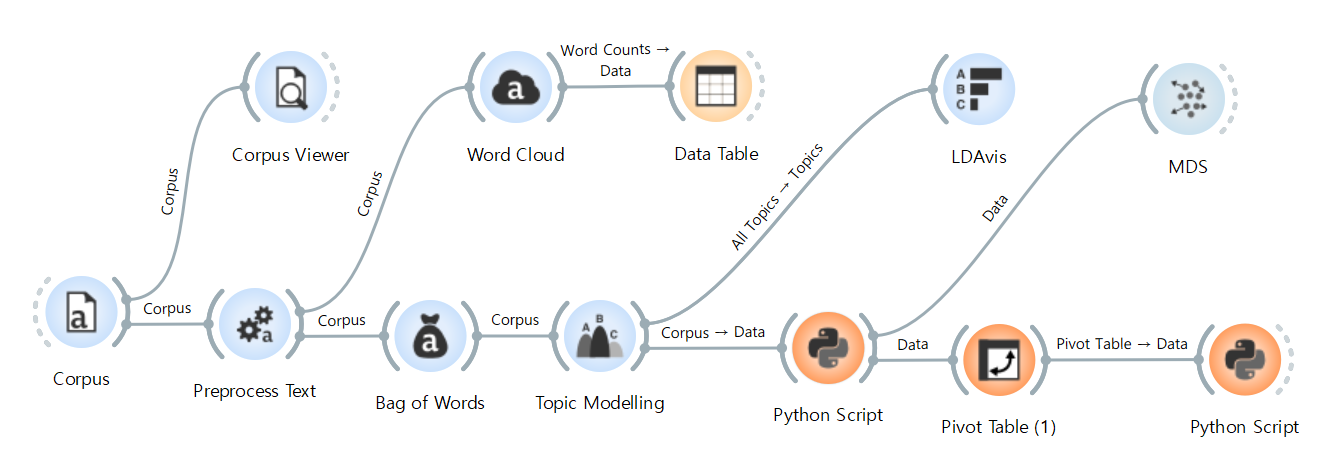
Accordingly, this study used Orange’s text-mining module to preprocess JMIC article data and perform topic modeling. The sequentially linked workflow ensures reproducibility and allows researchers to replicate the same procedures or extend them in subsequent research (Figure 1).
3.3 Text Preprocessing and Data Characteristics
This study analyzed 266 articles published in the Journal of Marine and Island Cultures (JMIC) from its inaugural issue in 2012 through 2024. The dataset was constructed by combining the title, keywords, and abstract of each article into a single text field (Mutate). This methodological choice follows prior text-mining studies, which highlight that integrating multiple textual elements helps overcome the limitations of relying on a single text type and enables a richer semantic representation (Heberling et al., 2019; Marine-Roig & Llonch-Molina, 2021).
Text preprocessing was conducted using Orange’s Preprocess Text module. All words were converted to lowercase, and HTML tags, URLs, and special characters were removed. Stopwords were eliminated, and lemmatization was applied to extract base forms of words. The analysis was restricted to nouns (NOUN) and verbs (VERB) to exclude parts of speech with weaker thematic relevance. As a result, 2,791 tokens and 107 unique word types were retained for topic modeling.
The preprocessing process represents a critical stage in ensuring data quality. By removing redundant or irrelevant words and normalizing synonyms and inflected forms into consistent representations, the validity of subsequent analyses was enhanced. The final dataset provides a solid foundation for systematically exploring the knowledge landscape that JMIC has developed over the past twelve years. The overall preprocessing and topic modeling workflow implemented in Orange is summarized in Fig. 1, which illustrates the sequential procedures from data import and preprocessing to visualization and topic analysis.
4. Results
4.1 Frequency-Based Keyword Analysis
A word frequency analysis was conducted on the preprocessed dataset, revealing that key terms such as tourism, fishing, conservation, diversity, mangrove, heritage, sustainability, biodiversity, climate, and governance appeared with high frequency. According to the Word Cloud and frequency table, “tourism” recorded the highest occurrence with 259 mentions, followed by “fishing” (117), “conservation” (110), “diversity” (100), “mangrove” (97), “heritage” (91), “forest” (74), “plastic” (67), and “sustainability” (65).
The prominence of “tourism” and “heritage” indicates that JMIC has consistently addressed the interaction between cultural identity and tourism development in island regions (Marine-Roig & Llonch-Molina, 2021). Similarly, the frequent occurrence of “fishing” and “livelihood” suggests that fisheries have been examined not merely as economic activities, but as vital components of community identity and survival in island societies (Syed et al., 2018).
Meanwhile, terms such as “conservation,” “biodiversity,” “mangrove,” and “climate” highlight that the conservation of marine and coastal ecosystems has been consistently emphasized in JMIC. The frequent appearance of “plastic” and “waste” underscores the growing significance of global issues such as microplastics and marine pollution, aligning with scholarly concerns about ecological risks (Pauna et al., 2019).
Finally, the presence of “governance,” “policy,” and “sustainability” suggests that JMIC research has extended beyond describing cultural and ecological aspects to actively engaging with international policy discourses and sustainability agendas. This aligns with research that visualized the transitions of Japan’s ocean policy through text-mining (Zhu et al., 2023), demonstrating the journal’s potential contribution to national and global policy discussions.
In sum, the frequency-based analysis shows that JMIC encompasses diverse thematic areas such as tourism, fisheries and livelihoods, marine ecosystem conservation, cultural heritage, sustainability, and responses to environmental pollution. These findings provide the foundation for subsequent topic modeling to generate a more refined knowledge landscape of JMIC. The detailed results of the word frequency analysis, including the top keywords and their occurrence counts, are presented in Table 1.
| No | Word | Word Count | Document Count | No | Word | Word Count | Document Count |
|---|---|---|---|---|---|---|---|
| 1 | tourism | 259 | 69 | 16 | climate | 47 | 20 |
| 2 | fishing | 117 | 37 | 17 | fish | 42 | 17 |
| 3 | conservation | 110 | 43 | 18 | islandness | 40 | 17 |
| 4 | diversity | 100 | 31 | 19 | governance | 40 | 14 |
| 5 | mangrove | 97 | 16 | 20 | river | 40 | 11 |
| 6 | heritage | 91 | 31 | 21 | protect | 39 | 25 |
| 7 | fisher | 77 | 19 | 22 | islander | 34 | 20 |
| 8 | forest | 74 | 21 | 23 | economy | 34 | 24 |
| 9 | plastic | 67 | 11 | 24 | waste | 31 | 9 |
| 10 | sustainability | 65 | 36 | 25 | litter | 30 | 7 |
| 11 | biodiversity | 59 | 26 | 26 | protection | 29 | 22 |
| 12 | biocultural | 53 | 16 | 27 | indigenous | 27 | 17 |
| 13 | pandemic | 51 | 9 | 28 | reserve | 25 | 13 |
| 14 | fishery | 48 | 25 | 29 | gender | 23 | 10 |
| 15 | livelihood | 47 | 23 | 30 | production | 22 | 14 |
4.2 Results of Topic Modeling
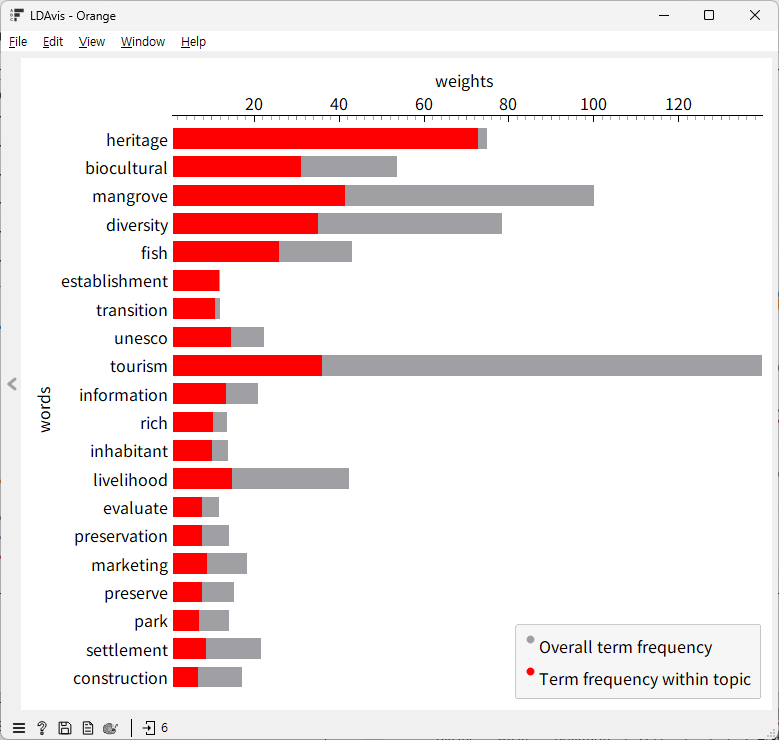
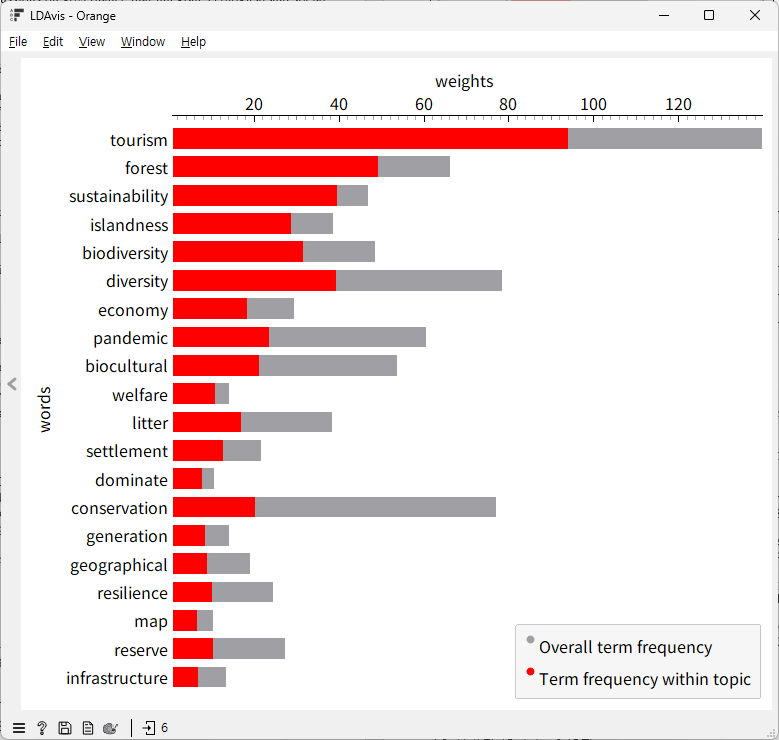
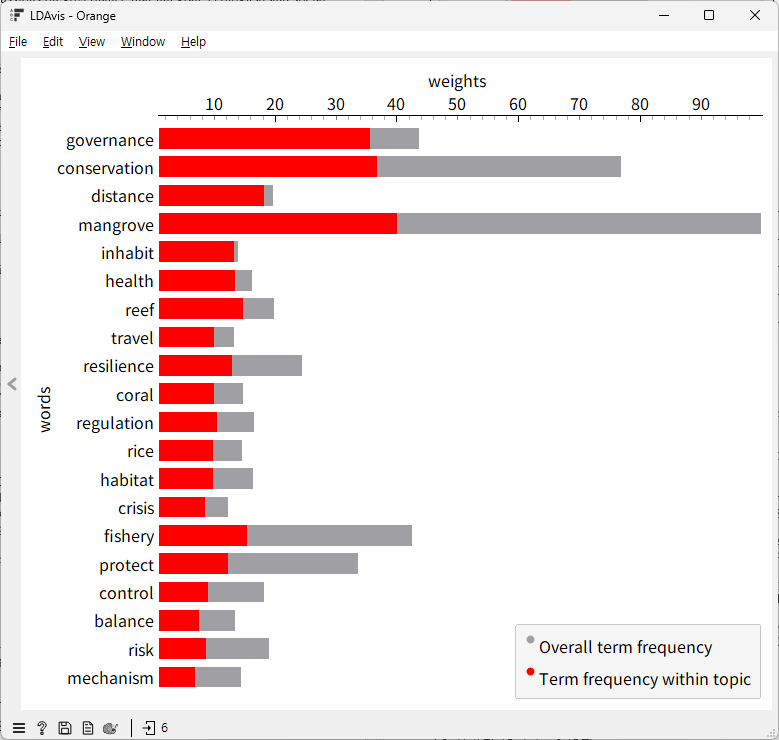
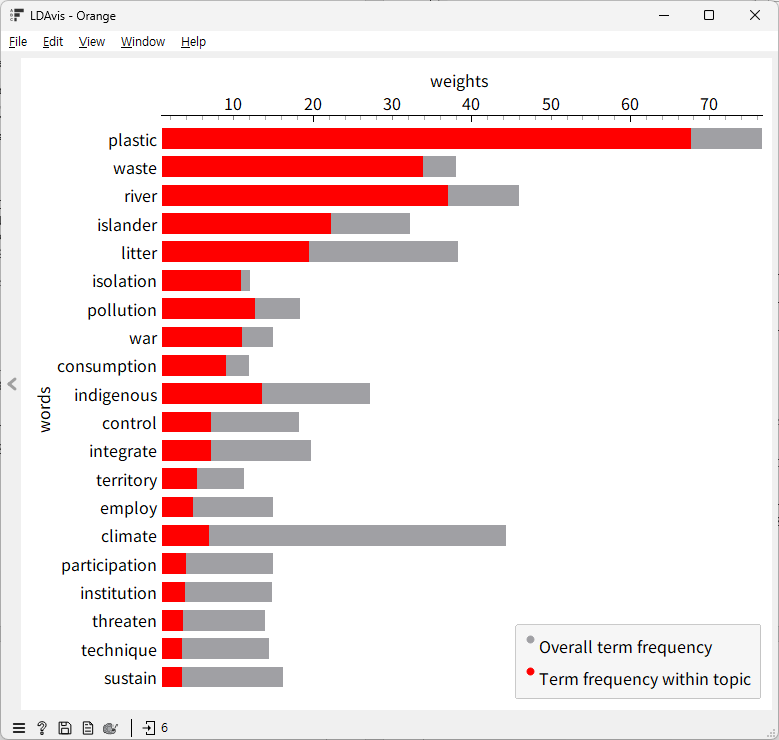
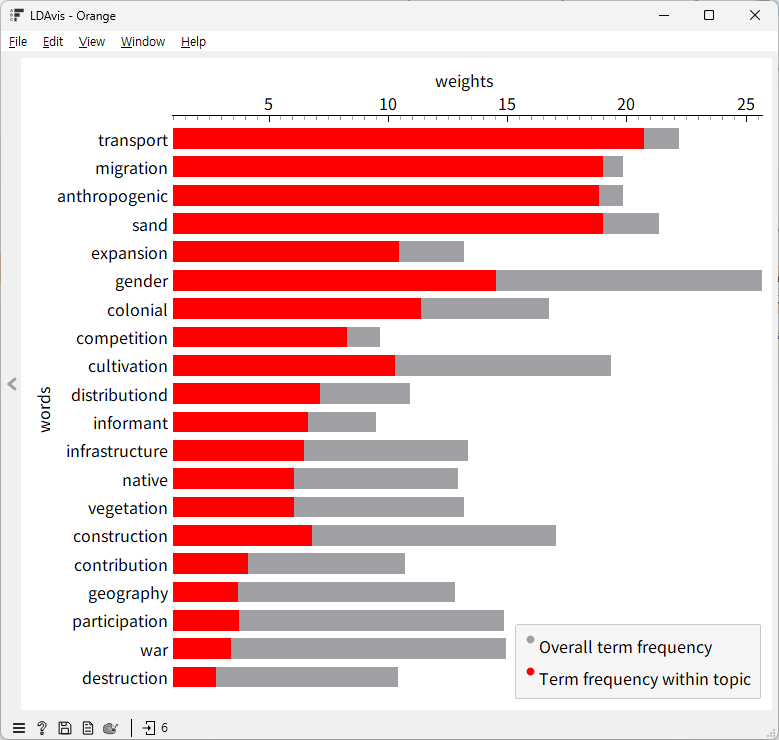
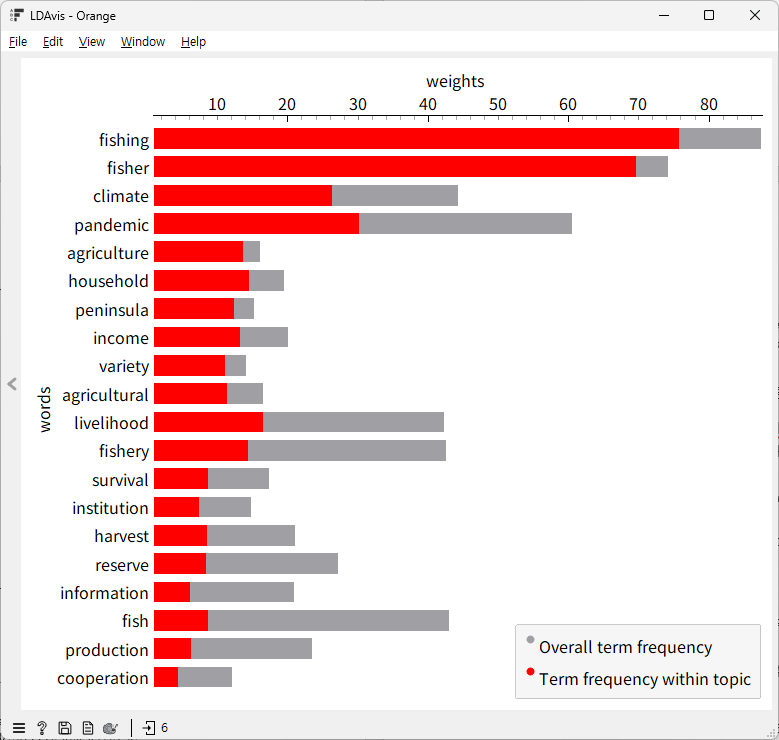
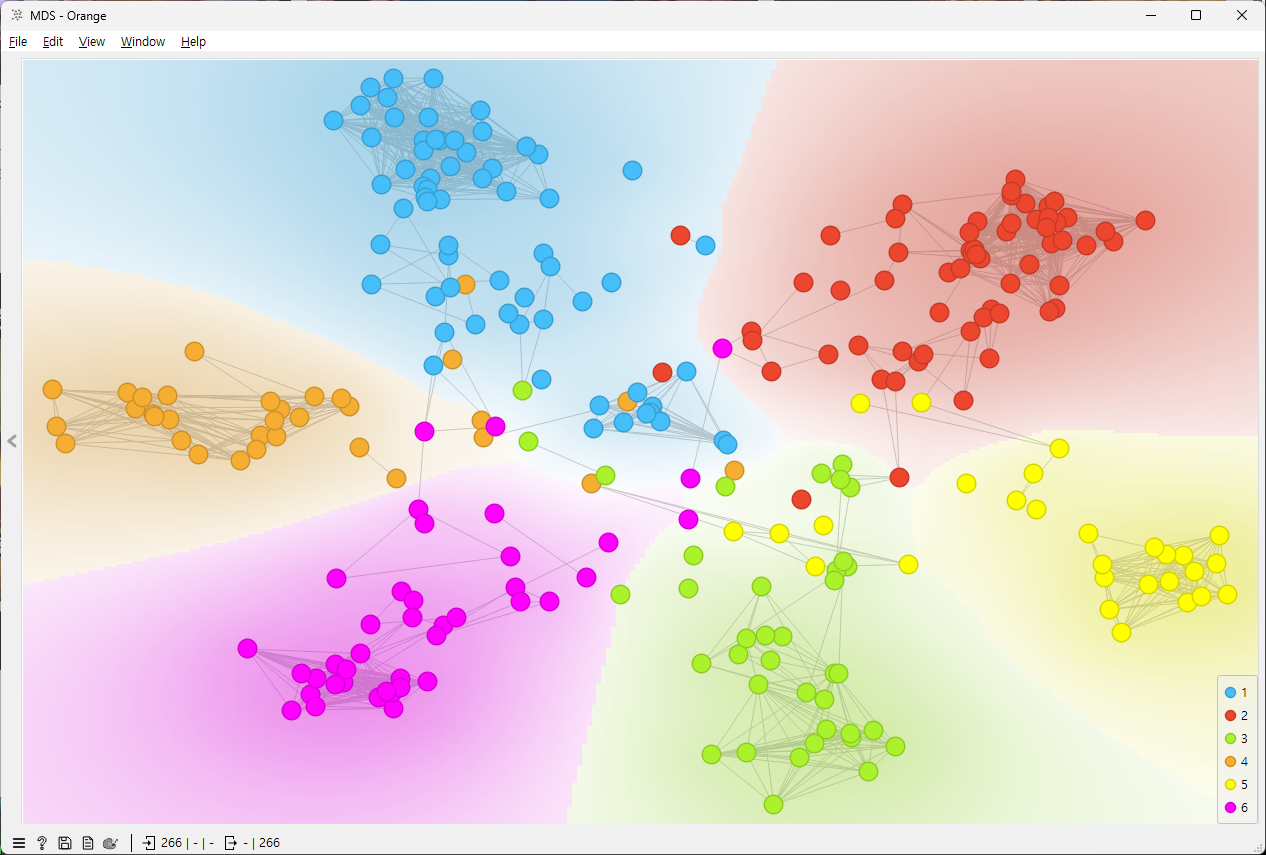
This study applied LDA topic modeling to classify 266 articles published in JMIC into six latent themes. By jointly evaluating Perplexity and Coherence metrics, the model with six topics was found to have the highest interpretability. LDAvis visualization displayed the distribution of key terms and the relative weight of each topic, enabling a more nuanced understanding of their thematic characteristics. In addition, multidimensional scaling (MDS) visualization revealed the structural clustering of articles by topic similarity, illustrating both the relative distances between topics and potential intersections.
-
Topic 1. Marine Cultural Heritage and Ecological Diversity
Key terms: heritage, mangrove, tourism, diversity, biocultural, fish, livelihood, UNESCO, information, establishment.
This topic reflects integrative research on cultural heritage and ecological resources in island regions. Terms such as “heritage” and “UNESCO” highlight links to global heritage discourses, while “mangrove” and “diversity” emphasize the importance of biodiversity conservation. The presence of “livelihood” and “fish” indicates the dependence of local communities on ecological resources. This topic illustrates JMIC’s interdisciplinary nature, bridging cultural anthropology and environmental studies.
-
Topic 2. Tourism, Sustainability, and Pandemic Impacts
Key terms: tourism, forest, sustainability, biodiversity, islandness, pandemic, economy, biocultural, conservation.
This topic centers on tourism research, while also addressing environmental conservation through “forest” and “biodiversity.” “Sustainability” broadens tourism beyond economic activity to encompass environmental and social concerns. The appearance of “pandemic” and “economy” reflects the vulnerabilities of island tourism during and after COVID-19. JMIC thus approaches island tourism from an integrated cultural, environmental, and economic perspective.
-
Topic 3. Marine Resource Governance and Resilience
Key terms: governance, conservation, mangrove, fishery, reef, health, resilience, travel, habitat, regulation.
This topic addresses governance structures and resilience in marine resource management. The presence of “governance” and “conservation” indicates attention to policy frameworks, while “mangrove” and “reef” highlight critical ecological resources. The co-occurrence of “health” and “resilience” suggests that ecological sustainability is intrinsically linked to community well-being and survival. This underscores JMIC’s role in advancing discussions on governance that integrate ecological and social dimensions.
-
Topic 4. Marine Pollution and Environmental Crises
Key terms: plastic, waste, river, islander, litter, pollution, isolation, indigenous, consumption, climate.
This topic revolves around marine pollution, particularly plastic waste and river-borne pollutants, as well as their impacts on island communities. The strong emphasis on “plastic” and “waste” reflects the global research interest in microplastics and marine debris. Terms such as “islander” and “indigenous” highlight the disproportionate effects of environmental crises on local and marginalized communities. Coupled with “pollution” and “climate,” this topic demonstrates how JMIC integrates anthropological perspectives into global environmental debates.
-
Topic 5. Migration, Gender, and Coloniality
Key terms: migration, transport, gender, colonial, anthropogenic, expansion, cultivation, infrastructure, geography.
This topic reflects anthropological studies on island and marine cultures, focusing on mobility, colonial legacies, and gender inequalities. The inclusion of “infrastructure” and “geography” indicates that spatial restructuring in island regions is intertwined with issues of colonialism and gender. JMIC thus provides a critical anthropological lens that connects historical experiences with contemporary social transformations.
-
Topic 6. Fisheries, Livelihoods, and Climate Change
Key terms: fishing, fisher, climate, livelihood, pandemic, agriculture, income, household, survival.
This topic highlights traditional fisheries as the foundation of island livelihoods while examining vulnerabilities caused by climate change and pandemics. The terms “fishing” and “fisher” underscore the centrality of fisheries, while “livelihood” and “income” reflect the socio-economic strategies of island residents. The joint presence of “climate” and “pandemic” points to structural fragilities in fishing communities. The links with “agriculture” and “household” further illustrate JMIC’s interdisciplinary analysis of survival strategies in island societies.
The topic modeling results indicate that over the past twelve years, JMIC has developed along six thematic axes: (1) cultural heritage and ecology, (2) tourism and sustainability, (3) governance and resilience, (4) environmental crises, (5) migration and gender, and (6) fisheries and livelihoods. This confirms JMIC’s academic role as an international platform that transcends mere documentation of regional cultures, integrating anthropology, ecology, social sciences, and policy studies. The detailed distribution of topics and their representative key terms derived from the LDA modeling are summarized in Table 2.
| Topic 1 | Topic 2 |
|---|---|
 |
 |
| Topic 3 | Topic 4 |
 |
 |
| Topic 5 | Topic 6 |
 |
 |
The MDS visualization shows that the six topics identified by LDA form relatively distinct clusters. The colored clusters represent relative distances among topics, with some nodes located at the boundaries, suggesting thematic intersections. For example, Topic 1 (cultural heritage and ecological diversity) and Topic 2 (tourism and sustainability) overlap where heritage preservation and tourism development intersect. Similarly, Topic 4 (pollution) and Topic 6 (fisheries and livelihoods) are linked through discourses on climate change and environmental crises. These results visually demonstrate JMIC’s role as an interdisciplinary platform that bridges cultural, social, environmental, and policy research. These clustering patterns and topic intersections are visually illustrated in Fig. 2, which maps the distribution of articles across six topics identified by LDA.
4.3 Temporal Trends in Research
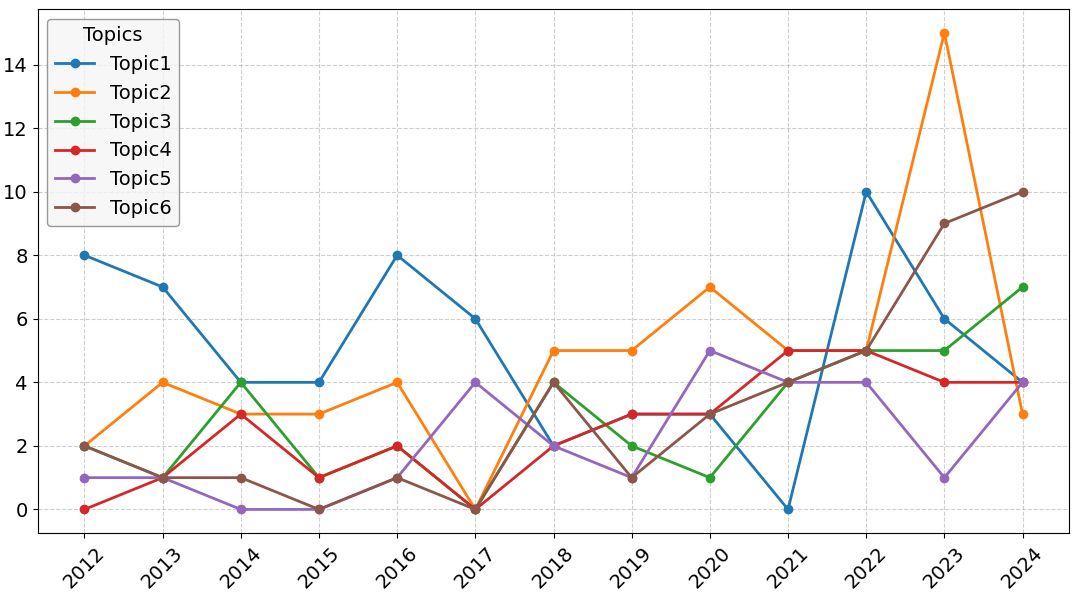
A temporal analysis of the six topics identified through LDA modeling reveals distinct shifts in JMIC’s research focus between 2012 and 2024. Based on pivot table analysis, three phases can be distinguished: the early stage (2012–2015), the middle stage (2016–2019), and the recent stage (2020–2024).
In the early stage (2012–2015), Topic 1 (marine cultural heritage and ecological diversity) dominated. Articles in the inaugural issue (2012) prominently featured “heritage” and “mangrove,” while “tourism” also emerged as a key theme. This indicates that from its inception JMIC positioned itself to expand discourses on island cultural identity and tourism into the international academic sphere.
In the middle stage (2016–2019), research topics diversified. Topic 6 (fisheries, livelihoods, and climate change), represented by “fishing” and “livelihood,” showed significant growth. At the same time, Topic 3 (marine resource governance and resilience), centered on “governance” and “conservation,” also gained prominence. This reflects the growing academic and international concern with fishing communities’ survival and marine resource management. Notably, in 2018, Topic 5 (migration, gender, and coloniality) appeared prominently, signaling an expanded anthropological interest in exploring islands within their historical and social contexts.
In the recent stage (2020–2024), JMIC increasingly engaged with urgent global agendas. From 2020 onward, Topic 4 (marine pollution and environmental crises), characterized by “plastic,” “waste,” and “pollution,” steadily expanded, aligning with global scholarly debates on microplastics and marine pollution (Pauna et al., 2019). Simultaneously, the COVID-19 pandemic marked a turning point. Topic 2 (tourism, sustainability, and pandemic impacts), represented by “pandemic” and “economy,” surged dramatically in 2023, surpassing other topics. Topic 6 (fisheries, livelihoods, and climate change) also rose sharply as discourses on climate change intersected with pandemic-induced vulnerabilities. These findings suggest that tourism, environmental crises, and fisheries–livelihood issues became focal points within the reconfigured global socio-economic landscape of the post-pandemic era (Syed et al., 2018; Zhu et al., 2023).
Overall, JMIC’s trajectory can be summarized as a transition from a focus on cultural heritage and tourism in the early stage → fisheries, governance, and socio-anthropological concerns in the middle stage → environmental crises and pandemic-related issues in the recent stage. This demonstrates that JMIC has evolved from documenting local island cultures and environments to functioning as an interdisciplinary platform engaging with global and contemporary issues. These temporal shifts are visually illustrated in Fig. 3, which plots the distribution of the six topics across three distinct research phases between 2012 and 2024.
5. Conclusion and Implications
This study analyzed the research trends and knowledge structure of the Journal of Marine and Island Cultures (JMIC) from its inception in 2012 to 2024 through text-mining and topic modeling. Using a combined text field of titles, abstracts, and keywords, LDA analysis in Orange identified six major topics: (1) marine cultural heritage and ecological diversity, (2) tourism, sustainability, and pandemic impacts, (3) marine resource governance and resilience, (4) marine pollution and environmental crises, (5) migration, gender, and coloniality, and (6) fisheries, livelihoods, and climate change. Temporal analysis showed that in the early period (2012–2015), research focused primarily on cultural heritage and tourism; in the middle period (2016–2019), fisheries, resource management, and socio-anthropological studies became prominent; and in the recent period (2020–2024), research on environmental crises and the pandemic increased sharply. These findings demonstrate that JMIC has evolved by incorporating both contemporary global agendas and international scholarly discourses without being confined to a single disciplinary domain.
Academically, this study makes three contributions. First, it maps the knowledge landscape of island and marine cultural studies by analyzing 12 years of accumulated publications in JMIC through text-mining. Second, it demonstrates that JMIC research forms an interdisciplinary structure linking cultural, ecological, social, and policy-oriented domains, as revealed through topic modeling and MDS visualization. Third, it empirically confirms that JMIC reflects both international academic discourses and local contexts through temporal trend analysis.
Policy and practical implications also emerge. The identified topic structures and temporal dynamics suggest that JMIC functions not merely as a record of regional culture and ecology, but as a platform connecting international scholarly networks with policy discourses. For example, fisheries and livelihood studies are closely tied to climate change and pandemic impacts, providing a basis for policies aimed at resilience and sustainable resource management. Tourism and heritage research extends beyond tourism promotion to inform sustainability, community identity, and intercultural exchange. Studies on marine pollution and environmental crises provide evidence to address global challenges such as plastic waste, linking JMIC research to international environmental governance.
Nevertheless, this study has limitations. First, the analysis was limited to titles, abstracts, and keywords, and thus did not fully incorporate the detailed contexts of full-text articles. Second, although perplexity and coherence indices were used for topic selection, interpretability inevitably involved subjective judgment. Third, since the analysis focused on JMIC alone, caution is needed in generalizing findings to the broader field of island and marine cultural studies.
Future research should address these limitations by analyzing full-text articles for more nuanced topic structures, conducting comparative studies with other related journals to clarify JMIC’s distinctiveness, and incorporating co-authorship or citation network analyses to better understand JMIC’s role within international scholarly communities.
In conclusion, this study objectively reveals JMIC’s research networks and academic status through text-mining–based analysis of its twelve-year span(2012). JMIC has functioned as an interdisciplinary platform where cultural, social, environmental, and policy discourses intersect, positioning itself as both an international hub for island and marine cultural studies and a site of knowledge exchange. Furthermore, by simultaneously engaging with global issues (e.g., pandemic, marine pollution, climate change) and regional contexts (e.g., livelihoods, heritage, migration), JMIC is expected to continue contributing to both international academia and policy discourse.
Acknowledgements
This work was supported by the Semyung University Research Grant of 2025.
References
- Blei, D.M., Ng, A.Y., Jordan, M.I., 2003. Latent Dirichlet allocation. Journal of Machine Learning Research 3: 993–1022.
- Chen, M.H., Bouvain, P., 2009. Is corporate responsibility converging? A comparison of corporate responsibility reporting in the USA, UK, Australia, and Germany. Journal of Business Ethics 87(1): 299–317.
- Dahal, B., Kumar, S.A.P., Li, Z., 2019. Topic modeling and sentiment analysis of global climate change tweets. Social Network Analysis and Mining 9(1): 24.
- Demsar, J., Curk, T., Erjavec, A., Gorup, C., Hocevar, T., Milutinovic, M., Zupan, B., 2013. Orange: Data mining toolbox in Python. Journal of Machine Learning Research 14(1): 2349–2353.
- Han, X., 2020. Evolution of research topics in LIS between 1996 and 2019: An analysis based on latent Dirichlet allocation topic model. Scientometrics 124(1): 167–187.
- Heberling, J.M., Prather, L.A., Tonsor, S.J., 2019. The changing uses of herbarium data in an era of global change: An overview using automated content analysis. BioScience 69(10): 812–822.
- Jacobi, C., van Atteveldt, W., Welbers, K., 2018. Quantitative analysis of large amounts of journalistic texts using topic modelling. in: Automated Content Analysis in Digital Journalism. Routledge, pp. 89–118.
- Jelodar, H., Wang, Y., Yuan, C., Feng, X., Jiang, X., Li, Y., Zhao, L., 2019. Latent Dirichlet allocation (LDA) and topic modeling: Models, applications, a survey. Multimedia Tools and Applications 78(11): 15169–15211.
- Joo, S., Choi, I., Choi, N., 2018. Topic analysis of the research domain in knowledge organization: A latent Dirichlet allocation approach. Knowledge Organization 45(2): 170–183.
- Kang, H.J., Kim, C., 2023. A study on environmental trends and sustainability in the ocean economy using topic modeling: South Korean news articles. Processes 11(8): 2253.
- Loureiro, S.M.C., Guerreiro, J., 2022. Past, present, and future of pro-environmental behavior in tourism and hospitality: A text-mining approach. Journal of Sustainable Tourism 30(11–12): 2409–2431.
- Marine-Roig, E., Llonch-Molina, N., 2021. Gastronomy as a sign of the identity and cultural heritage of tourist destinations: A bibliometric analysis 2001–2020. Sustainability 13(22): 12531.
- Martínez-Vázquez, R.M., Milán-García, J., 2021. Analysis and trends of global research on nautical, maritime and marine tourism. Journal of Marine Science and Engineering 9(1): 93.
- Momtazi, S., Naumann, F., 2013. Topic modeling for expert finding using latent Dirichlet allocation. Wiley Interdisciplinary Reviews: Data Mining and Knowledge Discovery 3(5): 346–353.
- Mooney, S.J., Pejaver, V., 2018. Big data in public health: Terminology, machine learning, and privacy. Annual Review of Public Health 39: 95–112.
- Pauna, V.H., Buonocore, E., Renzi, M., Russo, G.F., Franzese, P.P., 2019. The issue of microplastics in marine ecosystems: A bibliometric network analysis. Marine Pollution Bulletin 149: 110612.
- Röder, M., Both, A., Hinneburg, A., 2015. Exploring the space of topic coherence measures, in: Proceedings of the Eighth ACM International Conference on Web Search and Data Mining (WSDM’15), pp. 399–408.
- Satibi, I., 2025. Unearthing key themes in cryptoeconomics: A novel text-mining study with Orange. Jurnal Dinamika Ekonomi Pembangunan 8(2): 107–130.
- Sonk, M., Tunger, D., 2024. Trend mining with Orange–using topic modeling in futures research with the example of urban mobility. European Journal of Futures Research 12(1): 6.
- Syed, S., Borit, M., Spruit, M., 2018. Narrow lenses for capturing the complexity of fisheries: A topic analysis of fisheries science from 1990 to 2016. Fish and Fisheries 19(4): 643–661.
- Toplak, M., Prinčič, J., Kranjc, J., Zupan, B., 2017. Orange3 Text Mining. Journal of Open Source Software 2(11): 512.
- Tran, B.X., Nghiem, S., Sahin, O., Vu, T.M., Ha, G.H., 2019. Modeling research topics for artificial intelligence applications in medicine: Latent Dirichlet allocation application study. Journal of Medical Internet Research 21(11): e15511.
- Troian, J., Prokopenko, O., Järvis, M., Saichuk, K., 2023. Bibliometric analysis of marine tourism research: Mapping knowledge structure and emerging trends. Marine Policy 151: 105456.
- Wallach, H.M., Mimno, D., McCallum, A., 2009. Rethinking LDA: Why priors matter, in: Advances in Neural Information Processing Systems, vol. 22. pp. 1973–1981.
- Xing, W., Lee, H.S., Shibani, A., 2020. Identifying patterns in students’ scientific argumentation: Content analysis through text mining using latent Dirichlet allocation. Educational Technology Research and Development 68(5): 2439–2464.
- Xue, J., Chen, J., Chen, C., Zheng, C., Li, S., Zhu, T., 2020. Public discourse and sentiment during the COVID-19 pandemic: Using latent Dirichlet allocation for topic modeling on Twitter. PLoS ONE 15(9): e0239441.
- Zhang, Y., Wang, L., Li, H., 2016. Knowledge mapping of coastal tourism studies: A scientometric analysis. Tourism Management Perspectives 20: 187–198.
- Zhu, M., Tanaka, K., Akamatsu, T., 2023. Visualizing the annual transition of ocean policy in Japan using text mining. Marine Policy 155: 105452.