
Small Island Livelihood Adaptation Strategies: The Case of Mina-anod Island, Llorente, Eastern Samar, Philippines
 10.21463/jmic.2025.14.3.04
Abstract
Livelihood adaptation is critical for small island communities vulnerable to the exacerbating impact of climate change. However, there are limited studies on livelihood adaptation strategies to climate change and household resilience-building strategies for small rural islands. A survey using an interview schedule was conducted to determine the financial capital and livelihood adaptation strategies of 98 households on Mina-anod Island, Llorente, Eastern Samar, Philippines. Results showed four different small rural island livelihood adaptation strategies to enhance financial capacities, classified into expanded, productive savings, financial assistance, and collaborative. Results also showed that most islanders engage in nature-dependent livelihoods, such as fishing, vending, and tourism, indicating the importance of having multiple livelihood adaptation strategies and income streams, as both the island and the livelihood are vulnerable to climate change. Enhancing islanders’ capacity through education, entrepreneurial training, financial literacy, and skills development, among other initiatives, is crucial in building resilient livelihoods on the island. Moreover, government interventions, such as policies, programs, and projects that empower islanders and promote environmental conservation, in collaboration with other institutions and stakeholders, are crucial for enhancing the capacity of small rural islands to adapt to climate change and build island resilience.
Keywords
climate change, financial capital, livelihood adaptation strategies, small rural island
1. Introduction
Climate change is expected to exacerbate societal issues and threaten livelihoods (Shiiba et al., 2023) in small rural island communities. Small rural islands are generally vulnerable to climate change (Malherbe, Sauer, and Aswani, 2020) due to their geographical characteristics, small land area (Ratter, 2018), proximity to the coast, and limited natural resources. The limited resources on small islands are also an obstacle to increasing the income of island communities (Sulaiman, Ali, and Salman, 2019). Moreover, the increasing impacts of climate change jeopardize the capacity of marine and coastal ecosystems to support livelihoods (Shiiba et al., 2023; Hernández-Delgado, 2024), protect coastlines against wave action and sea level rise, and sustain islands’ economic progress (Hernández-Delgado, 2024).
The Philippines is an archipelagic country with about 7,641 islands (National Mapping and Resource Information Authority [NAMRIA], 2017). According to the World Risk Report (2022, 2023, 2024), the Philippines has been the country most at risk from the effects of natural events for three consecutive years. In 2023, about 17 Philippine provinces (Occidental Mindoro, Oriental Mindoro, Pangasinan, Ilocos Sur, Eastern Samar, Zambales, Aurora, Northern Samar, Cagayan, Surigao del Sur, Nueva Ecija, Tarlac, Sulu, Leyte, Pampanga, Samar and Southern Leyte) were included in the list of the top 100 provinces facing significant climate-related risks to the built environment worldwide by the Cross Dependency Initiative (XDI, 2023). Building livelihood adaptation, especially for small island communities in the Philippines, is critical for them to afford to adopt measures to secure lives, properties, and livelihoods from climate-related hazards.
Livelihood adaptation refers to the adjustments made by people to lessen the adverse effects of climate change risk on their livelihood and well-being (Aniah, Kaunza-Nu-Dem, and Ayembilla, 2019). Livelihood adaptation strategies are the activities households undertake to achieve their livelihood goals (Pour et al., 2018) to survive or improve (Suadi et al., 2022). However, limited research exists on rural households’ livelihood adaptation to climate change (Khan et al., 2024; Yang et al., 2021), livelihood adaptation strategies (Yang et al., 2021), and household resilience-building strategies (Do, 2023), especially in the small rural islands of the Philippines. The study was conducted on Mina-anod Island, Llorente, Eastern Samar, Philippines, to determine the island’s financial capital, livelihood adaptation strategies, and the relationship between the selected household profiles and their livelihood adaptation strategies. The results can serve as a basis for developing and enhancing policies and programs to improve the livelihood adaptation and resilience of small rural islands to climate change.
2. Methodology
2.1 Study Site
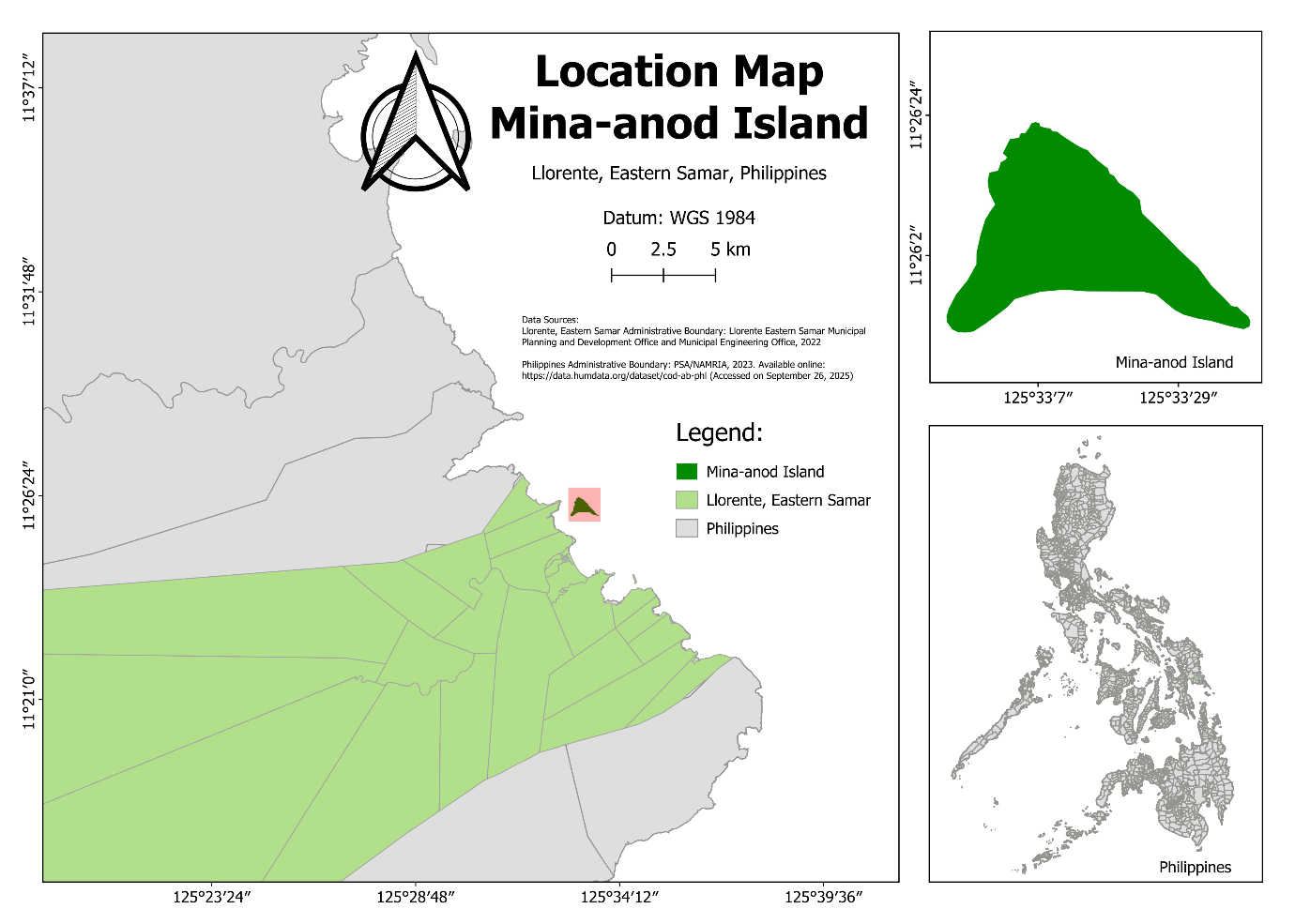
The study was conducted on Mina-anod Island, a small rural island barangay, in Llorente, Eastern Samar, Philippines. Mina-anod Island is about 66.27 hectares (Llorente Eastern Samar Municipal Planning and Development Office and Municipal Engineering Office, 2022) and is 3 kilometers from the center of Llorente, Eastern Samar. Fishing and vending are the significant sources of income for most households on the island. The island is prone to extreme weather events (Barangay Mina-anod Disaster Risk Reduction and Management Plan, 2021-2024).
2.2 Data Collection and Analysis
A survey was conducted on Mina-anod Island, Llorente, Eastern Samar, Philippines. Before conducting the survey, a letter request was sent to the punong barangay (barangay captain) of Mina-anod Island to solicit their approval for the study. Informed consent was also provided to the respondents before the survey to request their participation. There were 118 households in Mina-anod Island (Barangay Mina-anod Population Data, 2023). However, only 98 were surveyed because others were either not around, failed to complete the survey, or failed to participate. The household heads were asked, and, in their absence, any household member who was at least 18 years old was requested to answer the survey. An interview schedule guide, modified from the study by Hilvano et al. (2016) and based on the literature, was used to determine the financial capital and livelihood adaptation strategies of households on Mina-anod Island. A pretest was conducted with five (5) respondents (Sang et al., 2017) to check its clarity and adequacy. The socio-demographic profile of the respondents, such as house ownership, land tenure status, household size, education, length of stay, etc., was also asked. Descriptive analyses, such as frequency and percentage, were used to describe the socio-demographic profile, financial capital, and livelihood adaptation strategies of the households on Mina-anod Island. The rank-biserial coefficient and Spearman’s rank correlation were used to determine the relationship between the selected profile of the respondents and their livelihood adaptation strategies.
3. Results and Discussion
3.1 Financial Capital and Livelihood Strategies of Mina-anod Island
Table 1 shows the socio-demographic profile of the respondents of the study. About 77% of the respondents own their houses, but only 19% have land tenure status. All households on the island have access to communication, wherein all households have a cellphone, about 28% own a radio, and about 63% own a television set. More than half of the households use Liquefied Petroleum Gas (LPG) (58%) and charcoal (52%) as fuels for cooking. About 82% of households have members of 5 or fewer, and about 18% have members of more than 5. About 43% of the respondents have a secondary education, while only 3% have a college education. About 83% have lived on the island for over 20 years, while only about 9% have been there for 10 years or less.
| Variables | Frequency | Percentage (%) | |
|---|---|---|---|
| House ownership | Owner | 75 | 76.53 |
| Rented | 2 | 2.04 | |
| Living with relatives/friends | 20 | 20.41 | |
| Others | 1 | 1.02 | |
| Land tenure status | Owner | 19 | 19.39 |
| Non-owner | 79 | 80.61 | |
| Cellphone | With cellphone | 98 | 100.00 |
| Radio | With radio | 27 | 27.55 |
| No radio | 71 | 72.45 | |
| Television | With TV sets | 62 | 63.27 |
| No TV sets | 36 | 36.73 | |
| Fuel for cooking* | LP gas | 57 | 58.16 |
| Kerosene | 1 | 1.02 | |
| Firewood | 28 | 28.57 | |
| Charcoal | 51 | 52.04 | |
| Household size | ≤ 5 | 80 | 81.63 |
| > 5 | 18 | 18.37 | |
| Education | Elementary | 52 | 53.06 |
| High school/Senior High/Vocational | 43 | 43.88 | |
| College | 3 | 3.06 | |
| Length of stay | 0–10 years | 9 | 9.18 |
| > 10–20 years | 8 | 8.16 | |
| > 20 years | 81 | 82.65 |
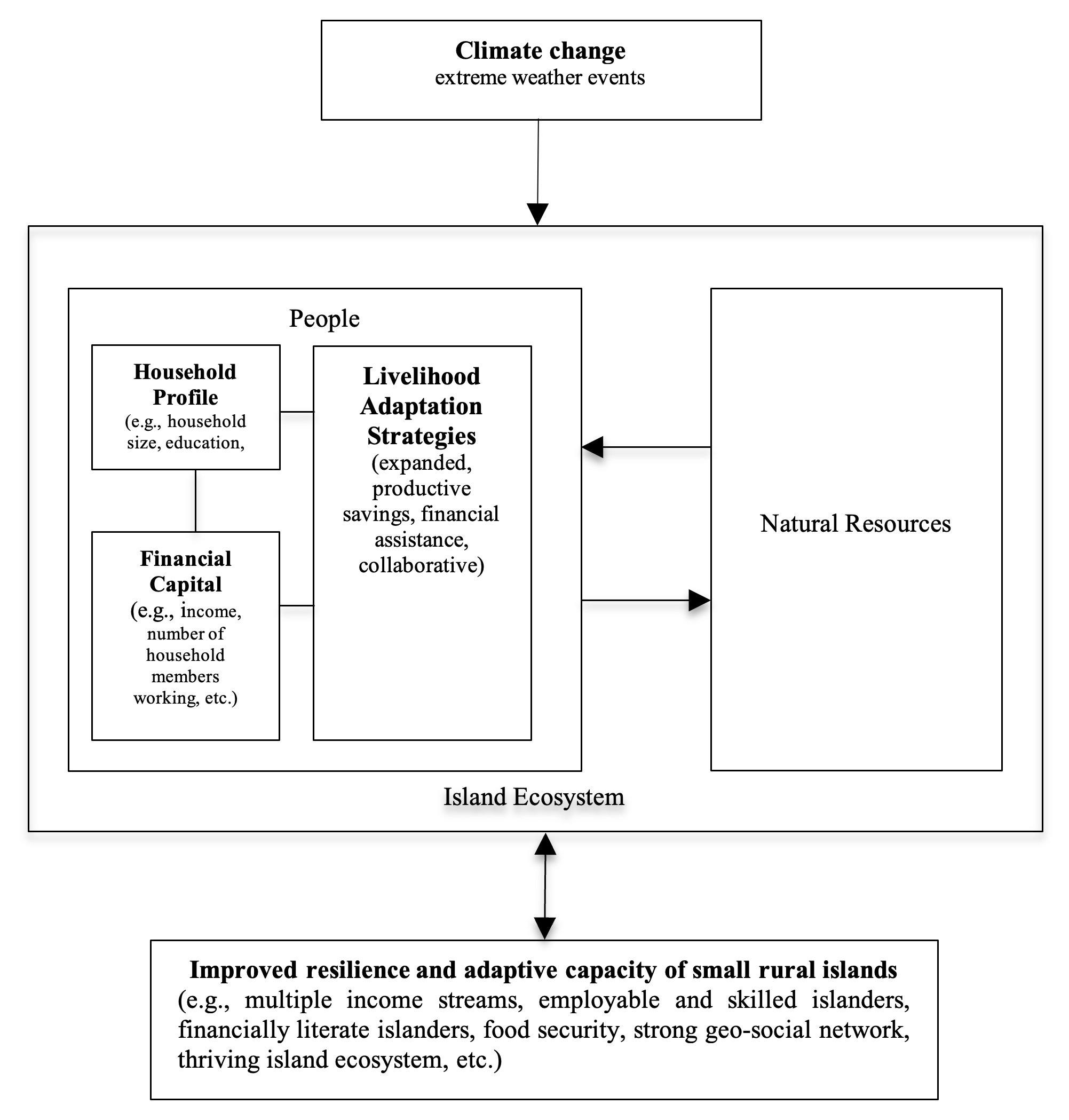
The households on Mina-anod Island employ various livelihood adaptation strategies, depending on their characteristics, to enhance their financial capacities and improve their resilience and adaptive capacity to climate change and weather extremes (Figure 2). Table 2 shows the financial capital, while Table 3 shows the livelihood adaptation strategies of the households on Mina-anod Island. Financial capital refers to the financial resources, e.g., income, savings, and credit (Malherbe, Sauer, and Aswani, 2020), used by households to support their existence and enable their livelihoods. The livelihood adaptation strategies of the households were classified into four types: expanded (Yang et al., 2021), productive savings, financial assistance, and collaborative. Expanded livelihood strategy refers to strategies that increase household output or source of income (Yang et al., 2021), e.g., looking for and working for a job outside the island, increasing the number of working household members, etc. The productive savings livelihood strategy refers to a household’s strategy of cash savings, livestock ownership, and increasing household education and livelihood skills. The financial assistance livelihood strategy refers to a household’s access to government financial assistance, remittances, and other external assistance, including credit access, e.g., borrowing from microfinance institutions, private individuals, etc. The collaborative livelihood strategy refers to the household strategy of joining cooperatives, paluwagan, and other livelihood groups.
3.1.1 Expanded Livelihood Strategies
3.1.1.1 Income and Alternative Livelihood
About 51% of households considered fishing their primary source of income (Table 2). Most respondents (71%) stated that fishing is the livelihood adaptation strategy on Mina-anod Island. The results also showed that income and fishing as a livelihood strategy are weakly related (.245) at a 0.05 significance level (Table 3). Fishers are among the most economically vulnerable in the Philippines, with one of the highest poverty rates due to the unpredictability of fishing as a source of income (Lomboy et al., 2019). Sustainable fishing is critical to ensure islanders’ sustainable livelihood and access to food. The Department of Agriculture Order No. 3, s. 1998 (Implementing Rules and Regulations pursuant to Republic Act No. 8550: An Act Providing for the Development, Management, and Conservation of the Fisheries and Aquatic Resources, Integrating All Laws Pertinent Thereto, and for Other Purposes), Chapter II, Sec. 14 mandates the Department of Agriculture the establishment of a monitoring, control, and surveillance system by in coordination with Local Government Units (LGUs), Fisheries and Aquatic Resources Management Councils (FARMCs), the private sector, and other agencies concerned to "ensure that the fisheries and aquatic resources in Philippine waters are judiciously and wisely utilized and managed on a sustainable basis and conserved for the benefit and enjoyment exclusively of Filipino citizens." Thus, strictly implementing fishery laws is crucial to curtail illegal and unsustainable fishing practices and ensure that islanders and Filipinos, in general, benefit from the ecosystem services the marine ecosystem provides.
Vending is a livelihood adaptation strategy for about 21% of households on Mina-anod Island (Table 3). Selling fish on the mainland was the primary source of income for about 18% of the households on the island (Table 2). The number of households working is weakly related (.196) with vending as a livelihood adaptation strategy at a 0.05 significance level, indicating the viability of vending as an additional livelihood strategy for households seeking another source of income. Moreover, the results demonstrate the importance of transportation on the island in sustaining the livelihood of these households. Sea transport is the only transport on the island, wherein two passenger vehicles alternately travel to the mainland and vice versa. One vehicle travels from the island to the mainland and vice versa in one day, and the other travels the next day. Moreover, the islanders also travel to the mainland to buy products (food, other basic needs, etc.), visit government offices, report for work, attend the fiesta, visit relatives/friends, access education, pay the electricity bill, and others. A high geo-social interaction with the mainland, where the fish vendors sell and the islanders get other goods and services, is critical in enhancing their livelihood adaptation. The study suggests safe and sufficient transport to ensure the sustainable flow of goods, services, and other economic activities from the island to the mainland and vice versa (Hilvano et al., 2023).
About 4% of households have sari-sari stores. A sari-sari store is a small-scale store typical in the Philippines that sells daily necessities, food, and drinks (Funahashi, 2013), which provides daily economic sustenance to low-income communities in the country (Turgo, 2013). According to Eadie, Atienza, and Tan-Mullins (2020), sari-sari store owners with entrepreneurial experience are likely to succeed than those without experience running a small business, especially in low-income communities where store owners compete for limited customers with low spending power. Hasan et al. (2023) stated that rural entrepreneurship can be a sustainable alternative livelihood to improve the resilience of households. Island entrepreneurship is critical as an alternative livelihood strategy; however, the study suggests that islanders venture into different businesses to limit competition for limited customers. The conduct of business training and financial literacy for islanders is critical in enhancing their entrepreneurial and financial management skills for successful entrepreneurial livelihood adaptation strategies.
| Financial capital | Frequency | Percentage (%) | |
|---|---|---|---|
| Income | No income | 7 | 7.14 |
| < 5,000 | 80 | 81.63 | |
| > 5,000 – 10,000 | 7 | 7.14 | |
| > 10,000 – above | 4 | 4.08 | |
| Primary source of income | No source of Income | 7 | 7.14 |
| Fishermen | 50 | 51.02 | |
| Farmer | 3 | 3.06 | |
| Employed | 7 | 7.14 | |
| Fish vendor | 18 | 18.37 | |
| Sari-sari store owner | 4 | 4.08 | |
| Others, e.g., barber, baker | 9 | 9.18 | |
| Number of Household members working | None | 7 | 7.14 |
| 1 | 62 | 63.27 | |
| 2 or more | 29 | 29.59 | |
| Farm Ownership | None | 82 | 83.67 |
| Owner | 13 | 13.27 | |
| Tenant | 3 | 3.06 | |
| Vehicle Ownership | With no vehicle | 54 | 55.10 |
| With vehicle | 44 | 44.90 | |
| Credit* | None | 43 | 43.88 |
| Sari-sari store | 17 | 17.35 | |
| Bank | 2 | 2.04 | |
| Microfinance | 23 | 23.47 | |
| Cooperative | 2 | 2.04 | |
| Private Person | 11 | 11.22 | |
| Financial Assistance* | None | 52 | 53.06 |
| With access to financial assistance, e.g., 4Ps, senior citizen stipend, AICS, TUPAD, etc. | 46 | 46.94 | |
| Livestock | None | 90 | 91.84 |
| With livestock (e.g., hog) | 8 | 8.16 | |
| Savings | None | 78 | 79.59 |
| Bank | 3 | 3.06 | |
| Microfinance | 13 | 13.27 | |
| Others, e.g., piggy bank | 4 | 4.08 | |
| Remittance | No remittance | 81 | 82.65 |
| With remittance | 17 | 17.35 | |
| Pension | None | 91 | 92.86 |
| <5000 | 6 | 6.12 | |
| >5000 | 1 | 1.02 |
About 8% of households engage in tourism as one of their livelihood adaptation strategies. A weak positive relationship (.172) between income and engaging in tourism as a livelihood strategy was found at a 0.10 significance level (Table 3). This implies that island tourism can be an additional livelihood, especially for islands with limited economic resources (Hilvano et al., 2023). Tourism development has been promoted as an alternative livelihood for small island communities to reduce their dependence on declining marine resources (Praptiwi et al., 2021) and diversify their income sources. Su, Wall, and Jin (2016) stated that tourism might enhance island livelihood options and reduce fishing pressures. Promoting tourism activities on Mina-anod Island can boost its local economy and economic relations by creating other economic opportunities (e.g., transport of tourists, marketing of local products) (Hilvano et al., 2023). However, tourism places new demands on a small island’s limited resources and can disrupt local livelihood systems and socio-cultural traditions (Su, Wall, and Jin, 2016). Thus, the study suggests the development of ecotourism programs and policies that are thoroughly planned in collaboration with stakeholders (Hilvano, 2023) and consideration of the environmental, economic, and socio-cultural aspects of ecotourism (Salman et al., 2021) of the island. Establishing the resilience of small island tourist destinations is essential, especially for countries that are economically dependent on tourism potential (Añasco et al., 2021).
About 3% of households considered farming their primary source of income. Access to productive farmland allows households to meet their food and nutritional needs and earn income. About 13% of households in Mina-anod Island own farmland, while only about 3% are tenants. As mentioned earlier, Mina-anod Island is about 66.27 hectares (Llorente, Eastern Samar Municipal Planning and Development Office and Municipal Engineering Office, 2022), and portions of which are used for agricultural purposes (Barangay Mina-anod Disaster Risk Reduction and Management Plan, 2021-2024). About 7% of households stated that planting crops is their livelihood strategy. However, natural resources on certain islands can be limited due to the limited size of the island (Pattiselanno et al., 2017). Coastal areas are also not conducive to cultivating various crops due to their vulnerability to climate change and consequential effects (Rahman et al., 2024). The study suggests that households in small island communities, such as Mina-anod, practice homestead gardening. This will help them increase their food supply and can serve as an additional source of income. Homestead gardening can increase food production and consumption, enhancing climate resilience and food security in climate-vulnerable areas (Rahman et al., 2024). The study suggests extension activities involving the distribution of seeds and other planting materials, and seminars on crop production and homestead gardening in island communities.
Diversifying livelihood is essential for managing economic and environmental shocks and reducing rural poverty in developing countries (Habib, Ariyawardana, and Aziz, 2023), like the Philippines. The number, amount, and sources of income or livelihood activities of the islanders can indicate their capacity to adapt and cope with climate change. About 30% of households have two or more working members, while the majority (64%) have only one working member. About 31% of the respondents encourage their household members to find a job as one of their livelihood strategies. A significant association (.186) between income and encouraging their household members to find a job as a livelihood adaptation strategy was found at a 0.10 significance level (Table 3). A significant association (.332) between the number of household members working and encouraging their household members to find a job as a livelihood adaptation strategy was found at a 0.01 significance level (Table 3). The results indicate that households with more members working are expected to encourage other members to work to increase income to meet their households’ needs and afford measures to adapt to the changing climate.
In addition, the income of most households is below the 2023 poverty threshold of Php 13,411.00 (Philippine Statistics Authority-Region VIII Eastern Visayas, 2024). As shown in Table 2, about 82% of the households on the island earn an income of Php 5,000.00 and below, while only 4% earn an income of more than Php 10,000.00. Moreover, about 7% of households have no income and were found incapable of working due to old age or disability, but they receive remittances and/or pensions. Household income in an island community is used to satisfy various needs, including food, tuition, clothing, shelter, and other daily needs (Pattiselanno et al., 2017). Kwan and Tam (2021) stated that low-income households cannot afford to adopt mitigation efforts against rising sea levels and other coastal hazards. For small islands with limited resources, the availability of multiple income streams can serve as a safety net, especially for households whose sources of income are irregular and dependent on fishing. It will enable them to adapt to the changing environment and climate.
| Type of Livelihood Strategy | Livelihood strategies | % | Household Profile | |||
|---|---|---|---|---|---|---|
| Income | Number of Household members working | Household Size | Education | |||
| Expanded | Fishing | 71.43 | .245** | |||
| Encouraging members of the households to find a job | 30.61 | .186* | .332*** | |||
| Vending (e.g., selling fish, operating a sari-sari store) | 20.41 | .196* | ||||
| Other members of the household look for jobs elsewhere | 17.35 | .172* | .195* | .200** | .220** | |
| Engaging in tourism | 8.16 | .172* | ||||
| Farming | 7.14 | |||||
| Productive savings | Saving money | 20.41 | .214** | |||
| Livestock ownership | 5.10 | |||||
| Sending children to school | 55.10 | .269*** | ||||
| Attending skills training/workshops | 11.22 | .290*** | ||||
| Financial Assistance | Applying for government financial assistance | 21.43 | ||||
| Asking for financial assistance from relatives | 18.37 | -.229** | ||||
| Borrowing money to serve as capital | 18.37 | -.229** | ||||
| Collaborative livelihood strategy | Joining credit cooperatives | 12.24 | .205** | |||
| Joining livelihood groups or organizations | 12.24 | .207** | .225** | |||
| Joining “paluwagan” | 3.06 | |||||
The results further showed that the livelihood of most households on Mina-anod Island was natural-resource dependent, thus vulnerable, the island being prone to extreme weather events due to its geographic location. Island communities with natural resource-dependent livelihoods are particularly affected by climate extremes. For example, when Super Typhoon Yolanda (internationally known as Super Typhoon Haiyan) hit Eastern Samar in 2013, it adversely affected the agroecosystem (Eadie, Atienza, and Tan-Mullins, 2020) and the coastal and marine ecosystems in the province (Anticamara and Go, 2017), including small islands, e.g., Manicani Island, Guiuan, Eastern Samar, resulting in a loss or decrease in income (Hilvano et al., 2016). The availability of alternative livelihoods on small islands is critical, especially since their primary source of income is fishing. However, there is a need to link alternative livelihoods for fisherfolk to environmental protection and conservation (Aguilar, 2022) to ensure they have sustainable access to livelihoods and food, and to decrease pressure on declining marine resources.
Moreover, the availability of trained and insured Bantay-Dagat (sea patrol) Program volunteers on the island and other coastal communities will also greatly help monitor fishing activities. The Bantay Dagat program is a community-based law enforcement initiative in the Philippines that voluntarily engages fisherfolk in barangays or coastal communities. The role of Bantay Dagat expands from safeguarding the marine ecosystem within 15 kilometers of the shore from illegal fishing activities to marine environment conservation and preservation, including the management of solid waste in the seascapes (Jabar and Ereneta, 2022). Engaging the fishermen on the island in the Bantay-Dagat program will influence them to practice sustainable fishing, protect the source of their livelihood from overexploitation and illegal activities, and encourage other islanders to participate in marine environment conservation.
3.1.1.2 Labor mobility
The limited resources on small islands are an obstacle to increasing the income of island communities (Sulaiman, Ali, and Salman, 2019), which necessitates other islanders to look for jobs outside the island. On Min-anod Island, about 17% of households have members who search for a job elsewhere as a livelihood adaptation strategy (Table 3). Accessing work outside the island can help improve the economic condition of the islanders (Hilvano et al., 2023). Employment outside Mina-anod enables the working household member to send money to their family on the island that can be used to buy their needs, support the education of household members, or as capital to improve their livelihood. Moreover, Jamero et al. (2019) stated that employment in the mainland is a crucial livelihood adaptation strategy for impoverished small islands in the Philippines vulnerable to climate change impacts, e.g., sea level rise, and consider island abandonment or mass migration as a last resort solution to the problem. The study suggests that islanders participate in job fairs and seek employment assistance from concerned government agencies like the Public Employment Service Office (PESO). The government strengthened interventions to increase the accessibility of employment opportunities, and the broader dissemination of job fairs is suggested.
3.1.2 Productive Savings Livelihood Strategies
3.1.2.1 Financial Savings
About 20% of households state that saving is one of their livelihood strategies. About 3% have savings in the bank, 13% save through membership in microfinance, and about 4% save money in other ways, e.g., piggy banks (Table 2). A positive relation (.214) between income and saving money was found at a 0.05 significance level (Table 3). As mentioned above, most households have a low income, which explains why only a few households have savings. Saving is a safety net for islanders to adapt to climate change and enhance their livelihoods. The study suggests extension activities about the importance of good savings practices and savings for investment to help secure future financial freedom. While enhancing the capacity of local communities regarding financial literacy is essential (Ali et al., 2023), it is also critical to build their capacity to have multiple income streams so they can save, which can be used as capital in establishing alternative livelihoods.
Livestock also constitutes a savings mechanism that can be used to invest in other income-generating activities or pay other household expenses. About 7% of households in Mina-anod Island own livestock (Table 2), and about 5% of the households stated that livestock was their livelihood strategy. Livestock production contributes to economic development at the household and community levels through its income and saving function (Baltenweck et al., 2020). The study suggests extension education on livestock production to enhance the knowledge and skills of the islanders to improve their income.
3.1.2.2 Education and Livelihood Skills enhancement
For rural island communities, education is an asset that has long-term effects on becoming financially independent (Hilvano et al., 2016). About 55% of the households send their children to school (Table 3) so they will have better jobs in the future. Household size and sending children to school as a livelihood strategy were correlated (.269) at a 0.01 significance level. Moreover, household size (.200) and the respondents’ educational attainment were weakly positively correlated (.220) with other household members looking for jobs elsewhere as a livelihood adaptation strategy at a 0.05 level of significance (Table 3). This indicates that households with educated members are expected to work and are employable outside the island to support their households, because they can compete in the labor market through their education.
Islam and Walkerden (2022) stated that increasing education improves livelihood flexibility. Education equips islanders with the necessary knowledge and skills to land a job, engage in island entrepreneurship, and pursue other income-generating opportunities. Republic Act No. 9155 (Governance of Basic Education Act of 2001) provides free elementary and high school education, including alternative learning systems for out-of-school youth and adult learners. Republic Act No. 10931 (Universal Access to Quality Tertiary Education Act) also provides free higher education, technical-vocational education and training, a tertiary education subsidy, and a student loan program to qualified Filipinos. Islanders, especially those with limited financial resources, can access education by enrolling in state-funded schools, colleges, and universities. Islanders can also seek financial assistance and scholarships to support their studies. The study suggests that islanders take advantage of these opportunities to improve their livelihood, resilience, and well-being.
Attending skills training and workshops is another livelihood strategy for about 11% of households on the island. The study also showed a positive relation (.313) between income and attending skills training and workshops as a livelihood adaptation strategy. The results indicate that those with skills training and who have attended workshops have an edge in finding employment that is relevant to their skills. Islanders with low educational attainment and fewer livelihood skills are less likely to be absorbed in the labor market (Hilvano et al., 2016). Macusi, Diampon, and Macusi (2023) stated that the availability of alternative non-fishing income, such as driving, construction work, carpentry, or other manual labor opportunities, helps fishing communities recover and earn income in days when fishing is not viable due to climate-related hazards, e.g., typhoons, northeast monsoon (Amihan), and southwest monsoon (Habagat).
The study suggests skills training for islanders to increase their job opportunities and livelihoods. The Department of Agriculture – Bureau of Fisheries and Aquatic Resources (DA-BFAR, nd) offers extension support, education, and training services. The islanders can also take advantage of the skills training provided by the Technical Education and Skills Development Authority (TESDA), the Philippine government agency created under Republic Act No. 7796 (Technical Education and Skills Development Act of 1994) and mandated to manage and supervise technical education and skills development. In addition, Higher Education Institutions (HEIs) offer skills training and other capacity-building activities through their extension mandate. Moreover, the study suggests developing mechanisms to make extension support, education, and training services of government agencies and other institutions more accessible to islanders.
3.1.3 Financial Assistance Livelihood Strategies
3.1.3.1 Government Financial Assistance
The households in Mina-anod Island have access to government financial assistance. Applying for government financial assistance is the livelihood strategy of about 21% of households on the island (Table 3). As shown in Table 2, nearly half (47%) of the respondents receive financial assistance, e.g., Pantawid Pamilyang Pilipino Program (4Ps), senior citizen stipend, Assistance to Individuals in Crisis Situation (AICS), Tulong Panghanapbuhay sa Ating Disadvantaged/Displaced Workers (TUPAD), etc. In the Philippines, government financial assistance refers to “monetary aid, in the form of guaranty letter, cash or check, which covers burial, transportation, and other allied assistance or physical aid, such as food, clothing, general assistive devices, given by agencies and mandated by existing laws, rules and regulations to provide such assistance (Republic Act No. 11463, 3 (b)).” However, enhancing the livelihood adaptation of the islanders requires more than social cash transfers. Government financial assistance provided can be coupled with other components, e.g., livelihood training (Sengupta and Stella, 2022), skills and technology transfer policies and programs to empower the beneficiaries and enhance their capacities for them to engage independently in self-help initiatives and resilient local livelihoods (Adjei, Adjei, and Serbeh, 2020) for government financial assistance alone has a limited contribution to adaptive capacity outcomes (Sengupta and Stella, 2022).
3.1.3.2 Remittance and Financial Assistance from Family and Relatives
Remittance is an essential supplement to overall household income or even a primary source of income and investment, especially for those dependent on it (Wang, Hagedorn, and Chi, 2021). About 7% of households receive remittances monthly, and the same percentage receive remittances occasionally, only when they ask for them. Only about 2% receive remittance twice a month. Remittances in the Philippines enable households to send their children to school, provide healthcare to household members, and provide income for older household members with little or no income (Martin and Abella, 2024:98). Banerjee et al. (2019) found that households receiving remittances for more extended periods had improved adaptive capacity.
Moreover, financial assistance from family members and relatives can help households diversify their livelihood adaptation strategies. About 18% of households asked for financial assistance from relatives as one of their livelihood strategies. As shown in Table 2, about 16% of the respondents receive financial assistance from their families and relatives. About 2% of households received remittance from their spouse, 10% from their children, 2% from their siblings, and 2% from their relatives, e.g., aunts. The results also showed a weak negative correlation (-.229) between the number of household members working and asking for financial assistance from relatives as a livelihood adaptation strategy (Table 3). The results suggest that having more working household members enables them to earn more income, which can help them become self-reliant and less dependent on the assistance of their relatives.
However, financial assistance from family members and relatives is crucial for households headed by senior citizens and others who can no longer work. About 5% of the households headed by senior citizens who are no longer working receive remittances from their children. Financial assistance can transform households’ livelihood capabilities (Wu, Neilson, and Connell, 2023) by providing financial support to non-working households and additional financial resources to working households. The study highlights the importance of building human and social capital in livelihood adaptation to increase islanders’ overall resilience and well-being.
3.1.3.3 Credit
Credit can play an essential role in improving the adaptive capacity of islanders on Mina-anod Island. The loaned amount is one of the economic capitals that helps households enhance their livelihood and resilience. About 57% of households have access to credit (Table 2). About 17% loaned goods from sari-sari stores for immediate household needs, 23% borrowed from microfinance, 2% from cooperatives, and 11% from private individuals. Of these, about 18% borrow money as capital. Credit facilitates adaptation by helping households enhance adaptive capacity by accumulating assets and diversifying livelihoods. According to Macusi et al. (2021), the lack of credit sources for the livelihood (financial resources for a fishing operation, such as fuel, bait, food, and replacing damaged fishing gear) of small-scale fishers contributes to their vulnerability. However, credit can also lead to maladaptation through over-indebtedness and when the money loaned is used in non-profit generating activities, e.g., to settle existing debts (Fenton, Paavola, and Tallontire, 2017). Moreover, the study found a weak negative correlation (-.229) between the number of household members working and borrowing money to serve as capital as a livelihood adaptation strategy at a 0.05 significance level. The results suggest that when more household members work, they can raise money as capital for their livelihood, decreasing the need to borrow from lending institutions or private individuals.
3.1.4 Collaborative Livelihood Strategy
3.1.4.1 Joining credit cooperatives and livelihood groups
A collaborative livelihood strategy is critical in enhancing the financial capital of a small island. Joining credit cooperatives and livelihood groups was the livelihood strategy of about 12% of households on Mina-anod Island. Income is positively correlated with joining cooperatives (.205) and livelihood groups or organizations (.207) at a 0.05 significance level. Household size is positively related (.225) to livelihood groups or organizations as a livelihood strategy at a 0.05 significance level (Table 3). The study suggests that those with more household members have more networks, which can be an advantage in joining cooperatives and livelihood groups. A collaborative livelihood strategy comprises networks of relatives, friends, and neighbors (Pattiselanno et al., 2017) in small islands, which can lead to income generation among members. Credit cooperatives help members improve income, finance their needs, buy assets, engage in income-generating activities (Faronilo and Ramos, 2023), and promote social cohesion (Mhembwe and Dube, 2017). According to Dapilah, Nielsen, and Friis (2020), households participating in several group activities and social networks had more diverse livelihood strategies contributing to resilience building against climate change. The study suggests empowering islanders to establish livelihood groups to increase their income, diversify their income streams, and enhance their social capital.
3.1.4.2 Joining paluwagan
About 3% of the households on Mina-anod Island joined paluwagan as their livelihood strategy. Paluwagan is a traditional and informal rotating savings and credit scheme in the Philippines and other parts of Southeast Asia (Bongalonta, Bongalonta, and Gigantoca, 2024) based primarily on trust and commitment (Castro-Bernardo and Cruz, 2022). Paluwagan serves as an informal safety net for members (Graybill et al., 1994). The members can use the pooled funds as capital, keep them as savings, or use them for other purposes. However, some issues may arise in paluwagan, e.g., some participants may not fulfil their obligations to contribute to the pool, especially after their turn to receive the pooled funds, disrupting the paluwagan and relations among members, which may lead to its dissolution (Bongalonta et al., 2024) if not immediately and adequately addressed. The study suggests that islanders join only a reputable group of paluwagan members they know and trust. The islanders can also transform their paluwagan into a cooperative with the assistance and support of concerned government agencies and other institutions.
Overall, the results showed that the livelihood adaptation strategies of households on Mina-anod Island are based on their household profile and financial capital, which shape their capacities, potentially leading to improved resilience and adaptive capacity to climate change and weather extremes (Figure 2). The natural resources of the island are the primary source of livelihood for islanders, indicating the need for effective environmental management and conservation to sustain the ecosystem services they provide and considering that these resources are also vulnerable to the impacts of climate change. A strong geo-social interaction with the mainland or other islands due to the island’s limited economic resources, and enhancing the island’s social and human capital, are important in augmenting the livelihood adaptation strategies of islanders. The development of policies and programs tailored to the unique geographical and cultural characteristics of small rural islands to increase their resilience and adaptive capacity, and promote conservation of natural resources, with the involvement of various stakeholders, is suggested.
4. Conclusion and Recommendation
Livelihood adaptation strategies are crucial in building resilience and adaptive capacity, particularly for small rural islands that are prone to extreme weather events. Yet, few studies focus on livelihood adaptation strategies to climate change and household resilience-building strategies, especially in the small rural islands of the Philippines. The livelihood adaptation strategies of a small rural island are classified as expanded, productive savings, financial assistance, and collaborative. Building household characteristics, including their financial capital, on a small rural island enables the creation and sustenance of livelihood adaptation strategies to cope with climate change. Nature-dependent livelihood adaptation strategies on small rural islands, such as fishing, vending, and ecotourism, underscore the importance of having multiple income streams, as both the livelihoods and the islands are vulnerable to the impacts of climate change. Moreover, effectively managing the natural resources of small rural islands is essential due to the limited availability of resources on these islands, as well as to sustain the ecosystem services they provide. Government interventions that empower islanders and promote environmental conservation, in collaboration with other institutions and stakeholders, are crucial for enhancing the livelihood adaptation of small rural islands. Further studies on the livelihood adaptation strategies of small rural islands are recommended to deepen understanding and uncover valuable insights and practices that can inform the development and strengthening of programs and policies aimed at building adaptive capacity and resilience to climate change in these islands.
References
- Adjei, P. O. W., Adjei, J. O., Serbeh, R. 2020. Looking beyond cash transfers for optimizing poverty reduction and livelihood sustainability in rural Ghana: Comparative analysis of two social policy interventions against poverty. Poverty & Public Policy, 12(1), 84-111. https://doi.org/10.1002/pop4.270.
- Aguilar, V. R. 2022. Conservation-based Alternative Livelihood as Key to the Sustainability of Marine Protected Area for Irrawaddy Dolphins in Negros Occidental. BU R&D Journal, 25(2), 1-14. Available online: https://systems.bicol-u.edu.ph/journal/assets/journal_pdf/Aguilar.pdf (Accessed April 9, 2025).
- Ali, A., Khan, M. Z., Khan, B., Ali, G. 2023. Migration, remittances and climate resilience: Do financial literacy and disaster risk reduction orientation help to improve adaptive capacity in Pakistan?. GeoJournal, 88(1), 595-611. https://doi.org/10.1007/s10708-022-10631-6.
- Aniah, P., Kaunza-Nu-Dem, M. K., Ayembilla, J. A. 2019. Smallholder farmers' livelihood adaptation to climate variability and ecological changes in the savanna agro ecological zone of Ghana. Heliyon, 5(4). https://doi.org/10.1016/j.heliyon.2019.e01492.
- Anticamara, J. A., Go, K. T. B. 2017. Impacts of super-typhoon Yolanda on Philippine reefs and communities. Regional Environmental Change, 17(3), 703-713. https://doi.org/10.1007/s10113-016-1062-8.
- Añasco, C. P., Monteclaro, H. M., Catedrilla, L. C., Lizada, J. C., Baylon, C. C. 2021. Measuring small island disaster resilience towards sustainable coastal and fisheries tourism: The case of Guimaras, Philippines. Human Ecology, 49, 467-479. https://doi.org/10.1007/s10745-021-00241-0.
- Barangay Mina-anod, Llorente, Eastern Samar. 2021-2024. Barangay Mina-anod Disaster Risk Reduction and Management Plan.
- Barangay Mina-anod, Llorente, Eastern Samar. 2023. Barangay Household Population.
- Baltenweck I, Enahoro D, Frija A, Tarawali S. 2020. Why is Production of Animal Source Foods Important for Economic Development in Africa and Asia? Animal Frontiers, 10(4), 22-29. https://doi.org/10.1093/af/vfaa036.
- Banerjee, S., Black, R., Mishra, A., Kniveton, D. 2019. Assessing vulnerability of remittance‐recipient and nonrecipient households in rural communities affected by extreme weather events: Case studies from S outh‐W est C hina and N orth‐E ast I ndia. Population, Space and Place, 25(2), e2157. https://doi.org/10.1002/psp.2157.
- Bongalonta, M. B., Bongalonta, M. M., Gigantoca, S. E. 2024. The Traditional Way of Saving Money Versus the Modern Style of Investment: The Financial Management Styles of Sorsogon State University (Sor-su) Bulan Campus Faculty Members. International Journal of Multidisciplinary: Applied Business and Education Research, 5(8), 3367-3389. https://doi.org/10.11594/ijmaber.05.08.32.
- Castro-Bernardo, M. T. M., Cruz, L. S. 2022. How do cooperatives enable empowerment among rural women? Evidence from the Municipality of Cavinti, Laguna. Journal of Economics, Management & Agricultural Development, 8(2), 19-42. https://doi.org/10.22004/ag.econ.342302.
- Cross Dependency Initiative (XDI). 2023. XDI Benchmark Series Gross Domestic Climate Risk ranking of 2,600+ territories. Available online: https://archive.xdi.systems/gross-domestic-risk-dataset/ (Accessed April 19, 2025).
- Dapilah, F., Nielsen, J. Ø., Friis, C. 2020. The role of social networks in building adaptive capacity and resilience to climate change: A case study from northern Ghana. Climate and Development, 12(1), 42-56. https://doi.org/10.1080/17565529.2019.1596063.
- Department of Agriculture – Bureau of Fisheries and Aquatic Resources (DA-BFAR). nd. Extension Support, Education & Training Services. Available online: https://www.bfar.da.gov.ph/other-services/extension-support-education-training-services/ (Accessed April 5, 2025).
- Do, M. H. 2023. The role of savings and income diversification in households’ resilience strategies: Evidence from rural Vietnam. Social Indicators Research, 168(1), 353-388. https://doi.org/10.1007/s11205-023-03141-6.
- Eadie, P., Atienza, M. E., Tan-Mullins, M. 2020. Livelihood and vulnerability in the wake of Typhoon Yolanda: lessons of community and resilience. Natural Hazards, 103(1), 211-230. https://doi.org/10.1007/s11069-020-03984-z.
- Faronilo, A. P., Ramos, V. 2023. The Role of City Employees Credit Cooperative and Allied Services (CECCAS) on Improving the Household Income of Employees of the City Government of Cabanatuan. The Quest: Journal of Multidisciplinary Research and Development, 2(3). Available online: https://neust.journalintellect.com/quest/article/view/114/85 (Accessed April 23, 2025).
- Department of Agriculture Order No. 3, s. 1998. Implementing Rules and Regulations pursuant to Republic Act No. 8550: An Act Providing for the Development, Management, and Conservation of the Fisheries and Aquatic Resources, Integrating All Laws Pertinent Thereto, and for Other Purposes. Available online: https://caraga.bfar.da.gov.ph/wp-content/uploads/2022/10/RA-No.-8550.pdf (Accessed May 5, 2025).
- Fenton, A., Paavola, J., Tallontire, A. 2017. The role of microfinance in household livelihood adaptation in Satkhira District, Southwest Bangladesh. World Development, 92, 192-202. https://doi.org/10.1016/j.worlddev.2016.12.004.
- Funahashi, T. 2013. Distribution and consumption in the base of the pyramid (BoP) market: The case of sari-sari stores in the Philippines. 経営論集, 60(4), 211-223. Available online: https://meiji.repo.nii.ac.jp/records/6565 (accessed April 9, 2025).
- Graybill, S., Lamberte, M., Sheets, D., Valdes, J., Vogel, R. 1994. Small Savers Instruments in the Philippines. Available online: https://econpapers.repec.org/RePEc:ags:hariid:294423 (Accessed April 8, 2025).
- Habib, N., Ariyawardana, A., Aziz, A. A. 2023. The influence and impact of livelihood capitals on livelihood diversification strategies in developing countries: a systematic literature review. Environmental Science and Pollution Research, 30(27), 69882-69898. https://doi.org/10.1007/s11356-023-27638-2.
- Hasan, M. A., Shahid, S., Sultana, M., Siddiqui, T. 2023. Rural entrepreneurship as a sustainable livelihood alternative for the returnee migrants: reviewing the potentials and challenges. Journal of Small Business Strategy, 33(1), 20-35. https://doi.org/10.53703/001c.57750.
- Hernández-Delgado, E. A. 2024. Coastal restoration challenges and strategies for small island developing states in the face of sea level rise and climate change. Coasts, 4(2), 235-286. https://doi.org/10.3390/coasts4020014
- Hilvano, N. F., Nelson, G. L. M., Coladilla, J. O., Rebancos, C. M. 2016. Household Disaster Resiliency on Typhoon Haiyan (Yolanda): The Case of Manicani Island, Guiuan, Eastern Samar, Philippines. Coastal Engineering Journal, 58(01), 1640007. https://doi.org/10.1142/S0578563416400076.
- Hilvano, N. (2023). Awareness of Ecosystem Services and Management of Mangroves in Maliwaliw Island, Salcedo, Eastern Samar, Philippines. Indian Journal of Science and Technology, 16(21), 1580-1589. https://doi.org/10.17485/IJST/v16i21.231.
- Hilvano, N. F., Bantayan, N. C., Pulhin, J. M., Nelson, G. L. M., Arboleda, M. D. M. 2023. No Island is an Island: Understanding the Geo-social Interaction of Small Islands in the Philippine Archipelagoscape. J. Mar. Isl. Cult 12 (1), 51-67. https://doi.org/10.21463/jmic.2023.12.1.04.
- Islam, R., Walkerden, G. 2022. Livelihood assets, mutual support and disaster resilience in coastal Bangladesh. International Journal of Disaster Risk Reduction, 78, 103148. https://doi.org/10.1016/j.ijdrr.2022.103148.
- Jabar, M., Valerio, M., Ereneta, L. 2022. Role of Sea Patrols in Marine Environmental Protection and Conservation in the Philippines. In DLSU Research Congress. Available online: https://www.dlsu.edu.ph/wp-content/uploads/pdf/conferences/research-congress-proceedings/2022/SEE-13.pdf (Accessed March 12, 2025).
- Jamero, M. L., Onuki, M., Esteban, M., Chadwick, C., Tan, N., Valenzuela, V. P., ... Avelino, J. E. 2019. In-situ adaptation against climate change can enable relocation of impoverished small islands. Marine Policy, 108, 103614. https://doi.org/10.1016/j.marpol.2019.103614.
- Khan, N. A., Shah, A. A., Chowdhury, A., Wang, L., Alotaibi, B. A., Muzamil, M. R. 2024. Rural households’ livelihood adaptation strategies in the face of changing climate: A case study from Pakistan. Heliyon, 10(6). https://doi.org/10.1016/j.heliyon.2024.e28003.
- Kwan, C., Tam, H. C. 2021. Ageing in Place in Disaster Prone Rural Coastal Communities: A Case Study of Tai O Village in Hong Kong. Sustainability, 13(9), 4618. https://doi.org/10.3390/su13094618.
- Llorente Eastern Samar Municipal Planning and Development office & Municipal Engineering office, 2022. Land Area of Mina-anod Island, Llorente, Eastern Samar, Philippines.
- Lomboy, C. G., Belinario, F., Pomeroy, R., Pedrajas, J., Tirona, R. S., Box, S., ... Balbido-Ramirez, K. 2019. Building household economic resilience to secure a future for near shore fishers in the Philippines. Marine Policy, 99, 334-342. https://doi.org/10.1016/j.marpol.2018.11.013.
- Macusi, E. D., Camaso, K. L., Barboza, A., Macusi, E. S. 2021. Perceived vulnerability and climate change impacts on small-scale fisheries in Davao Gulf, Philippines. Frontiers in Marine Science, 8, 597385. https://doi.org/10.3389/fmars.2021.597385.
- Macusi, E. D., Diampon, D. O., Macusi, E. S. 2023. Understanding vulnerability and building resilience in small-scale fisheries: the case of Davao Gulf, Philippines. Climate Policy, 25(1), 1–14. https://doi.org/10.1080/14693062.2023.2261889.
- Malherbe, W., Sauer, W., Aswani, S. 2020. Social capital reduces vulnerability in rural coastal communities of Solomon Islands. Ocean & Coastal Management, 191, 105186. https://doi.org/10.1016/j.ocecoaman.2020.105186.
- Martin, P., Abella, M. 2024. Temporary labor migration and social remittances. In Shah, N. (Ed.), Social Remittances and Social Change Focus on Asia and the Middle East, 96. Available online: https://www.gids.org.pk/wp-content/uploads/2024/12/BOOK.Social-remittances-and-social-change-COMPLETE-4.2.pdf#page=90 (Accessed April 10, 2025).
- Mhembwe, S., Dube, E. 2017. The role of cooperatives in sustaining the livelihoods of rural communities: The case of rural cooperatives in Shurugwi District, Zimbabwe. Jàmbá: Journal of Disaster Risk Studies, 9(1), 1-9. https://doi.org/10.4102/jamba.v9i1.341.
- National Mapping and Resource Information Authority. 2017, January 10. Administrator Tiangco welcomes 2017. Retrieved from http://www.namria.gov.ph/list.php?id=1032&alias=administrator-tiangcowelcomes-2017&Archive=1.
- Pattiselanno, A. E., Tuhumury, M. T., Wenno, N. F., Sopamena, J. F. 2017. Collaborative Livelihood Strategy: A Reflection of Social Network in Economic Activity (Case Study in Small Islands, Maluku Province, Indonesian). International Journal of Environment, Agriculture and Biotechnology, 2(5), 238927. https://doi.org/10.22161/ijeab/2.5.25.
- Philippine Statistics Authority-Region VIII Eastern Visayas. October 14, 2024. Poverty Situation in Eastern Visayas (Full Year 2023). Available online: https://rsso08.psa.gov.ph/content/poverty-situation-eastern-visayas-full-year-2023#:~:text=In%202023%2C%20the%20average%20monthly,PhP%2011%2C989%20(Figure%203).
- Pour, M. Barati, A, Azadi, H., Scheffran, J. 2018. Revealing the role of livelihood assets in livelihood strategies: Towards enhancing conservation and livelihood development in the Hara Biosphere Reserve, Iran. Ecological Indicators. 94. 336-347. 10.1016/j.ecolind.2018.05.074. https://doi.org/10.1016/j.ecolind.2018.05.074.
- Praptiwi, R. A., Maharja, C., Fortnam, M., Chaigneau, T., Evans, L., Garniati, L., Sugardjito, J. 2021. Tourism-based alternative livelihoods for small island communities transitioning towards a blue economy. Sustainability, 13(12), 6655. https://doi.org/10.3390/su13126655.
- Rahman, M. S., Zulfiqar, F., Ullah, H., Himanshu, S. K., Rahman, M., Datta, A. 2024. Does the adoption of homestead gardening increase dietary diversity in climate-vulnerable coastal areas? Evidence from Bangladesh. Asia-Pacific Journal of Regional Science, 8(3), 859-878. https://doi.org/10.1007/s41685-024-00347-5.
- Ratter, B. 2018. Geography of Small Islands Outposts of Globalisation. Switzerland: Springer International Publishing AG.
- Republic Act No. 7796. An Act Creating the Technical Education and Skills Development Authority, Providing for its Powers, Structure and for Other Purposes. Available online: https://ldr.senate.gov.ph/sites/default/files/2022-12/RA%207796.pdf (Accessed May 6, 2025).
- Republic Act No. 9155. An Act Instituting a Framework of Governance for Basic Education, Establishing Authority and Accountability, Renaming the Department of Education, Culture and Sports as the Department of Education, and for Other Purpose. Available online: https://elibrary.judiciary.gov.ph/thebookshelf/showdocs/2/7353 (Accessed May 6, 2025).
- Republic Act No. 10931. An Act Promoting Universal Access to Quality Tertiary Education by Providing for Free Tuition and Other School Fees in State Universities and Colleges, Local Universities and Colleges and State-Run Technical-Vocational Institutions, Establishing the Tertiary Education Subsidy and Student Loan Program, Strengthening the Unified Student Financial Assistance System for Tertiary Education, and Appropriating Fund Therefor. Available online: https://www.officialgazette.gov.ph/2017/08/03/republic-act-no-10931/ (Accessed May 6, 2025).
- Republic Act No. 11463. An Act Establishing Malasakit Center in All Department of Health (DOH) Hospitals in the Country and in the Philippine General Hospital (PGH), Providing Funds Therefor and for Other Purposes. Available online: https://elibrary.judiciary.gov.ph/thebookshelf/showdocs/2/92793 (Accessed March 3, 2025).
- Salman, A., Jaafar, M., Mohamad, D. 2021. Understanding the importance of stakeholder management in achieving sustainable ecotourism. Pertanika Journal of Social Sciences and Humanities, 29(1), 731-753. Available online: http://119.40.116.186/resources/files/Pertanika%20PAPERS/JSSH%20Vol.%2029%20(1)%20Mar.%202021/40%20JSSH-6154-2020.pdf (Accessed May 5, 2025).
- Sang, L. T., Mail, R., Abd Karim, M. R., Ulum, Z. K. A. B., Mufli, M., Lajuni, N. 2017. Pretesting and piloting the research instrument to examine the central roles of risk perception and attitude towards financial investment behavioural intention among Malaysians. Journal of the Asian Academy of Applied Business (JAAAB), 4, 97-97. https://doi.org/10.51200/jaaab.v0i0.1295.
- Sengupta, S., Costella, C. 2023. A framework to assess the role of social cash transfers in building adaptive capacity for climate resilience. Journal of Integrative Environmental Sciences, 20(1), 2218472. https://doi.org/10.1080/1943815X.2023.2218472.
- Shiiba, N., Singh, P., Charan, D., Raj, K., Stuart, J., Pratap, A., Maekawa, M. 2023. Climate change and coastal resiliency of Suva, Fiji: a holistic approach for measuring climate risk using the climate and ocean risk vulnerability index (CORVI). Mitigation and Adaptation Strategies for Global Change, 28(2), 9. https://doi.org/10.1007/s11027-022-10043-4.
- Su, M. M., Wall, G., Jin, M. 2016. Island livelihoods: Tourism and fishing at Long Islands, Shandong Province, China. Ocean & Coastal Management, 122, 20-29. https://doi.org/10.1016/j.ocecoaman.2015.11.014
- Suadi, Husni, A., Nissa, Z., Trialfhianty, T., Ekantari, N., Mustafa, M. 2022. Vulnerability and Livelihood Adaptation Strategies of Small Island Fishers under Environmental Change: A Case Study of the Barrang Caddi, Spermonde Islands, Indonesia. J. Mar. Isl. Cult 11 (2), 158-176. https://doi.org/10.21463/jmic.2022.11.2.11.
- Sulaiman, S., Ali, M.S.S., Salman, D. 2019. The Adaptation Strategies of a Community's Food Production and Consumption Within A Small Island Ecosystem (A Case Study at Karampuang Island in Mamuju District, West Sulawesi, Indonesia). Journal of Asian Rural Studies, 3(2), 186-195. https://doi.org/10.20956/jars.v3i2.1908.
- Turgo, N. 2013. ‘Here, we don't just trade goods, we also “sell” people's lives’: Sari‐sari stores as nodes of partial surveillance in a Philippine fishing community. Singapore Journal of Tropical Geography, 34(3), 373-389. https://doi.org/10.1111/sjtg.12033.
- Wang, D., Hagedorn, A., Chi, G. 2021. Remittances and household spending strategies: evidence from the Life in Kyrgyzstan Study, 2011–2013. Journal of ethnic and migration studies, 47(13), 3015-3036. https://doi.org/10.1080/1369183X.2019.1683442.
- World Risk Report 2022. Focus: Digitalization. Bündnis Entwicklung Hilft, Ruhr University Bochum – Institute for International Law of Peace and Armed Conflict (IFHV). Available online: https://weltrisikobericht.de/wp-content/uploads/2022/09/WorldRiskReport-2022_Online.pdf (Accessed May 5, 2025).
- World Risk Report 2023. Focus: Diversity. Bündnis Entwicklung Hilft, Ruhr University Bochum – Institute for International Law of Peace and Armed Conflict (IFHV). Available online: https://weltrisikobericht.de/wp-content/uploads/2024/01/WorldRiskReport_2023_english_online.pdf (Accessed May 5, 2025).
- World Risk Report 2024. Focus: Multiple Crises. Bündnis Entwicklung Hilft, Ruhr University Bochum – Institute for International Law of Peace and Conflict 2024. https://weltrisikobericht.de/worldriskreport (Accessed May 5, 2025).
- Wu, A., Neilson, J., Connell, J. 2023. Remittances and social capital: livelihood strategies of Timorese workers participating in the Australian Seasonal Worker Programme. Third World Quarterly, 44(1), 96-114. https://doi.org/10.1080/01436597.2022.2131519.
- Yang, X., Guo, S., Deng, X., Xu, D. 2021. Livelihood adaptation of rural households under livelihood stress: Evidence from Sichuan Province, China. Agriculture, 11(6), 506. https://doi.org/10.3390/agriculture11060506.