
Re-evaluating Island Sustainability: Navigating Tourism Pressures and Ecological Constraints in Archipelagic Development
 10.21463/jmic.2025.14.3.08
Abstract
This study explores a reimagined approach to tourism development on small islands in Indonesia—specifically the Natuna Islands, Seribu Islands, Karimun Jawa Islands, and Gili Matra Islands—through an island-centric lens. Employing a mixed-methods approach that integrates both qualitative and quantitative analyses, the findings reveal that the traditional growth pole model often generates backwash effects, exacerbating the socioeconomic and environmental vulnerabilities of small island communities. The research identifies critical weaknesses in the regulatory framework governing tourism in these regions, including insufficient government oversight and a lack of locally tailored regulations. Despite these challenges, small island communities demonstrate strong social cohesion, characterized by close intrapersonal relationships and structured communication networks due to their relatively small populations. This cohesive social fabric empowers communities to resist development programs that are incongruent with their cultural and ecological contexts, as observed in Natuna. Similarly, communities in the Seribu Islands and Gili Matra have become increasingly critical of inequities in development outcomes, particularly with regard to access to resources and benefits from government- or foreign-led initiatives. The study emphasizes the necessity of recognizing the distinct characteristics of small island societies when planning and implementing development strategies. A stakeholder analysis further reveals that tourism managers often fall short in applying sustainable practices, while ecosystem managers remain marginalized with limited authority. These findings underscore the importance of an inclusive, context-sensitive, and environmentally responsible approach to tourism development in small island settings.
Keywords
Tourism, sustainable development, island ecology, archipelagic, small island
1. Introduction
Tourism development on small islands within archipelagic states necessitates a tailored and context-specific framework, given their distinct geographical, ecological, and socio-economic conditions. When discussing archipelagic or small. When discussing archipelagic or small islands, they present distinct characteristics from literary, artistic, geographical, cultural, anthropological, and sociological perspectives (Stratford, Baldacchino, MacMahon, Farbotko & Harwood 2011). On one hand, small islands are widely regarded as highly promising for tourism development due to their unique ocean-surrounded topography and the distinct ecological and cultural attributes that arise from their relatively closed-system nature (Baldacchino 2008; Conkling 2007). Many developing countries and peripheral regions, including rural areas with limited economic opportunities, are increasingly turning to tourism and recreational activities as a means of stimulating local economies and attracting visitors (Lerpold & Sjöberg 2021).
This trend is particularly evident in archipelagic nations, where small islands are often targeted for tourism development due to their unique natural attractions and cultural heritage. Tourism has emerged as a vital sector in many countries, generating substantial revenue and driving economic growth. According to recent projections, total export revenues from tourism, including passenger spending and transportation services, are expected to reach a record $1.9 trillion in 2024, representing a 3% increase compared to 2019 figures (United Nations World Tourism Organization (UNWTO), 2025). On the other hand, tourism development on small islands is often viewed as well-suited to their physical and ecological constraints (Kakazu 2011). This perception stems from the belief that tourism is one of the most sustainable forms of regional development, given its environmentally friendly image, relatively minimal environmental degradation compared to other industrial sectors, and the economic benefits that are frequently experienced directly by local communities (Hicks et al. 2019; Cohen & Kennedy 2000; Richardson 1993). Academic discussions around tourism on small islands have been prominent since the 1990s, contributing to the evolution of the concept of sustainable island tourism. Despite its promise, the realization of sustainable tourism on small islands remains challenging.
In many cases, tourism development overlooks the environmental carrying capacity, particularly when investor and market interests diverge from ecological priorities. This often results in significant ecological pressures, including the overextraction of groundwater, habitat degradation, excessive waste generation, and air pollution. Furthermore, tourism can erode cultural values by commodifying local traditions and practices. In some instances, the use of sustainability language becomes mere marketing rhetoric—a phenomenon known as greenwashing—rather than a genuine commitment to environmental stewardship and community well-being (Feghali, Najem & Metcalfe 2025; Pattanayak & Padhy 2020).
Tourism development, often perceived as directly benefiting local communities, is in many cases disproportionately enjoyed by outside investors and non-resident stakeholders. Since 2017, the phenomenon of "overtourism" has gained increasing global attention (Boluk, Cavaliere & Higgins-Desbiolles 2019; Higgins-Desbiolles 2018). Overtourism refers to the excessive and negative impact of tourism on a destination or parts of it, which undermines both the quality of life for local residents and the overall visitor experience (United Nations World Tourism Organization (UNWTO) 2018). Iconic destinations such as Venice, Dubrovnik, Santorini, Machu Picchu, Barcelona, Bali, and others now grapple with overwhelming tourist crowds. Many of these locations face ecological and social threats exacerbated by climate change and unsustainable human activity (Genç, Türkay & Ulema 2022).
This argument is developed through four key discussions. First, the article outlines the theoretical distinctions between the concept of “islandness” and conventional development paradigms. Second, it explores the dynamics and consequences of tourism sector development as they relate to the ecological, social, and spatial characteristics of small islands—particularly those within archipelagic states, where policy complexity is heightened by decentralization, power imbalances between central and local governments, governance inequalities, and diverse stakeholder influences. Third, it critically examines the limitations of conventional development approaches that have long dominated tourism planning on small islands. Lastly, the article proposes an alternative conceptual framework for understanding and guiding tourism development in island regions—one that is better aligned with the socio-ecological realities of these territories.
The primary objective of this article is to challenge the prevailing assumption that tourism development on small islands can be approached in the same manner as tourism development in non-island or mainland regions. It also criticizes the common perception that tourism is inherently sustainable due to its reliance on natural resources for economic activity. The central argument presented is that island-based development—particularly in the tourism sector—requires a distinct and context-sensitive framework that reflects the unique characteristics of small islands.
2. Methods
2.1. Related literature (developmental paradigm and concept of ‘islandness’)
Development programs often accentuate macroeconomic growth while neglecting disparities between investor-preferred areas and peripheral regions, which are frequently exploited for their natural resources (Postoiu & Busega 2015). The prevailing development paradigm continues to rely on the growth pole model, which posits that regions possess centrifugal and centripetal forces that interact to generate new centers of economic activity (Perroux 1955). However, this model has been criticized for its assumption that development strategies suitable for large or capital-rich regions can be equally applied to smaller or economically constrained areas, which often lack the necessary capital to stimulate similar growth. The growth pole approach eventually evolved into the understanding that regions are interconnected both vertically and horizontally (Schmitt-Egner 2002). Peripheral regions, typically underdeveloped, depend on the economic activities of core regions in the hope of experiencing what termed the "trickle-down effect"—a diffusion of prosperity from developed to less-developed areas.
Tourism is often viewed as a viable sector to stimulate development in peripheral regions (McAreavey & McDonagh 2011; Ploeg & Marsden 2008). In particular, small islands are considered to hold strong potential for the development of marine tourism or ecotourism (Qodriyatun 2018). By promoting an image of natural beauty, cultural uniqueness and environmental health, such development is expected to attract both residents and tourists to these areas (Panzer-Krause 2020; Jędrusik 2011; Kakazu 2011; Dahuri 1998). However, this form of development frequently creates a misleading illusion that masks the harsh realities faced by peripheral communities—high poverty levels, limited employment opportunities, inadequate healthcare services, and more (Casini et al. 2021; Christiaanse 2020; Shucksmith & Rønningen 2011).
Their economic development is significantly influenced by the cultural traditions and customs of the local population, as well as the surrounding physical environment (Ma & Wu 2020). While they may be economically dependent and exposed to various external threats, they also have the capacity to adapt and endure (Hay 2013). Post-COVID-19 overtourism has raised significant concerns among local communities and academics, particularly as tourism development in many areas—especially small islands—has begun to exceed environmental carrying capacities. This situation underscores the urgent need for more sustainable and balanced approaches to tourism development (Baldacchino 2024).
On one hand, islands are often characterized by small-scale economies constrained by their remoteness from major markets and limited natural resources (Foley et al. 2023). On the other hand, their strategic geographic locations can elevate them into centers of global influence and economic activity. This duality enables some islands—such as Singapore and Hong Kong—to emerge as prominent international business hubs despite their physical limitations. The process of globalization—often associated with increased interconnectedness—poses a significant threat to the coherent sense of "islandness," as it tends to undermine the distinct characteristics traditionally attributed to islands, such as containment, remoteness, and a sense of separateness (Hay 2013).
The complexity of small island development is further heightened by the varying classifications of small islands, each with distinct characteristics and challenges. Broadly, small islands can be categorized into three groups: (1) Small Island Developing States (SIDS), (2) small islands located within non-island (continental) countries, and (3) small islands that are part of archipelagic states. The table below outlines these classifications and their respective features:
| Criteria | Small Island Developing States (SIDS) | Islands in non-island countries | Small Island in an Archipelago Country |
|---|---|---|---|
| Definition | Countries with full sovereign status composed primarily of small, low-lying islands that are entirely surrounded by ocean | A small ocean-surrounded island that is administratively part of a mainland country | An island that is part of a widely dispersed archipelago composed of numerous other islands |
| Political Status | Possesses full sovereignty but operates on a small economic and political scale | Sub-national entity, integrated within a mainland country, lacking independent statehood | Constituent of an archipelagic state, without independent sovereignty |
| Budgeting | Typically donor-dependent sovereign states with limited fiscal capacity | It is highly dependent on the mainland country for governance, resources, and policy direction | Highly dependent on central and sub-national governments, with no authority to receive direct funding from donor countries |
| Economic characteristics | Highly dependent on 1–2 natural resource-based sectors, with small populations, limited resources, and minimal economies of scale | Typically more closely connected to the mainland country | Local economy with high marine resource potential but limited infrastructure and access |
| Vulnerability | Highly vulnerable to climate change impacts, including tropical storms, coastal erosion, rising sea levels | While vulnerable to climate change, these areas typically have more comprehensive planning in place compared to mainland countries | Vulnerable to climate change and geographically distant from centers of power, mitigation strategies are typically initiated by local island communities |
| Global power | Possess recognized rights in international forums | Lack direct rights and are governed according to the mainland country’s policies | No direct rights; subject to the authority of the central government |
| Role of the Planner | Typically inhabited by indigenous local populations | Planners are typically external stakeholders or outsiders | In developing countries, planners are typically outsiders |
| Regional Planning Practice | Collaborative and participatory | Technocratic | Planning in developed countries is collaborative and comprehensive |
| Example | Tuvalu, Maldives, Fiji | Langkawi (Malaysia), Jeju (Korea), Wallis, Futuna, Bora-Bora (France) | Natuna (Indonesia), Cebu (Philippines) |
For Small Island Developing States (SIDS), broad access to international assistance is essential. Given their small scale and full sovereignty, these countries require highly competent human resources who deeply understand their national needs. A community-based regional development approach is most appropriate, as it aligns with their local contexts and governance structures (Matsumura & Miyoshi 2018; Dahl 1998; McCall 1994). In contrast, small islands that are part of mainland countries often do not face significant budgetary constraints. However, enhancing community participation is crucial to ensure that the voices and needs of small island populations are adequately represented in broader national development strategies.
For small islands within archipelagic states, the primary challenges lie in uneven infrastructure development and strong central government control. The geographic distance between the central government and outlying islands exacerbates knowledge gaps and marginalizes these regions in national planning. Therefore, it is essential to delegate greater authority to small islands, enabling them to shape development strategies that reflect their unique regional characteristics. Without such decentralization, small islands in archipelagic countries often remain excluded from national development discussions, and their growth strategies tend to replicate those of more dominant central or larger islands—further reinforcing inequality and underdevelopment structures (Matsumura & Miyoshi 2018; Dahl 1998; McCall 1994).
2.2. Methodology
Data sources, research locations, and Timeframe
This study employs both primary and secondary data sources. Primary data were gathered through direct observation and in-depth interviews conducted at each research site. Respondents represented a wide range of stakeholders involved in tourism management, including village-owned enterprises (BUMDes), community-based tourism groups (Pokdarwis), culinary entrepreneurs, fashion and souvenir vendors, accommodation providers (homestay operators), visitors, travel agents, island tourism managers, marine and fisheries centres, local tourism government agencies, dive center managers, and protected area authorities. Primary data were collected to conduct a comprehensive stakeholder analysis and to examine intrapersonal factors, including individual knowledge, attitudes, behaviours, self-concept, skills, and personal developmental history. The distribution of respondents across the research sites is presented in Table 2 below.
| Number | Research location | Number of respondents |
|---|---|---|
| 1 | Natuna island | 90 |
| 2 | Seribu island | 37 |
| 3 | Karimun Jawa island | 60 |
| 4 | Gili Matra Island | 34 |
| 5 | Total respondent | 221 |
This article also incorporates secondary data through a collective or multiple case study approach, drawing on various existing studies to build a broader case for further investigation. Utilizing previous research provides additional insights and alternative perspectives on the research problems (Creswell & Poth 2017). The secondary data were sourced from published studies and official records from authorized institutions. These data support analyses in the following areas:
- Examination of public policy, regulatory frameworks, primary social groups, interpersonal processes, institutional structures, and community dynamics;
- Critical evaluation of the limitations inherent in conventional tourism development models in addressing island sustainability;
- Reconceptualization of island sustainability through an alternative framework for tourism development tailored to island-specific contexts.
This study draws on multiple case studies from various small islands in Indonesia—specifically the Natuna Islands (2018–2022), Seribu Islands (2018–2022), Karimun Jawa Islands (2018–2022), and Gili Matra Islands (2014 and 2022). These cases serve as representative examples of island development within archipelagic states, which inherently possess distinct characteristics compared to non-archipelagic countries.
Data analysis method
This study adopts a mixed-methods approach, with the initial phase employing qualitative methods to examine several key dimensions. These include public policy, rules, and regulations at the local, national, and international levels; community dynamics, interpersonal processes, and primary social groups—such as relationships among organizations, institutions, and formal and informal social networks; institutional factors, both formal and informal, related to social structures and organizational characteristics; and intrapersonal factors, including individual knowledge, attitudes, behaviors, self-concept, skills, and personal development history. Qualitative data were collected through in-depth interviews, direct observation, and document analysis. Interviews were conducted with key informants from the Directorate General of Marine Spatial Management at the Ministry of Maritime Affairs and Fisheries, as well as representatives from regional Tourism Offices, Maritime Affairs and Fisheries Offices, and other relevant stakeholders involved in small island tourism development, including village government officials. In-depth interviews were also conducted with tourism-related business actors, including representatives from community-based tourism groups (Pokdarwis), village-owned enterprises (Bumdes), souvenir shop owners, homestay operators, and other local stakeholders.The qualitative approach is employed to present nuanced, in-depth textual descriptions and to uncover underlying meanings that may not be immediately apparent, thereby enabling the development of a more coherent and insightful conceptual framework (Lune & Berg n.d.).
In this mixed-methods approach, in-depth interviews are complemented by questionnaires distributed to stakeholders and tourism business actors. The questionnaire responses, though qualitative in nature, require respondents to identify and rank actors they perceive as influential or affected in maintaining the balance between tourism development and conservation efforts. These actors are then assessed quantitatively based on their level of influence—ranging from strong to weak—and mapped into four quadrants of influence. This structured influence analysis is further processed using the Mactor (Matrix of Alliances, Conflicts, Tactics, Objectives, and Recommendations) tool to identify strategic alignments and policy directions.
Mactor is employed in this study as an analytical tool categorized under mixed-methods research (Mafruhah, Supriyono, Mulyani & Istiqomah 2020). It integrates quantitative assessments derived from qualitative interview data, where stakeholder perceptions regarding the influence of other stakeholders and their alignment with research objectives are evaluated. As noted by Fauzi (2019), MACTOR is a structural analysis technique that has evolved since 1962, following the development of the industrial dynamics model introduced by Jay Forrester. The section titled "Balancing Tourism Development and Ecosystem Sustainability: The Role of Stakeholders" utilizes a structural quantitative analysis to map stakeholder positions and assess their relative influence within the system. These entities hold critical roles in mobilizing resources and shaping outcomes, reflecting the complex interplay of actors in tourism development and ecological sustainability. To further analyze the dominant development paradigm in the tourism sector and critically assess the distinctive characteristics of small islands and their communities—both of which are closely tied to environmental conditions—this study also employs an ecological approach (Spalding et al. 2017; Burke, Joseph, Pasick & Barker 2009; O’Campo, Salmon & Burke 2009; McElroy 2003).
The stages of stakeholder analysis using the MACTOR method are as follows: First, identify the key actors involved in the system. Second, determine the set of objectives relevant to the analysis. Third, assess the relationships between actors using a scale from 0 to 4, where 0 indicates no influence and 4 represents a very high level of influence. Subsequently, evaluate each actor’s stance toward the identified objectives, ranging from strong support to strong opposition. Finally, assess the degree of importance each objective holds for each actor, using a scale from unimportant to very important. This structured approach allows for a comprehensive understanding of power dynamics, alignments, and potential conflicts among stakeholders.
3. Results and discussion
3.1. Context: Contrasting Tourism Development Practices with the Unique Characteristics of Small Islands in Archipelagic Nations
The development of marine and ecotourism-based tourism in Indonesia accounts for approximately 35% of the market share (Qodriyatun, 2018), with a projected GDP contribution of 6.8% in 2024 (Kementrian Pariwisata 2024). A significant portion of this tourism growth is concentrated on small islands. However, promoting tourism on small islands within an archipelagic country presents a unique and complex challenge. While tourism is often positioned as a national priority sector, small islands face inherent vulnerabilities—spatial, ecological, and socio-economic—that complicate their development trajectories.
These islands frequently confront tensions between national tourism objectives and the limited local capacities to support them. Issues of governance, involving a wide array of actors—central and regional governments, private sector stakeholders, and island communities—further complicate the landscape. Moreover, with thousands of small islands across the archipelago, the vast majority of which remain underdeveloped, many are seemingly “pushed” to open themselves up for tourism, often without adequate preparation or infrastructure. Thus, the discourse on tourism development must be critically examined through the lens of small island characteristics, considering the implications of rapid tourism expansion on their fragile environments, governance capacities, and community resilience (Mira, Marrou & Muawanah 2019).
Policy/Regulation
At the national level, the primary legal framework governing tourism in Indonesia is Law No. 10 of 2009 on Tourism. This legislation serves as the central reference for the development and regulation of tourism across the country. However, in the context of small island regions, additional legal frameworks apply—most notably, Law No. 27 of 2007 and its amendment, Law No. 1 of 2014—both of which specifically address the Management of Coastal Areas and Small Islands (Table 3). While each of these laws has distinct objectives, the overlapping jurisdictions between tourism development and coastal/marine resource management can potentially lead to conflicts in interpretation and implementation. These inconsistencies often arise in the field where tourism projects intersect with conservation mandates, zoning restrictions, or local resource use regulations. The table below provides a comparative overview of these key legal instruments, highlighting their primary objectives, relevant authorities, scope of application, and potential areas of overlap or conflict in relation to small island tourism development.
| Aspect | Tourism Regulations | Small Island Management Regulations | Potential areas of conflict |
|---|---|---|---|
| Policy direction | Key economic development sectors | Prioritizing community well-being and environmental sustainability | Differences in policy direction may lead to conflicting interests in regional development |
| Authority | Tourism activities governed by the National Tourism Development Master Plan (RIPPARNAS) | Collaborative management and zoning of coastal and small island areas under RZWP3K | Complexities and overlaps in RZWP3K zoning and tourism regulation under Rippanas |
| Environment | Integration into tourism business operations | Conservation | Infrastructure development for tourist destinations often overlooks conservation zones, leading to ecological degradation on islands |
| Community Engagement | Partnerships and community empowerment to support tourism attractions | Community participation in zoning decisions | Insufficient legal protection limits community involvement to economic interests |
The legal framework is implemented through ministerial decrees issued by the Ministry of Tourism and the Ministry of Maritime Affairs and Fisheries, both of which hold authority over tourism activities and small island development (Table 4). At this level, there has been a growing alignment between the objectives of central decision-makers in the tourism sector and those focused on small island development. In Table 4, the comparison examines key tourism regulations—such as Minister of Culture and Tourism Regulation No. KM.67/UM.001/MKP/2004 and Minister of Tourism and Creative Economy Regulation No. 14 of 2016—alongside small island management frameworks, including Minister of Marine Affairs and Fisheries Regulations No. 10 and No. 12 of 2024, as well as Government Regulation No. 21 of 2021 on Spatial Planning Implementation. The analysis highlights areas of alignment, divergence, and potential overlap in regulatory scope and implementation authority.
It is essential to translate national policies into clear and actionable regulations to ensure effective implementation by authorities and stakeholders on small islands. However, this process currently depends heavily on the initiative of individual ministries to interpret and operationalize tourism development policies in these areas. The Ministry of Tourism and Creative Economy has introduced four pillars of sustainable tourism—destination management, economic sustainability, socio-cultural sustainability, and environmental sustainability—accompanied by 108 indicators to assess the sustainability of tourist attractions. Despite these efforts, the actual practice of sustainable tourism remains far from achieving its intended goals, primarily due to persistent imbalances between investment priorities and environmental protection. Furthermore, the existing indicators function more as technical checklists (e.g., ISO standards, ecolabels) rather than tools that drive structural transformation or meaningfully engage local communities in the development process.
| Aspect | Tourism regulations | Small island management regulations | Potential areas of conflict |
|---|---|---|---|
| Objective | Tourism development for environmental conservation and community empowerment | Highlighting the role of small islands in national priorities and environmental conservation | Initiating alignment of goals for environmental sustainability |
| Authority | Lacks specific licensing regulations for special tourism development on small islands | Delegation of Responsibilities Between the Ministry of Maritime Affairs and Fisheries and the Investment Coordinating Board (BKPM) | The numerous unresolved grey areas concerning authority may create legal loopholes within the regulations |
| Approach | Applying socio-economic and ecological systems | Leaning more toward the conservation approach | The tug-of-war approach may lead to conflicting outcomes |
| Community Engagement | Partnerships and community empowerment | Community involvement in zoning decisions exists but lacks specific regulatory provisions | Ministry of Marine Affairs and Fisheries’ Limited Emphasis on Community Participation |
Furthermore, in regions with autonomous governance, provincial and district-level regulations often prioritize generating Regional Original Income (PAD), resulting in regional interpretations of laws that are heavily influenced by local policies. Therefore, synchronization and consistency of regulations are critical to ensure alignment with higher-level laws at the local level. In practice, however, conflicts may arise when regulations are adapted to regional contexts. Table 5 presents a comparative overview of regional regulations related to tourism and island development in Natuna, Karimunjawa, the Seribu Islands, and Gili Matra.
| Archipelago | Tourism regulations | Small island management regulations | Potential areas of conflict |
|---|---|---|---|
| Natuna Islands | Regulated under Regional Regulation No. 5 of 2012 concerning the Regional Tourism Development Master Plan (RIPPDA) | Regulated under Regional Regulation No. 18 of 2021 on the Natuna Regency Spatial Planning Plan (RTRW) for 2021–2041 | The outdated RIPPDA creates the potential for inconsistencies with the newly established RTRW. |
| Karimunjawa | Regulated under Jepara Regency Regional Regulation No. 6 of 2018 concerning the Regional Tourism Development Master Plan (RIPPDA) | Regulated under Jepara Regency Regulation No. 4 of 2023, which designates Karimunjawa as an official tourism area | Proactive Regulatory Framework Supporting Tourism-Led Development in Karimunjawa |
| Seribu Islands | Promotion of the Seribu Islands as a Tourism-Based Economic Zone Despite Lack of Specific Regulations | Regional Regulation No. 2 of 2024 Governing the Thousand Islands Integrated into DKI Jakarta’s Detailed Spatial Plan (RDTR) | Recent Revitalization of Regional Development Efforts in the Seribu Islands |
| Gili Matra Islands | Absence of Specific Tourism Regulations in the Gili Matra Islands | Ministerial Decree No. 57/KEPMEN-KP/2014 on the Management and Zoning Plan of Gili Matra Marine Tourism Park | The lack of comprehensive regulations governing tourism, coupled with the region’s reluctance to regulate small island management activities, raises concerns |
Community dynamics
Therefore, any effort to understand or intervene in small island development must begin with a recognition of the local values, social institutions, and cultural identities that define these communities. Small island communities typically comprise two primary social groups: indigenous populations and fishing communities. Fishing remains the predominant livelihood, reflecting a deep reliance on marine resources (Mira & Yusuf 2019). Indigenous groups, by contrast, have evolved through geographic isolation and maintain cultural traditions passed down through generations.
Regional development strategies rooted in modernization often marginalize the perspectives, knowledge systems, and lifestyles of these communities. In particular, fishermen face significant challenges in transitioning to alternative livelihoods. As noted by Phillipson & Williams (2005), this difficulty is not only due to limited transferable skills but also stems from a deeply embedded perception that leaving the fishing profession equates to a loss of personal and cultural identity. This issue became especially evident during the COVID-19 pandemic (2020–2023), when many members of fishing communities in areas such as Gili Matra and Karimunjawa shifted to tourism-related occupations. The sudden collapse in tourism due to travel restrictions left them economically vulnerable and highlighted the fragility of such transitions. The key findings include (Table 6).
| Aspect | Natuna | Karimunjawa | Thousand Islands | Gili Matra |
|---|---|---|---|---|
| Local community reception toward external actors | Island communities: a history of welcoming migrants | Coastal communities in Java: facilitating adaptation and integration | Proximity to the capital: shaping resident attitudes towards outsiders | Global connections, local openness: the impact of foreign interactions |
| Employment | Predominance of solitary fishing practices among island communities | Primary livelihoods: fishing, seaweed farming, and tourism employment | Main employment sectors: fishing, seaweed farming, and tourism | Employment distribution: tourism dominance with fishing |
| Level of confidence | High levels of trust in community and traditional leaders among island populations | Historical receptivity of island communities to incoming migrants | Roles of government and religious leaders | Sasak traditional leaders, religious figures, and local tourism entrepreneurs |
| Traditional practices and social networks | Strong kinship networks and adherence to traditional customs | Lack of a strong community customary structure | Predominance of modern administrative structure over customary social organization | Strong customary structure and kinship networks |
The level of trust within island communities is a critical factor to consider when integrating paradigms such as tourism sustainability. Dependence on weather, seasonal cycles, and other natural processes is pervasive and constitutes a fundamental aspect of life in the archipelago. Coastal communities develop resilience, tolerance, and mutual trust as essential practices to thrive in these environments (Conkling 2007). Additionally, it is important to recognize that certain professions within these communities are deeply rooted ways of life rather than mere sources of income.
For instance, in Natuna, numerous government programs have failed because they do not align with the community’s traditional way of life, rendering them ultimately unsustainable. Sustainability on these islands reflects a deliberate choice of lifestyle aimed at ensuring that future generations—children, grandchildren, and beyond—can continue to live peacefully and happily on the island. Island communities play a vital role in development processes, as they possess their own social norms and mechanisms for responding to external influences, shaped by their geographic isolation from other territories (Lattas 2007).
The high level of social control in Natuna has contributed to strong community resistance against government programs perceived as misaligned with local conditions. A notable example is the rejection of modern fiberglass boats provided by the government, which were deemed unsuitable for the rough sea conditions characteristic of the North Natuna waters. This reflects the community’s deep understanding of their environment and their preference for solutions that align with their lived realities and traditional knowledge. In the case of Natuna, regional regulations addressing tourism are limited, reflecting the island’s status as one of Indonesia’s outermost territories where tourism is not a primary focus.
In Karimunjawa, initial community support for tourism has gradually shifted toward resistance as a result of overtourism. The absence of effective regulatory mechanisms has allowed tourist numbers to exceed the islands’ ecological carrying capacity. Uncontrolled development—particularly the conversion of critical catchment areas into hotels, homestays, airports, and government facilities—has significantly threatened access to clean water and disrupted the environmental balance. Among the islands studied, only Karimunjawa has taken initial steps to address waste management issues stemming from tourism and other economic activities. This underscores the essential role of well-designed and consistently enforced regulations in guiding the behavior of development stakeholders and promoting sustainable tourism practices on small islands.
Indonesia’s tourism industry continues to face considerable challenges. Beyond limited infrastructure, the quality and availability of human resources—such as tour guides and local operators—often fall short of meeting standard service expectations. However, it is essential to recognize that island communities possess valuable skills, knowledge, and deeply rooted values that can play a critical role in driving regional development. These include not only individual capacities but also the strength of intrapersonal relationships, social norms, and cultural beliefs that shape community life and resilience (Thompson, Carrol & Atterton 2007).
In the Seribu Islands, communities have become more vocal in criticizing unequal access to and distribution of development benefits, particularly in light of large-scale projects like the Giant Sea Wall, which they perceive as threatening their existence. Similarly, the Seribu Islands and Gili Matra have seen minimal regulatory oversight from local governments. Notably, the Gili Matra Islands have attracted numerous foreign investors operating without adequate local regulation, highlighting a critical oversight that requires urgent attention to ensure alignment with sustainable tourism development objectives. Meanwhile, residents of Gili Matra, who have long engaged with foreign investors, are now expressing concerns about growing disparities in access and benefit-sharing, highlighting the perceived imbalance in their partnership with the private sector. The absence of clear regulations has led to conflicting development directions, with sustainability often reduced to mere rhetoric used by private entities or investors.
Intrapersonal relationships within island communities are often deeply developed and resilient due to the relatively small population size and more structured communication dynamics. This close-knit social fabric fosters strong community bonds, enabling positive outcomes such as collective environmental stewardship, informal agreements, and communal practices like shared childcare responsibilities. However, such strong social cohesion can also lead to heightened social control, making it difficult for individuals to challenge established norms, alter social hierarchies, or integrate as outsiders over extended periods.
Stakeholder relations
As previously noted, the inherent vulnerabilities of small island regions necessitate a distinct approach to tourism development, one that diverges from traditional concepts such as growth poles and core-periphery dynamics. Instead, a balanced approach that reconciles tourism development with ecosystem sustainability is essential. The challenges inherent in achieving this balance are evident in Table 7, which highlights the complexities of managing tourism development in a manner that preserves ecosystem integrity. Notably, tourism stakeholders across all three locations (Gili Matra, Karimun Jawa, and the Seribu Islands) confront similar problems and challenges, owing to their shared small island context and the presence of marine protected areas. These stakeholders include a diverse range of actors, such as: village-owned enterprise (Bumdes), community-based tourism group (Pokdarwis), culinary entrepreneur, fashion and souvenir vendor, accommodation provider (homestay), visitor, travel agent, island tourism management, marine fisheries centers, government tourism agency, dive centre manager, protected area management. The shared challenges faced by these stakeholders underscore the need for a coordinated and sustainable approach to tourism development in small island regions.
Table 7 reveals that, in the context of balancing tourism development and ecosystem sustainability, business actors—such as Pokdarwis, homestay operators, and dive centers—exert greater influence compared to ecosystem management entities, including protected area management authorities, island management bodies, and fishery centers. The competitiveness scores for ecosystem managers are relatively low, with protected area management scoring 0.67, island management 1.03, and fish centers 0.85. In contrast, business actors demonstrate higher levels of competitiveness, with Pokdarwis, homestays, and dive centers scoring 1.10, 1.11, and 1.15, respectively. Bumdes, however, shows a comparatively weaker role among business actors, primarily because its involvement in tourism development on small islands remains limited. Bumdes tends to focus on non-tourism activities, except in select areas such as Bali where its role in tourism is more prominent.
| Stakeholder | The competitiveness scores |
|---|---|
| Bumdes | 0.82 |
| Pokdarwis | 1.10 |
| Culinary | 1.03 |
| Souvenirs | 1.03 |
| Homestay | 1.11 |
| Visitor | 1.11 |
| Bank | 0.91 |
| Travel agent | 1.08 |
| Island management | 1.03 |
| Fish Center | 0.85 |
| Gouvernement tourism | 1.10 |
| Dive center | 1.15 |
| Protected Area Management | 0.67 |
Table 7 categorizes stakeholders into two distinct groups: tourism managers and ecosystem managers. Our analysis of the data reveals that tourism management actors, including: culinary entrepreneur, fashion and souvenir vendor, accommodation provider (homestay), visitor, travel agent, dive center, village-owned enterprise (Bumdes), community-based tourism group (Pokdarwis). exhibit weak relationships with ecosystem management actors, comprising: island tourism management, marine fisheries centers, protected area management. Furthermore, our research indicates that conflicts between tourism and ecosystem managers have arisen in certain locations, specifically Karimun Jawa, the Seribu Islands, and Gili Matra. Notably, these conflicts were primarily associated with the establishment and socialization of marine protected areas.
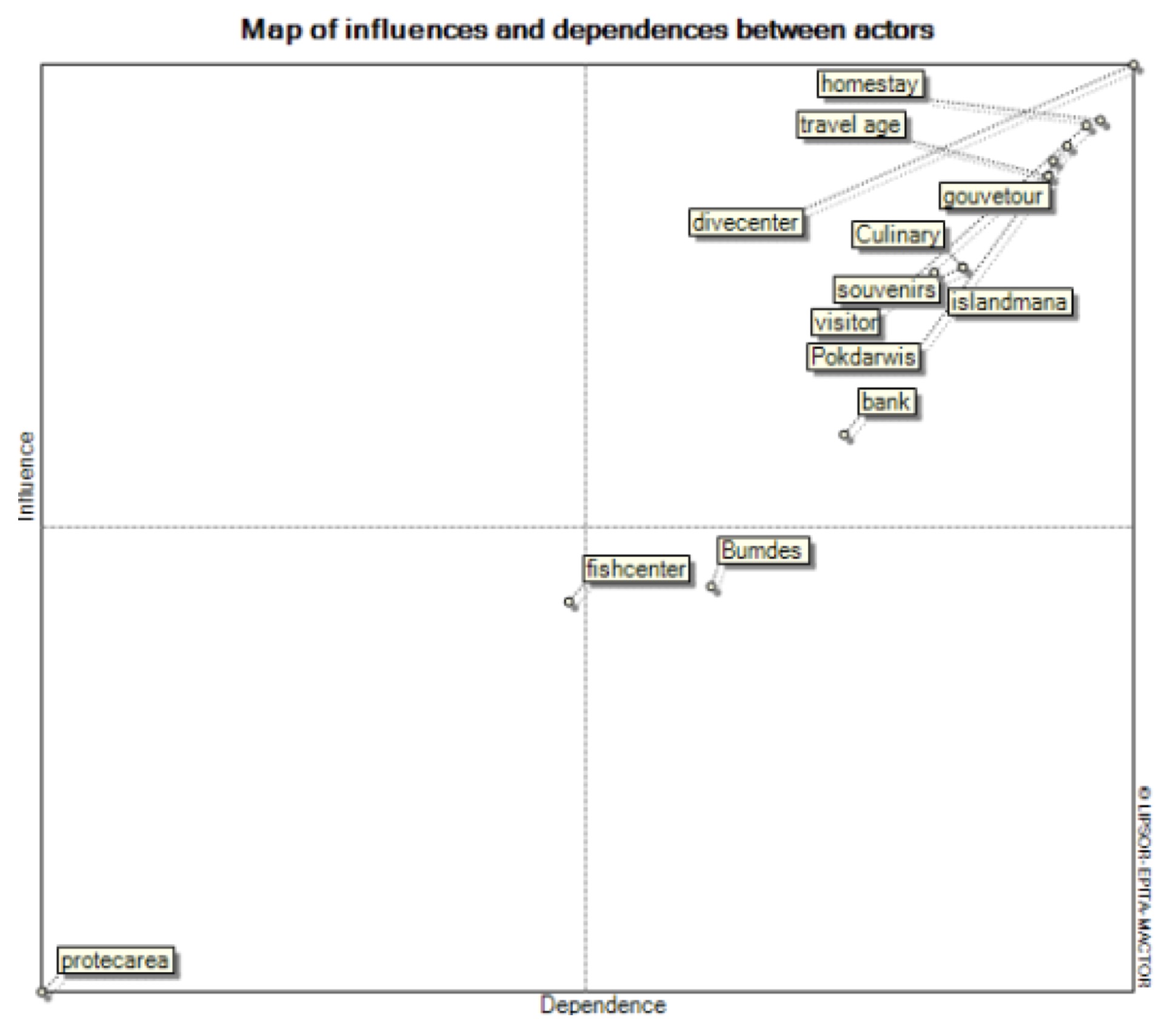
According to Figure 1, tourism managers are significantly influenced by and dependent on the balance between tourism development and ecosystem sustainability. However, in practice, tourism businesses often fail to implement sustainable tourism development practices. Conversely, ecosystem management actors exhibit relatively weak dependence and influence. As illustrated in Figure 1, stakeholders with high levels of influence and dependence include: culinary entrepreneur, fashion and souvenir vendor, accommodation provider (homestay), visitor, travel agent, dive center, community-based tourism group (Pokdarwis), bank, island tourism management.
These findings highlight the complex relationships between stakeholders and the need for more effective collaboration and sustainable practices in tourism development. It is essential to foster a more balanced relationship between tourism-related businesses—such as homestays, travel agencies, dive centers, culinary establishments, and souvenir shops—and institutions responsible for protected area management, island governance, and fisheries centers. For tourism development to be truly sustainable, businesses must recognize that small islands possess limited ecological carrying capacity, making them unsuitable for mass tourism, as exemplified by the situation in Gili Matra. Accordingly, tourism operators must comply with the regulations established by relevant environmental and resource management authorities. This alignment is crucial to ensuring that tourism activities do not compromise the long-term ecological and social sustainability of small island regions.
Alternative framework and policy implications
Inclusive island studies, as well as governance frameworks, must acknowledge the ontological distinctiveness of islands—recognizing the paradoxes they embody and the ways these differences can serve as lenses for reinterpreting development challenges (Foley et al. 2023). Such an approach counters the prevalent mainland-centric paradigm, which often applies generalized development logic to island contexts without accounting for their spatial, ecological, and cultural constraints. Both theoretical frameworks and empirical observations indicate that conventional approaches to tourism development, particularly those focused on economic growth—exhibit significant limitations when applied to island regions.
Firstly, these approaches tend to be highly homogenized. They often rely on the replication of mainland development models, such as the establishment of growth centers, without adequately accounting for the distinct ecological, social, and cultural characteristics of small islands. This lack of contextual sensitivity undermines the long-term viability of tourism initiatives. In contrast, integrating social and cultural capacities into regional planning enhances the likelihood of achieving sustainable development. Each community and region possess unique network structures that shape local dynamics (Borgatti & Foster 2003). In island communities in particular, social networks play a central role in shaping development outcomes (Paldam, 2000; Lee et al., 2005). Ignoring these deeply rooted networks in the development process not only overlooks critical assets but also risks implementing initiatives that are misaligned with the local way of life and thus unsustainable.
Local governments are encouraged to incorporate local knowledge into regional planning processes through community mapping and the establishment of co-management structures. A key entry point is integrating community mapping into tourism development planning—specifically by identifying tourism assets, involving local communities in setting priorities, and ensuring their participation throughout the planning, implementation, and evaluation phases. However, in several study areas, limited community involvement has led to significant issues. In Karimunjawa, the absence of inclusive planning contributed to overtourism and local resistance. In the Seribu Islands, conflicting priorities between tourism and fisheries development emerged, while in Gili Matra, the dominance of foreign investment has sidelined local voices and eroded community benefits.
Lessons can be drawn from the successful example of Ban Laem in Nakhon Si Thammarat, Thailand—an award-winning model of Community-Based Tourism (CBT) (Suriyankietkaew, Krittayaruangroj, Thinthan & Lumlongrut 2025). The success of Ban Laem’s tourism development lies in several critical factors: collaborative governance that engages all stakeholders, adaptive innovation tailored to local conditions, capacity-building initiatives that strengthen community leadership, and participatory management that places communities at the center of decision-making. These principles offer a practical framework for enhancing the inclusivity and sustainability of tourism development on Indonesia’s small islands.
Moreover, the current application of “sustainable tourism” remains far from inclusive (especially in Gili Matra). It rarely incorporates meaningful participation from local stakeholders or reflects the lived experiences of island residents. True sustainability in island tourism requires a shift from tokenism to transformative approaches—those that are grounded in local context, driven by community agency, and responsive to the interconnected dynamics of island ecosystems and societies.
Equally important is the integration of local knowledge into regional planning processes. Indigenous island communities possess deep-rooted understandings of marine dynamics, seasonal patterns, and areas of ecological and spiritual significance. Incorporating this knowledge into policymaking enhances the relevance, precision, and sustainability of regulations. By embedding community insights into planning frameworks, island populations are empowered to actively participate in tourism development that upholds environmental stewardship (Dodds & Graci 2012). Moreover, the presence of island communities is crucial in safeguarding development amid increasingly blurred environmental and jurisdictional boundaries (Putri & Salim 2020). Their participation ensures that island development remains culturally respectful, ecologically balanced, and socially inclusive.
Second, there is a critical neglect of the ecological dimension and the carrying capacity of small islands. These areas are inherently vulnerable to environmental pressures due to their limited spatial resources and low ecological thresholds—particularly in terms of freshwater availability, land area, and fragile coastal ecosystems. Community responses (Karimun Jawa, Gili Matra, and Seribu Island) such as the rejection of external assistance, protests against infrastructure projects, and growing dissatisfaction with the uncontrolled influx of tourists serve as clear indicators that the island environment is facing significant degradation. While tourism is often portrayed as an environmentally friendly sector—based on its reliance on natural beauty and ecological preservation as key attractions—the reality is more complex.
Tourism development in the study areas—Karimunjawa, Gili Matra, Natuna, and the Seribu Islands—must be guided by comprehensive carrying capacity audits. These audits should extend beyond assessments of environmental degradation and visitor satisfaction to also incorporate socio-cultural dimensions that impact local communities. Drawing insights from Taiwan's approach to tourism planning, where the government has developed practical guidelines for preserving and managing ecologically sensitive destinations (Chen 2025).
It is imperative that both central and local governments in Indonesia adopt similar measures. These guidelines should clearly define limits on infrastructure development, such as the number of hotels and homestays, as well as visitor caps, to prevent environmental degradation and maintain the quality of life for local residents. Although environmental carrying capacity studies have been conducted in several of these locations—including the Seribu Islands, Karimunjawa, and Gili Matra—these findings have yet to be integrated into actual tourism planning or regulatory frameworks. To ensure sustainable development, it is essential that such research be institutionalized and used as a critical reference in shaping tourism policies and investment decisions on small islands.
In practice, tourism development frequently imposes substantial burdens on the environment, including increased waste generation and higher demands for water and electricity. Environmental Impact Assessments (EIAs) are typically conducted only at the initial stages of tourism infrastructure development. However, there is a notable absence of ongoing environmental audits to monitor and manage the cumulative impacts, particularly in relation to the island’s limited carrying capacity. This oversight significantly undermines efforts toward sustainable tourism and ecological resilience.
In addition to incorporating carrying capacity assessments, tourism development on small islands must adopt participatory zoning approaches. This is particularly critical in areas where community livelihoods—such as seaweed farming—often conflict with expanding tourism interests, as observed in the Seribu Islands and other research locations. Implementing participatory zoning can significantly reduce the potential for conflict between tourism development and traditional economic activities like fisheries. By actively involving local communities, stakeholders, and relevant authorities in the zoning process, planners can ensure that diverse interests are represented and respected. Moreover, participatory zoning helps establish a more equitable and sustainable balance among tourism, fisheries, and conservation priorities. It reinforces local ownership of development outcomes, enhances policy legitimacy, and supports long-term socio-ecological resilience within small island communities.
Drawing from the experience of marine protected area (MPA) zoning development in Portugal, a key lesson lies in the use of a collaborative and participatory zoning approach (Horta e Costa et al. 2022a). The initial zoning design incorporated ecological, socioeconomic, and spatial considerations, ensuring a holistic foundation for sustainable management. Importantly, the zoning proposal underwent thorough review by relevant stakeholders, including representatives from local communities. This inclusive process not only enhanced the legitimacy and transparency of the zoning but also fostered a sense of shared ownership and responsibility among all involved parties.
Utilizing a framework grounded in ecological boundaries and local knowledge, ecological and social sensitivity must serve as the foundational principles for regulatory development on small islands. These principles should be translated into zoning regulations that are collectively upheld and respected by all stakeholders. Zoning must not be dictated by investor interests or external pressures but should reflect the intrinsic value of small islands as vital assets within an archipelagic state. Highly vulnerable areas must be designated as conservation zones with strict usage monitoring, while regions with significant biodiversity should be protected from large-scale tourism development. This zoning approach ensures that the ecological integrity of the islands is maintained for future generations.
To achieve cohesive and sustainable island development, the Ministry must effectively integrate marine and coastal spatial plans with tourism development strategies. This includes reconciling ecological protection mandates with tourism infrastructure needs, ensuring that development complies with spatial regulations while respecting the ecological and socio-cultural limitations of small islands. Clear coordination mechanisms and inter-ministerial collaboration are essential to prevent regulatory fragmentation and to ensure that all policies contribute to the overarching goals of environmental sustainability, community welfare, and responsible tourism.
Another critical consideration is the integration of tourism regulations with small island management regulations. This responsibility primarily falls under the purview of the Ministry of Agrarian Affairs and Spatial Planning (ATR/BPN), the central authority responsible for spatial planning across Indonesia. While tourism-related policies are issued by the Ministry of Tourism and Creative Economy, small island management regulations fall under the jurisdiction of the Ministry of Marine Affairs and Fisheries, as well as provincial governments. As a result, the Ministry of Agrarian Affairs and Spatial Planning serves a pivotal role in harmonizing and aligning these often overlapping or conflicting regulatory frameworks.
Third, adopting a sectoral approach to small island development can have detrimental consequences. Relying heavily on a single economic sector—particularly tourism—significantly increases the vulnerability of island communities. This was clearly demonstrated during the COVID-19 pandemic, when the collapse of tourism severely impacted local livelihoods. Similarly, the escalating effects of climate change further underscore the risks of overdependence on tourism as the sole driver of economic growth. Effective tourism control entails regulating development based on international, national, and regional tourism demands. These three governing levels must demonstrate a collective commitment to managing tourism as a strategic means of preserving small island ecosystems, rather than simply capitalizing on economic gains.
Evaluating development success solely based on tourist arrivals, regional income, or investment inflows tends to obscure the broader and more critical objective: the long-term sustainability of small islands. What must be prioritized is not just economic growth, but the adaptive capacity of island communities. This includes their ability to respond to external shocks, shifting environmental conditions, and socio-economic disruptions. A community’s flexibility and resilience are central to the sustainability of island systems. Ensuring diverse, balanced, and context-sensitive development pathways is essential to safeguard the future of small island communities in an increasingly uncertain global landscape.
Rethinking island sustainability thus goes beyond enhancing tourism sector management. It requires fundamentally reimagining how development is approached in the context of small islands within an archipelagic state. This perspective prioritizes ecological resilience, cultural preservation, and long-term community well-being as core pillars of sustainable development.
4. Conclusions
Both theoretical frameworks and empirical evidence suggest that conventional approaches to tourism development remain dominant, with an excessive emphasis on economic growth. While such models may offer short-term gains, they present significant limitations when applied to island regions. These approaches are often overly homogenous, relying heavily on replicating development patterns from mainland areas—such as the establishment of growth centers—without accounting for the unique ecological, social, and cultural dynamics of small islands. This lack of contextual sensitivity results in development strategies that overlook the islands’ limited resources, fragile ecosystems, and deeply rooted community structures.
This study adopts a mixed-methods approach, integrating both qualitative and quantitative analyses to develop a comprehensive understanding of tourism development and its implications in small island settings. Case studies were conducted across various small islands in Indonesia, representing the broader context of an archipelagic state. These include the Natuna Islands (2018–2022), the Seribu Islands (2018–2022), the Karimunjawa Islands (2018–2022), and the Gili Matra Islands (2014 and 2022).
Findings indicate that the regulatory frameworks governing tourism across the studied islands remain insufficient and poorly integrated. For instance, Natuna lacks specific regional regulations focused on tourism, reflecting a broader absence of strategic planning in this sector. Meanwhile, the Seribu Islands and Gili Matra, although more advanced in terms of tourism infrastructure, suffer from inadequate governmental oversight. In particular, Gili Matra's tourism industry—marked by significant foreign investment—functions with minimal local regulatory control, raising serious concerns about governance, equity, and long-term sustainability.
These shortcomings are exacerbated by the strong intrapersonal relationships and high levels of social cohesion typical of small island communities. With relatively small populations and well-structured communication networks, these communities are tightly knit, fostering a collective awareness and resistance to development initiatives that are perceived as incompatible with local values and environmental conditions. In Natuna, for example, this resistance has materialized in the rejection of programs deemed unsuitable for local needs. Similar dynamics are becoming increasingly evident in the Seribu Islands and Gili Matra, where residents are voicing growing dissatisfaction with the inequitable distribution of access and benefits from both government-led projects and investor-driven development efforts.
Stakeholder analysis highlights a power imbalance: while tourism operators (e.g., homestays, dive centers, and local tourism associations) play a dominant role in development, they frequently fall short in implementing sustainable practices. Conversely, actors focused on ecosystem management—such as marine protected area managers—tend to have limited influence and institutional support.
Local governments are increasingly expected to incorporate local knowledge into regional planning processes through mechanisms such as community mapping and the establishment of co-management structures. However, in several of the study areas, a lack of meaningful community participation has led to various challenges. In Karimunjawa, for instance, the absence of inclusive planning has fueled local resistance to overtourism. In the Seribu Islands, tourism development has come into conflict with traditional fisheries, creating tensions over resource allocation. Meanwhile, in Gili Matra, the dominance of foreign investment has marginalized local voices, resulting in limited and uneven benefits from tourism for the broader community. Valuable lessons can be drawn from the case of Ban Laem in Nakhon Si Thammarat, Thailand—an award-winning model of Community-Based Tourism (CBT) (Suriyankietkaew et al. 2025). Ban Laem’s success is rooted in several key principles: collaborative governance that includes all stakeholders; adaptive innovation tailored to local socio-ecological conditions; sustained capacity-building programs to strengthen community leadership; and participatory management practices that place communities at the heart of decision-making.
Tourism development in the study areas—Karimunjawa, Gili Matra, Natuna, and the Seribu Islands—must be guided by a comprehensive carrying capacity audit. Such an audit should extend beyond assessments of environmental degradation to also include indicators of visitor satisfaction and the socio-cultural impacts on local communities. Addressing these multidimensional aspects is essential to ensure that tourism growth does not compromise the ecological integrity or cultural fabric of these small islands. A model worth emulating is Taiwan’s approach to tourism planning, where the government has established practical, enforceable guidelines for the preservation and management of ecologically sensitive destinations (Chen 2025).
Tourism development on small islands must also incorporate a participatory zoning approach to ensure long-term sustainability and minimize conflict with traditional livelihoods, such as fishing. This method emphasizes the active involvement of local communities, stakeholders, and relevant authorities in the zoning process. A valuable example can be drawn from Portugal’s development of Marine Protected Area (MPA) zoning, which successfully applied a collaborative and participatory zoning framework (Horta e Costa et al. 2022b). This model integrated ecological, socioeconomic, and spatial considerations while encouraging inclusive dialogue among diverse interest groups.
Another critical consideration is the integration of tourism regulations with policies governing the management of small islands. This task primarily falls under the purview of the Ministry of Agrarian Affairs and Spatial Planning (ATR/BPN), which holds central authority over spatial planning across Indonesia. Tourism-related regulations are issued by the Ministry of Tourism and Creative Economy, while the management of small islands is regulated by the Ministry of Maritime Affairs and Fisheries in coordination with provincial governments. Given the potential for overlap and conflict between these regulatory domains, the Ministry of Agrarian Affairs and Spatial Planning plays a pivotal role in harmonizing and aligning these frameworks.
Further research opportunities lie in exploring effective strategies for implementing community mapping and establishing co-management structures in the context of tourism development on small islands. Such approaches should emphasize active community participation in land-use zoning processes and environmental carrying capacity audits. This includes identifying locally valued areas, integrating traditional ecological knowledge, and ensuring that local stakeholders are involved not only in planning but also in decision-making, implementation, and ongoing monitoring.
Acknowledgments
We gratefully acknowledge the generous support provided by the Center for Maritime and Fisheries Socio-Economic Research, which funded this research. Their financial assistance was instrumental in facilitating the successful completion of this study.We acknowledge with appreciation the Central Statistics Agency for furnishing the data that supported this research.
Declaration of competing/conflicting interests
The authors declare that there are no competing interests associated with the conduct of this research. This study has been conducted in accordance with international ethical and legal standards for research, upholding the principles of confidentiality and respect for human participants' rights, including their right to privacy.
Artificial Intelligence (AI) Usage Declaration
This manuscript utilised artificial intelligence tools to enhance the English language structure.
References
- Baldacchino, G. 2008. Studying Islands: On Whose Terms? Some Epistemological and Methodological Challenges to the Pursuit of Island Studies. Island Studies Journal. 3(1). https://doi.org/10.24043/001c.81189.
- Baldacchino, G. 2024. Editorial: The archipelagic turn in island tourism, in: Archipelago Tourism Revisited. London: Routledge. 2–23. https://doi.org/10.4324/9781003451037-1.
- Boluk, KA, Cavaliere, CT & Higgins-Desbiolles, F. 2019. A critical framework for interrogating the United Nations Sustainable Development Goals 2030 Agenda in tourism. Journal of Sustainable Tourism. 27(7):847–864. https://doi.org/10.1080/09669582.2019.1619748.
- Borgatti, SP & Foster, PC. 2003. The Network Paradigm in Organizational Research: A Review and Typology. Journal of Management. 29(6):991–1013. https://doi.org/10.1016/S0149-2063_03_00087-4.
- Burke, NJ, Joseph, G, Pasick, RJ & Barker, JC. 2009. Theorizing Social Context: Rethinking Behavioral Theory. Health Education & Behavior. 36(5_suppl):55S-70S. https://doi.org/10.1177/1090198109335338.
- Casini, L, Boncinelli, F, Gerini, F, Romano, C, Scozzafava, G & Contini, C. 2021. Evaluating rural viability and well-being: Evidence from marginal areas in Tuscany. Journal of Rural Studies. 82:64–75. https://doi.org/10.1016/j.jrurstud.2021.01.002.
- Chen, H-S. 2025. Sustainable tourism and ecological challenges in Taiwan’s southwest coast national scenic area: An ecological footprint and carrying capacity assessment. Environmental and Sustainability Indicators. 27:100863. https://doi.org/10.1016/j.indic.2025.100863.
- Christiaanse, S. 2020. Rural facility decline: A longitudinal accessibility analysis questioning the focus of Dutch depopulation-policy. Applied Geography. 121:102251. https://doi.org/10.1016/j.apgeog.2020.102251.
- Cohen, R & Kennedy, P. 2000. Global sociology. Houndsmills, Basingstoke, UK: Macmillan Press.
- Conkling, P. 2007. On Islanders and Islandness. Geographical Review. 97(2):191–201. https://doi.org/10.1111/j.1931-0846.2007.tb00398.x.
- Creswell, JW & Poth, CN. 2017. Qualitative inquiry and research design: Choosing among five approaches. Sage publications.
- Dahl, A. 1998. Island Directory: Basic environmental and geographic information on the significant islands of the world. United Nations Environment Programme (UNEP).
- Dahuri, R. 1998. Pendekatan Ekonomi-Ekologis Pembangunan Pulau-Pulau Kecil Berkelanjutan. In: Prosiding Seminar dan Lokakarya Pengelolaan Pulau-Pulau Kecil di Indonesia. Departemen Dalam Negeri, Direktorat Pengelolaan Sumberdaya Lahan dan Kawasan – TPSA – BPPT - Coastal Resources Management Project (CRMP) USAID.
- Dodds, R & Graci, S. 2012. Sustainable Tourism in Island Destinations. Routledge. https://doi.org/10.4324/9781849776660.
- Feghali, K, Najem, R & Metcalfe, BD. 2025. Greenwashing in the era of sustainability: A systematic literature review. Corporate Governance and Sustainability Review. 9(1):18–31. https://doi.org/10.22495/cgsrv9i1p2.
- Foley, A, Brinklow, L, Corbett, J, Kelman, I, Klöck, C, Moncada, S, Mycoo, M, Nunn, P, et al. 2023. Understanding “Islandness”. Annals of the American Association of Geographers. 113(8):1800–1817. https://doi.org/10.1080/24694452.2023.2193249.
- Genç, K, Türkay, O & Ulema, Ş. 2022. Tourısm gentrıfıcatıon: Barcelona and Venıce. Turismo y Sociedad. 31:125–140. https://doi.org/10.18601/01207555.n31.06.
- Hay, P. 2013. What the Sea Portends: A Reconsideration of Contested Island Tropes. Island Studies Journal. 8(2):209–232. https://doi.org/10.24043/isj.283.
- Hicks, CC, Cohen, PJ, Graham, NAJ, Nash, KL, Allison, EH, D’Lima, C, Mills, DJ, Roscher, M, et al. 2019. Harnessing global fisheries to tackle micronutrient deficiencies. Nature. 574(7776):95–98. https://doi.org/10.1038/s41586-019-1592-6.
- Higgins-Desbiolles, F. 2018. Sustainable tourism: Sustaining tourism or something more? Tourism Management Perspectives. 25:157–160. https://doi.org/10.1016/j.tmp.2017.11.017.
- Horta e Costa, B, Guimarães, MH, Rangel, M, Ressurreição, A, Monteiro, P, Oliveira, F, Bentes, L, Sales Henriques, N, et al. 2022a. Co-design of a marine protected area zoning and the lessons learned from it. Frontiers in Marine Science. 9. https://doi.org/10.3389/fmars.2022.969234.
- Horta e Costa, B, Guimarães, MH, Rangel, M, Ressurreição, A, Monteiro, P, Oliveira, F, Bentes, L, Sales Henriques, N, et al. 2022b. Co-design of a marine protected area zoning and the lessons learned from it. Frontiers in Marine Science. 9. https://doi.org/10.3389/fmars.2022.969234.
- Jędrusik, M. 2011. Island Studies. Island Geography. but What is an Island? Miscellanea Geographica. 15(1):201–212. https://doi.org/10.2478/v10288-012-0012-7.
- Kakazu, H. 2011. Challenges and opportunities for Japan’s Remote Islands. Eurasia Border Review .
- Kementrian Pariwisata. 2024. Laporan akuntabilitas kinerja Kementerian Pariwisata Tahun 2024. Jakarta.
- Lattas, A. 2007. Cargo Cults and the Politics of Alterity: A Review Article. Anthropological Forum. 17(2):149–161. https://doi.org/10.1080/00664670701438407.
- Lerpold, L & Sjöberg, Ö. 2021. Tourism as (Un)sustainable Production and Consumption. In: Sustainable Consumption and Production, Volume II. Cham: Springer International Publishing. 149–170. https://doi.org/10.1007/978-3-030-55285-5_8.
- Lune, H & Berg, BL. n.d. Qualitative research methods for the social sciences. Pearson.
- Ma, X & Wu, W. 2020. Deficiencies in China’s Island Development Processes Compared with Other Countries. Emerging Markets Finance and Trade. 56(13):2963–2976. https://doi.org/10.1080/1540496X.2019.1644498.
- Mafruhah, I, Supriyono, S, Mulyani, NS & Istiqomah, N. 2020. Causality Between Tourism Industry Development and the Ecological Sustainability in Marine Environment: A Convergence and Divergence Among Stakeholder With Mactor Analysis. International Journal of Energy Economics and Policy. 10(4):85–92. https://doi.org/10.32479/ijeep.7989.
- Matsumura, Y & Miyoshi, E. 2018. Forces in the development of remote islands in Japan : A case study of local energy enterprises in Tsushima Island. Osaka Human Sciences. 4(1):61–83.
- McAreavey, R & McDonagh, J. 2011. Sustainable Rural Tourism: Lessons for Rural Development. Sociologia Ruralis. 51(2):175–194. https://doi.org/10.1111/j.1467-9523.2010.00529.x.
- McCall, G. 1994. Nissology. Journal of the Pacific Society . 17(2):1–14.
- McElroy, JL. 2003. Tourism development in small islands across the world. Geografiska Annaler. 85(4):231–242.
- Mira & Yusuf, R. 2019. Keunggulan sub sektor perikanan dan pariwisata bahari di Belitung. Jurnal Sosial Ekonomi Kelautan dan Perikanan. 14(1):13–22.
- Mira, Marrou, L & Muawanah, U. 2019. Sustainable tourism development in Kepulauan Seribu. In: IOP Conference Series: Earth and Environmental Science. V. 399. Institute of Physics Publishing. https://doi.org/10.1088/1755-1315/399/1/012114.
- O’Campo, P, Salmon, C & Burke, J. 2009. Neighbourhoods and mental well-being: What are the pathways? Health & Place. 15(1):56–68. https://doi.org/10.1016/j.healthplace.2008.02.004.
- Panzer-Krause, S. 2020. The lost rural idyll? Tourists’ attitudes towards sustainability and their influence on the production of rural space at a rural tourism hotspot in Northern Ireland. Journal of Rural Studies. 80:235–243. https://doi.org/10.1016/j.jrurstud.2020.09.013.
- Phillipson, J & Williams, R. 2005. Review of the North East fisheries regeneration initiative. Newcastle University. Centre for Rural Economy Research Report. https://eprint.ncl.ac.uk/55841
- Pattanayak, KP & Padhy, C. 2020. Green washing and its impacts on consumers and businesses — A review. Indian Journal of Natural Sciences. 10(62):27954–27958.
- Perroux, F. 1955. Note on the growth pole concept’ in Livingstone: Economic policy for development. London.
- Ploeg, JVD & Marsden, T. 2008. Unfolding webs: The dynamics of regional rural development.Royal van Gorcum. . Netherland: Royal Van Corgum.
- Postoiu, C & Busega, I. 2015. Inter-regional disparities in the european union. Romanian review of regional studies. Romanian review of regional studies. 11(1):3–14.
- Putri, H & Salim, W. 2020. The Maritime Silk Road’s potential effects on outer island development: The Natuna Islands, Indonesia. Island Studies Journal. 15(2):155–172. https://doi.org/10.24043/isj.136.
- Qodriyatun, SN. 2018. Implementasi Kebijakan Pengembangan Pariwisata Berkelanjutan di Karimunjawa. Aspirasi: Jurnal Masalah-Masalah Sosia. Aspirasi: Jurnal Masalah-Masalah Sosial. 9(2):171–184.
- Richardson, J. 1993. Ecotourism and nature-based holidays. Sydney: Simon and Schuster.
- Schmitt-Egner, P. 2002. The concept of ‘region’: theoretical and methodological notes on its reconstruction. European Integration. 24(3):179–200.
- Shucksmith, M & Rønningen, K. 2011. The Uplands after neoliberalism? – The role of the small farm in rural sustainability. Journal of Rural Studies. 27(3):275–287. https://doi.org/10.1016/j.jrurstud.2011.03.003.
- Spalding, M, Burke, L, Wood, SA, Ashpole, J, Hutchison, J & zu Ermgassen, P. 2017. Mapping the global value and distribution of coral reef tourism. Marine Policy. 82:104–113. https://doi.org/10.1016/j.marpol.2017.05.014.
- Stratford, E, Baldacchino, G, MacMahon, E, Farbotko, C & Harwood, A. 2011. Envisioning the archipelago. Island Studies Journal. 6(1):113–130. https://doi.org/10.24043/isj.253.
- Suriyankietkaew, S, Krittayaruangroj, K, Thinthan, S & Lumlongrut, S. 2025. Creative tourism as a driver for sustainable development: A model for advancing SDGs through community-based tourism and environmental stewardship. Environmental and Sustainability Indicators. 27:100828. https://doi.org/10.1016/j.indic.2025.100828.
- Thompson, N, Carrol, T & Atterton, J. 2007. Assessment of social capital on rum and the small isles.
- United Nations World Tourism Organization (UNWTO). 2018. ‘Overtourism’? Understanding and managing urban tourism growth beyond perceptions. UNWTO.
- United Nations World Tourism Organization (UNWTO). 2025. International tourist arrivals recover pre-pandemic levels in 2024. World Tourism Organization.