
The Fuganutu Tradition Connecting Remote Islands: An oral history of 15th century drifters from Jeju to Yonaguni
 10.21463/jmic.2026.15.1.05
Abstract
This article presents an examination of oral traditions concerning drifters that have been transmitted on Yonaguni Island, which marks Japan’s southwestern-most point. This oral history, recorded in Dunan munui—one of the endangered languages designated by the United Nations Educational, Social and Cultural Organization (UNESCO)—comprises a text of 80,000 characters written in katakana. The text chronicles interactions and friendships with three men belonging to a group known as the Fuganutu (people from elsewhere). These individuals arrived from a region that did not correspond to Japan, mainland China, Taiwan, Lan-yu, or the West. This period preceded the incorporation of Yonaguni Island under the Ryukyu Kingdom’s domain. Collaborative research with the last woman who memorized this heritage revealed detailed correspondences with accounts in the 1479 The Veritable Records of the Joseon Dynasty concerning a drift from Jeju Island to Yonaguni and the survivors’ six-month stay there. After creating a 4,000-word vocabulary list, recording the narrative to build a corpus, and translating it into Japanese, we proceeded with the visualization of key scenes. A picture book authored by the narrator-drawer was published in March 2025, four months prior to her demise. This oral history included numerous life-wisdom teachings passed down through Fuganutu. These encompassed new food sources and fiber materials, cooking methods, drying preservation techniques, and forecasting weather and tidal patterns. Cultural exchange with drifters from Jeju Island significantly influenced environmental governance on Yonaguni Island. The author wished for us to help preserve the memory of an era when the island lived autonomously under female leadership and traded peacefully with places like Taiwan, ensuring that no one suffered from hunger and neglect.
Keywords
Yonaguni Island, Jeju Island, oral history, the Veritable Records of Joseon Dynasty, visualization
1. Introduction
1.1 Yonaguni, a border island of Japan
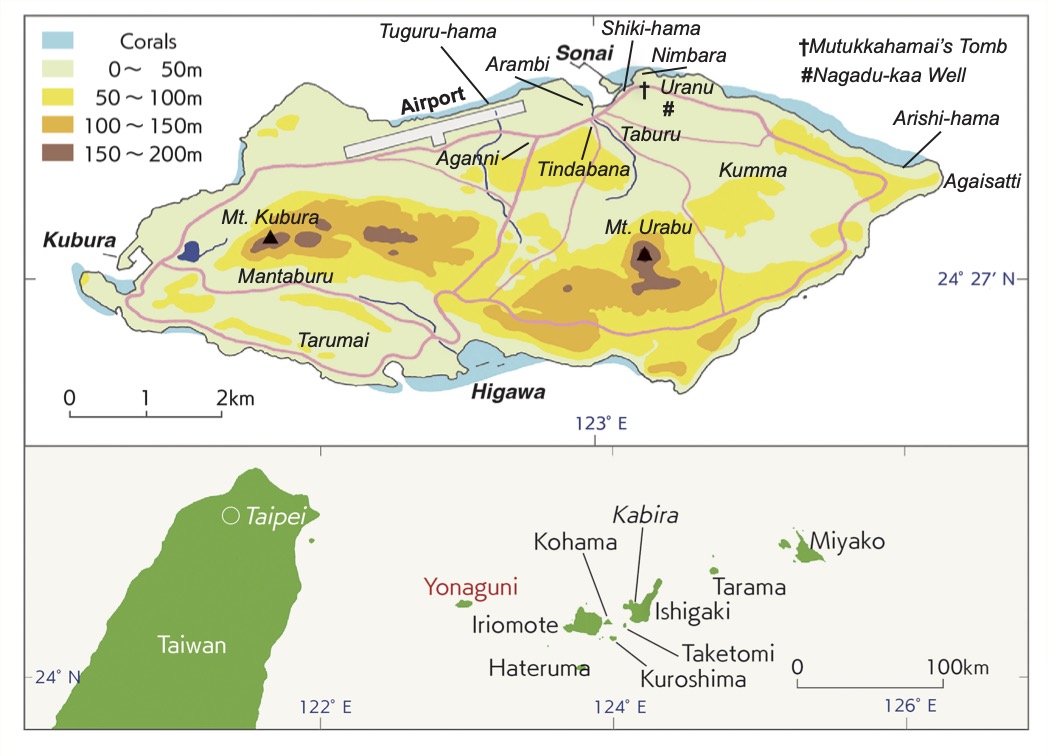
Yonaguni Island is located 111 kilometers east of Taiwan (Fig. 1). From the 16th to the late 19th century, the area was incorporated into the Yaeyama Islands, which were part of the Ryukyu Kingdom. Following Taiwan’s incorporation into Japanese territory in 1895, Yonaguni came under the domain of Taiwan’s economic zone. From 1945 to 1972, it was under the control of the United States. It is now recognized as Japan’s westernmost border island. As of September 2025, the population was 1,660, with approximately 20% comprising Self-Defense Forces personnel and their families (Yonaguni Town webpage).
1.2 Study methods: Narrator-led oral history through remote collaboration.
Since 1974, our research has focused on the history of human-nature interactions, with a particular emphasis on Iriomote Island, which is located approximately 70 kilometers east of Yonaguni Island (see Fig. 1). For a comparative study with Iriomote, a visit was made to Yonaguni Island in late December of 1989, with an approximately one-week stay continuing until the beginning of the following year. It was in this setting that we had the opportunity to meet Ms. Wakaranko[1] (1954–2025. Fig. 2).
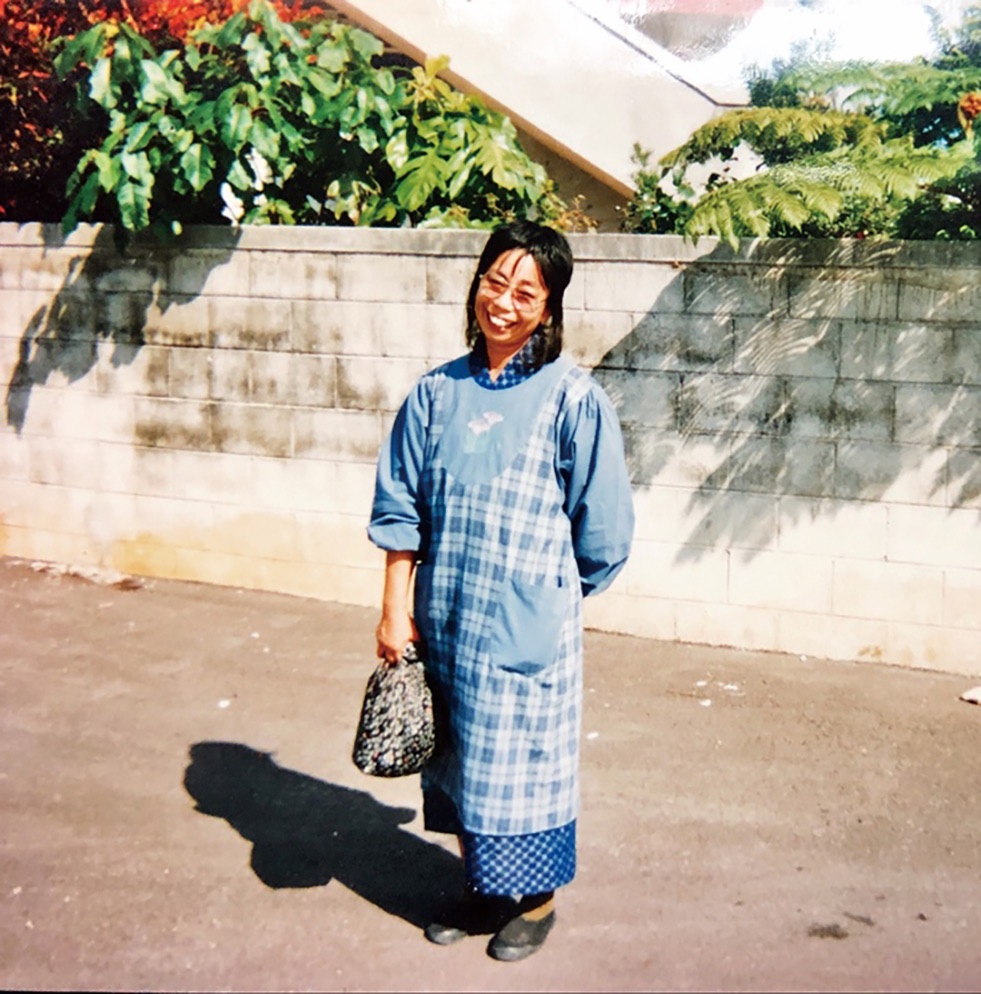
Wakaranko was an artist of weaving and dyeing, and a self-taught folklorist. By 1989, she had created 4,000 vocabulary cards in Dunan munui, or the Yonaguni language, designated by UNESCO (2010) as ‘severely endangered’. Since that time, she has continued to provide us with her memories of the island’s oral history. This included voluminous, unorganized resources: stacks of paper exceeding 160 centimeters in thickness, hundreds of hours of recordings, and approximately 1,000 drawings.[2] This extensive collection includes the tradition of the drifters from an island presumed to be Jeju in 1477, of which the outline was first reported by Ankei and Ankei (2011a, 2011b), and had not been previously documented.
In 2021, we published a database online that shows the Yonaguni Island’s biocultural diversity as memorized by Wakaranko. Then, we published her autobiographical picture-text collection (Wakaranko, 2023), which reflects the cosmology of the island. We published her second collection of pictures and texts about the Jeju Island drifters’ tradition (Wakaranko, 2025). A process of patient co-creation was needed to compile her memories as if they were the ‘pieces of eternally unfinished jigsaw puzzles’ as she stated them (Ankei and Ankei, 2023). For her books, we encouraged her to draw her memories and the portraits of the narrators of oral histories to make her stories convincing.
2. A 15th-Century account of drifters from Jeju Island to Yonaguni Island found in the Veritable Records of the Joseon Dynasty
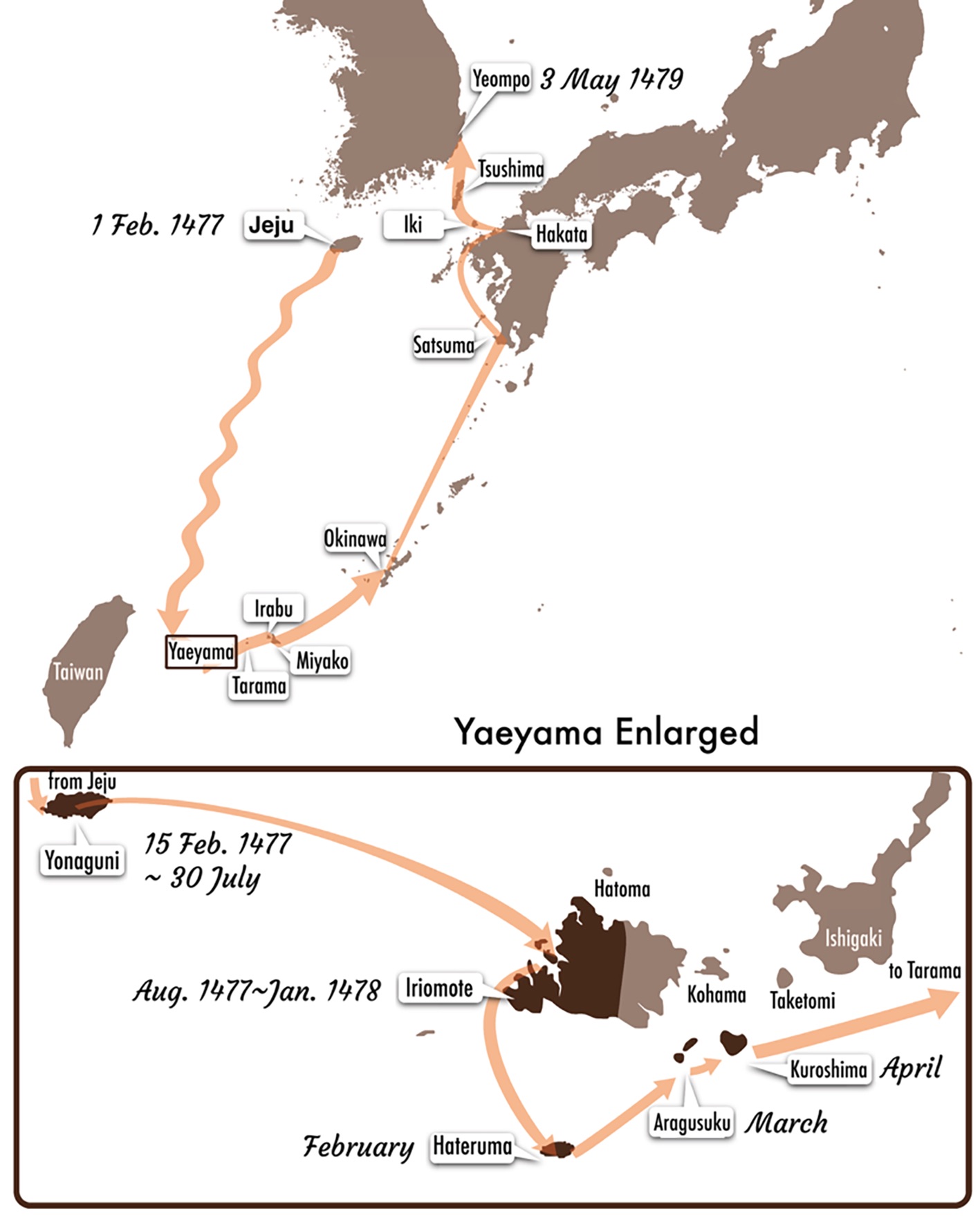
The earliest and most reliable historical source for our studies in the Yaeyama Islands was the Veritable Records of the Joseon Dynasty. They contain an account based on interviews with drifters’ narratives on their journey. In February 1477, a ship from Jeju Island drifted for two weeks and arrived at Yonaguni Island in southern Ryukyu, today’s Okinawa. Three men were rescued and, after being escorted across the islands for two years and three months, finally returned to their homeland. In Japan, the contents of this account of their drifting voyage were first introduced through an article published in 1927 by Fuyū Iha (伊波普猷, 1876–1947), known as the ‘Father of Okinawa Studies.’ The islands they visited were identified as belonging to the present-day Yaeyama and Miyako archipelagos, beginning with Yonaguni Island. Figure 3 depicts the itinerary of the three drifters from Jeju Island.
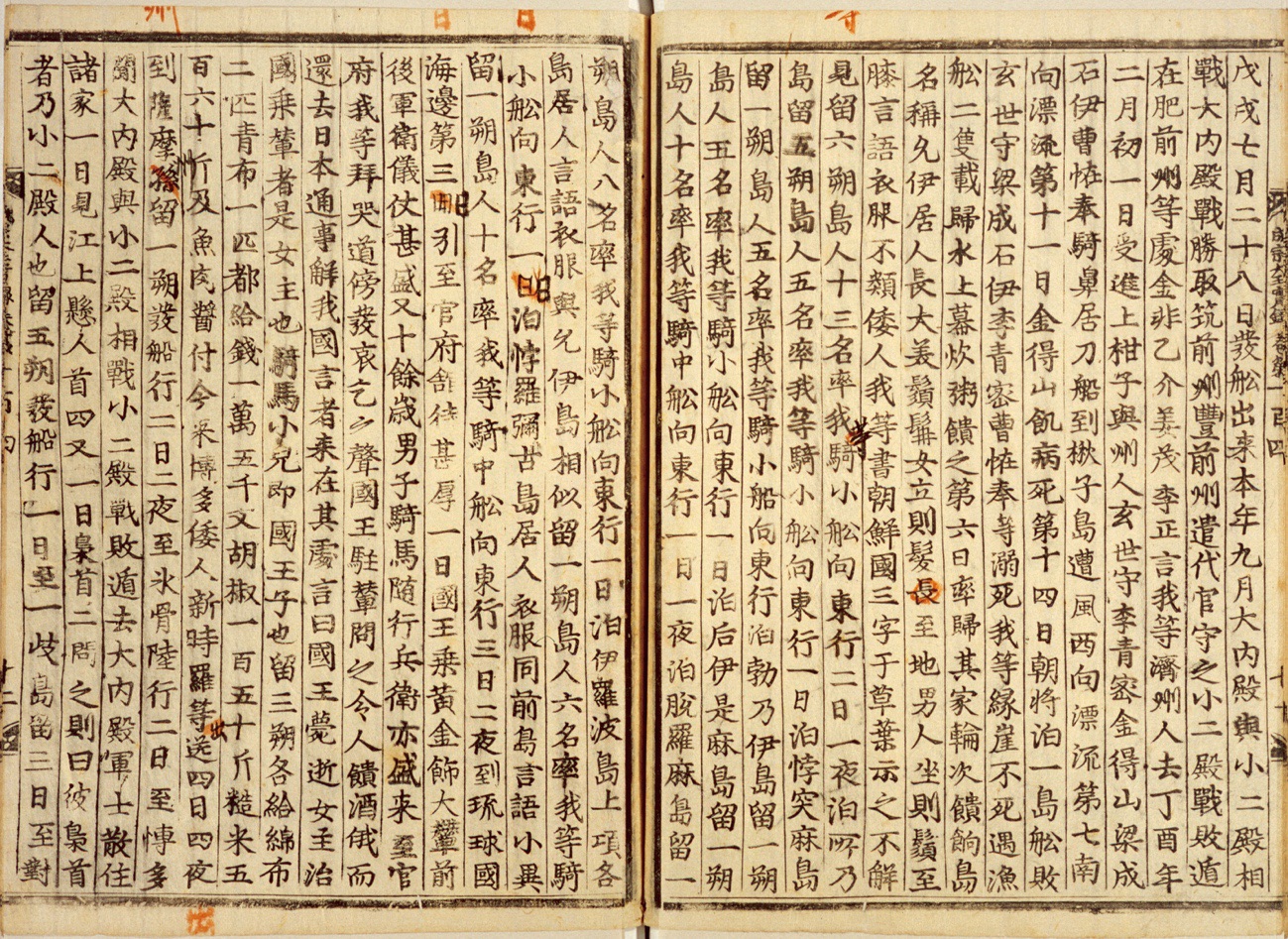
The Veritable Records of the Joseon Dynasty is a chronological record compiled by the state (1392–1910). It contains many descriptions on the drifters to and from the Ryukyu Kingdom. It is inscribed on UNESCO’s ‘Memory of the World’ Register.[3]
Ikeya et al. (2005) published a compilation of the Ryukyu-related entries from the Veritable Records, with detailed annotations. The record of the 1477 Jeju Island drifters discussed here is exceptionally detailed. Consequently, it serves as the oldest and most reliable record of daily life for our research on the history of the relationship between people and nature in the Yaeyama region, a project we began in 1974.
The three drifters from Jeju repatriated in Korea on May 3, 1479. The first record of their interrogation appears in the King Seongjong(成宗)’s Volume 104 of the Veritable Records of the Joseon Dynasty, dated May 16, 1479. It first covered the news they brought: the Shōni (少弐) clan, which had ruled Northern Kyushu, had been defeated in battle by the Ōuchi (大内) clan. It only briefly mentioned the islands through which they had been transported. Next month the king ordered his Records Office (弘文館), to compile a detailed record of their narratives. Consequently, a second interview record was created on June 10 collected in the King Seongjong’s Volume 105. The latter record is more than six times longer than the former. Furthermore, the Chinese characters used to transcribe local place names differ almost entirely between the two. Even the name of one of the three men was recorded differently, as will be described later. The following are the excerpts from the two versions with our translation in English.
2.1. An excerpt from the King Seongjong’s Vol. 104 (May 16, 1479)
Kim Bi-eul-gae (金非乙介), Kan Mo (姜茂) and Li Jeong (李正), returned from the Ryukyu Islands. They were shipwrecked during their journey from Jeju Island that started on the Feb. 1st, 1477. They had five companions. One died from hunger on the eleventh day and the others drowned on the fourteenth day on arrival at an island. We clung to the cliff, rescued by two fishing boat and fed with porridge. The islanders did not understand the letters of 朝鮮國 (Joseon Country). After a six-month stay, thirteen islanders took them to Sone Island in the east. [To be continued with descriptions of other islands.] The record is concluded by the King’s decree to the Governor of Jeju Island: Regarding the three survivors, whose boat was wrecked while transporting mandarin oranges as tribute, inform their families of their return; as for the families of the five who drowned, offer official condolences and provide for their funerals (Fig. 4).
2.2. An excerpt from the King Seongjong’s Vol. 105 (June 10, 1479)
The king ordered his Records Office to compile a written account of the extraordinary oral testimony of the three drifters from Jeju Island to the Ryukyus: Kim Bi-ui (金非衣) , Kan Mo (姜茂) and Li Jeong (李正).
On February 1, 1477, we set sail with a cargo of mandarin oranges to offer to the king, but we encountered strong winds. We drifted westward, and the sea became murky [because of the Yellow River] on the seventh and eighth days. Then, we drifted south, and the sea became clear and blue. On the fourteenth day, we saw a small island. Before we could reach the shore, our boat broke apart, and five crews drowned. We were rescued by two fishing boats with four men on each of it.
The island’s name was Yun-i Shima. In local language they call an island shima. The island was small, with a population of just over 100 people. Their houses were scattered on the island. The people of the island built a hut on the beach and let us live there.
Only three of us could steer and bail water from the boat during the storm. The other crew members had collapsed from seasickness. Fourteen days passed without cooking or eating.
When we arrived on the island, we were first given rice porridge and garlic. Our first meal consisted of boiled rice, turbid rice wine, and dried fish. The fish were all unfamiliar to us. Seven days later, we were moved to private homes. Meals were served in rotation at each house. A month later, we were divided to live in three villages. We had three meals a day served with rice wine.
The islanders’ appearance was the same as that of Jeju people. Men and women, excepting the old, wore earrings and headdresses of blue beads. They had no footwear. They had very long hair and beards. No pottery or metalware. Their earthenware pots broke after 5–6 days’ use. Rice was their staple food. They did not like planting millet. They ate boiled rice rolled into balls served on leaves. They used seawater as seasoning. They used gourds or wooden bowls as dishes. A weak wine was made by fermenting rice, chewed by women. Fish was dried or sliced raw to mix with garlic and vegetables. They ground rice and boiled it to make rice cakes. The grass-thatch of their house touched the ground, and it had no doors or windows at its back. A granary was bult in front of a house. They wore no headdresses or sashes. They made round hats from palm leaves resembling those of our Buddhist priests. Their clothing was dyed with indigo.
There were mice, cows, chickens, and cats. They did not eat cows or chickens. The islanders, burying the body of a dead cow, laughed at us and spat when we said we should better eat it. There was plenty of timber in the hills, where there were no wild beasts. There were only two kinds of wild birds: pigeons and yellow sparrows. Turtles, snakes, toads, frogs, mosquitoes, bats, bees, butterflies, mantises, dragonflies, centipedes, earthworms, fireflies, and crabs also lived there.
There were iron smiths. They cultivated rice paddies by the trampling of cows. Rice was planted once and harvested twice. Before the harvest, they observed a period of abstinence and a ban on playing flutes. They harvested rice with sickles to be stored and processed. Types of cutting tools were sickles, axes and small spears. The dead were laid to rest in niches beneath cliffs. The island had a warm climate without frost or snow even in winter. Vegetables were garlic, eggplant, melon, taro, and ginger. Trees were ‘black plum’ [烏梅, Diospyros ferrea?], mulberry, and bamboo. Fruits were green mandarin oranges and beech. Mandarin oranges bloomed year-round. They lit bamboo torches at night. There were no toilets, and they were relieving themselves in the open. A loom for weaving was the same as in Jeju. They dug small wells in the ground and drew water with a gourd. Their boats had rudders, oars, and sails. They did not use a paddle [櫓].
There were no thieves. They did not quarrel or fight. They cherished their young children and did not hit them even when they cried. As a custom, there was no chieftain. The islanders did not understand writing, but we came to understand what they said. When we cried in homesickness, the islanders placed an unripe rice ear and last year’s ripe one side by side. They blew them toward the east and tried to tell us that our departure was near.
We stayed on this island for six months. On the last day of July, thirteen islanders took us aboard a boat with food and rice wine. After a day and a half journey, we arrived at Sone-Shima. [To be continued with descriptions of other islands. The following remark by an officer was added at the end of the lines.]
On the 20th June 1479, the three drifters were repatriated to Jeju. They were exempted from labor duties for two years and ordered to be provided with six months’ worth of provisions, including four long robes for different seasons.
3. Excerpts from the Fuganutu tradition, as passed down on Yonaguni Island
In early March 2007, we visited Jeju Island for the first time to trace the footsteps of the three drifters who left behind these precious testimonies. There, we were guided by a folklorist, Mr. Go Gwang-min (高光敏). He lamented that, despite the importance of these records, the common people of Jeju Island themselves remember or know nothing about the eight men’s shipwreck and return of the three.
On the morning of March 12, 2007, just after we returned from our visit to Jeju Island, we received a phone call from Wakaranko. She recounted to us a tradition regarding an encounter with three drifters. It was a story that had never been told in the eighteen years since we first met. It began this way in the Yonaguni language:
Nkaci nkaci daraa nkaci, ici nu manguru ndi bagaranu daraa nkaci du maa. Nma nu cima nu ‘tu di baraganu ‘tu mitaintu nu binganga n’ga cima nki su ndi ndoo. Damatun aranun, Tuun aranun, Taiwan aranun, Kōtōsho[4] aranun, Urandan[5] aranun. Unnibi maa Fuganutu ndidu ndi butantu naa... (Wakaranko, 2025: 139–140)
(Ago, ago, long ago, so long ago as we don’t know when. Three men came to our island from a place we did not know. Neither from Japan, China, Taiwan, Lan-yu, nor Europe. Therefore, they were named Fuganutu, people from the outside world…)
We were utterly shocked because nobody ever told us or published on the existence of such narratives corresponding to the Jeju Islanders' testimony in 1479. We began listening to her for two and a half years without any comments before providing our knowledge on the Jeju drifters. It was published as a picture book with Wakaranko (2025) as the author and illustrator.[6]
3.1. The Arrival of the three drifters from afar
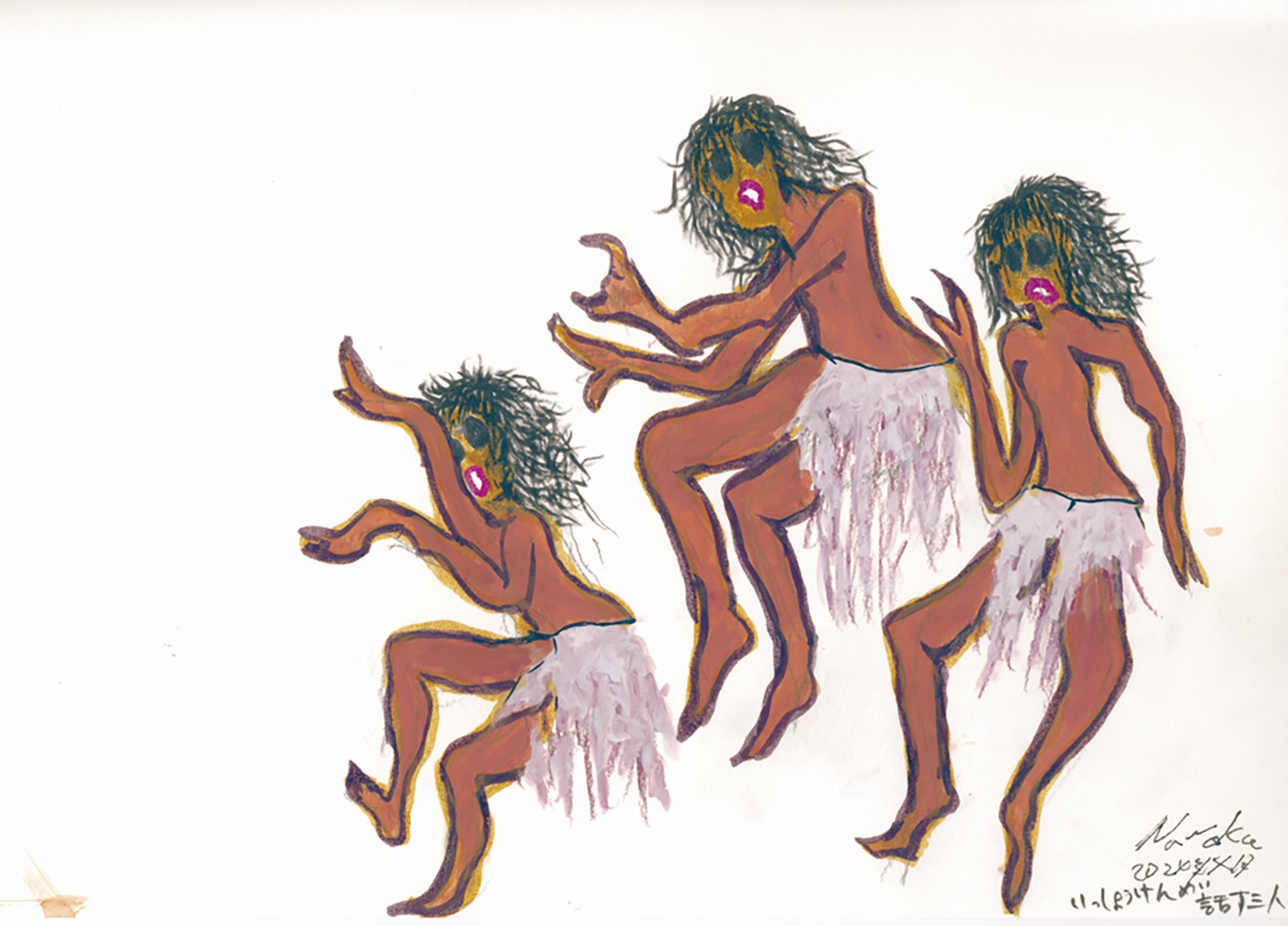
Long, long ago, four boats that had gone out fishing found three men clinging to a piece of driftwood in the sea between Yonaguni and Iriomote Islands (Fig. 5). They immediately emptied two boats in which they took the men aboard and returned to the shore. The men were nearly naked and utterly exhausted. We could not understand their language. They were not from any of the places we knew of [then and thereafter]. So, we called them Fuganutu, ‘people from outside’. An elderly woman called Muranuuya[7] took the lead and sent her people to care for the men on the beach. The first meal we gave them consisted of rice, foxtail millet, and yams boiled together, dried fish, vegetable soup, and fermented wine made by chewing rice. They seemed to have gone without food for a very long time and ate heartily. We built each person a house made of wood and grass. It was called duicida and had a thatched roof that extended down to the ground with no back wall. We remade their underpants, called appá[8], and made outer garments for them.
3.2. Various care for the Fuganutu
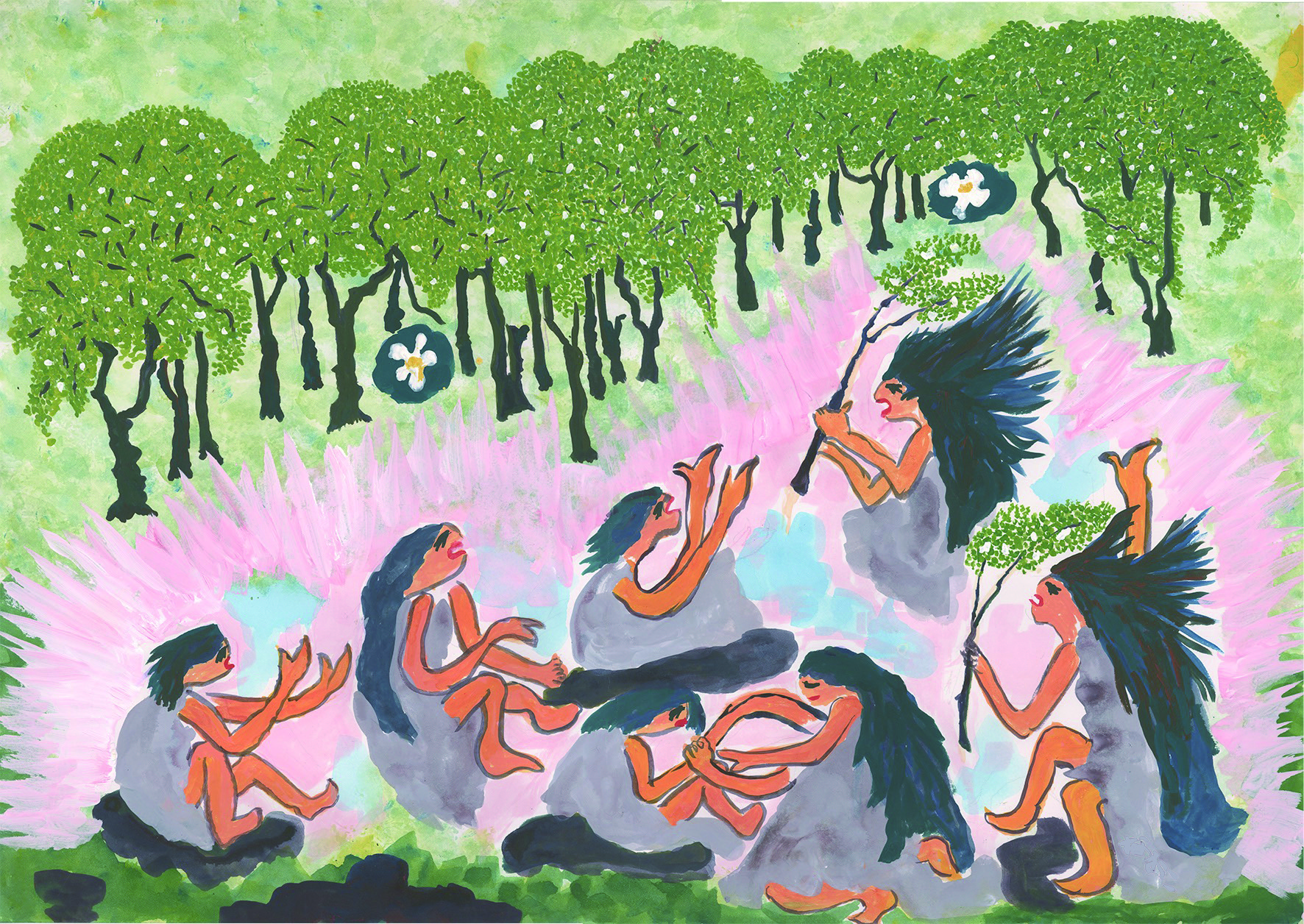
The Fuganutu recovered their physical health, but they continued to cry every day. Muranuuya realized they were mourning the deaths of their five companions. She decided that she herself would eat five small rice balls every day to soothe the hunger of the five deceased and invited their souls to rest on Arishi-hama beach. One day, Fuganutu broke down crying at the sight of the white flowers of the wild lemon [Citrus depressa] growing on the hills (Fig. 6). We thought their homeland must also be a place where lemons grew. When they fell ill with constipation, fever, skin diseases, and other ailments, we treated them with medicinal herbs and helped them recover.
3.3. What Fuganutu taught us
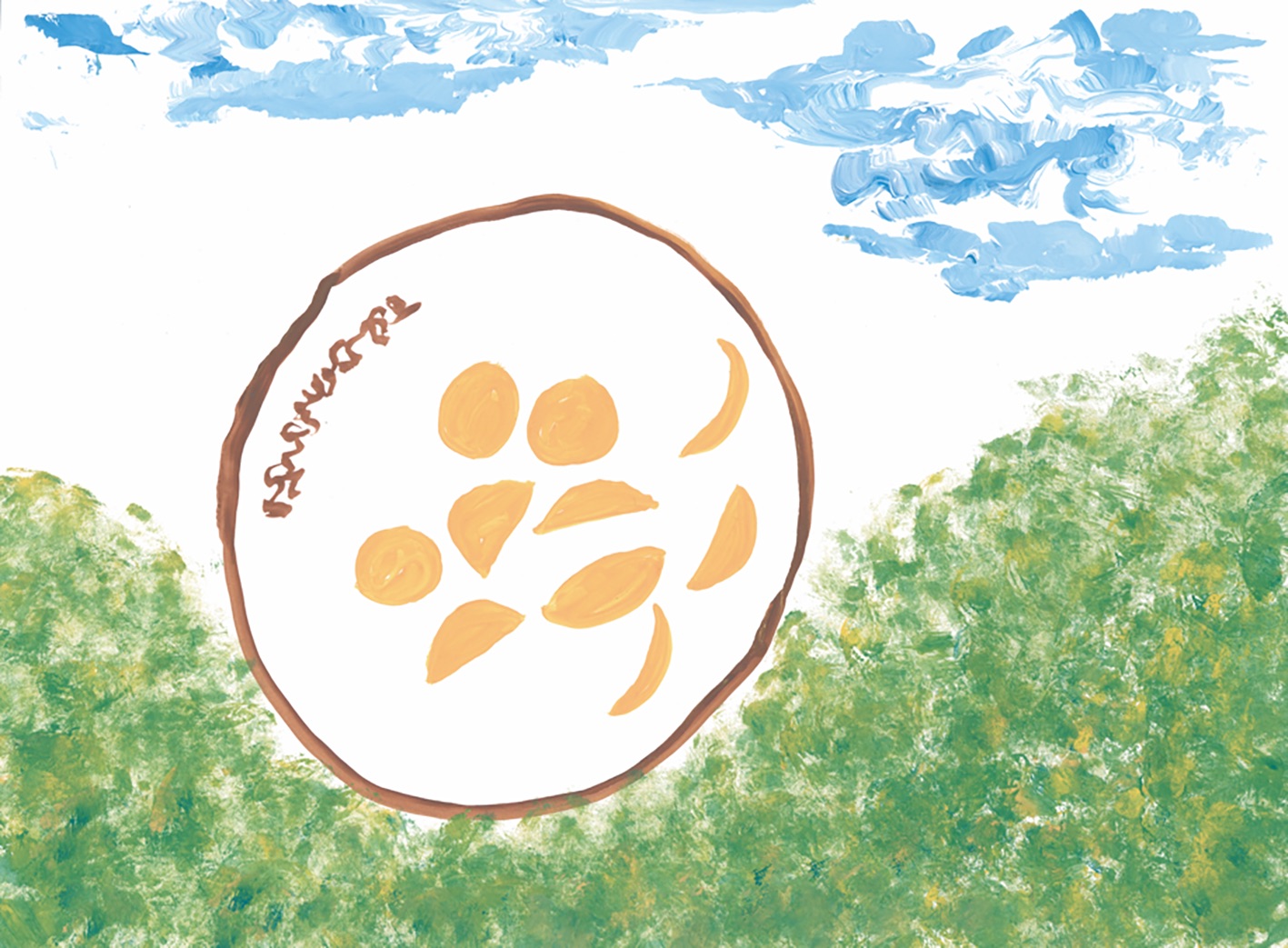
They were exceptionally wise people. We learned so many new ideas from them. They measured and predicted the tides and counted the days and months (Fig. 7). Every day, they drew sketches on the ground to explain things and events they experienced that day. Besides the sketches, one of them always added complex patterns[9] and explained them, but we never understood the patterns. There still exists spring water at Tindabana they liked, and a well Nagadu-kaa they used [see the map in Fig. 1 for Fuganutu-related place names]. We had our own toilet customs, but we were too embarrassed to demonstrate them. Muranuuya instructed us not to tell them that cycads [Cycas revoluta] and coconut crabs, which are edible but can be poisonous. We were surprised by their curiosity regarding the fish caught on the coast of Uranu and Nimbara (Fig. 8). They never got lost on a path they had traveled before. Every morning, they provided a weather forecast and drew the day’s schedule on the ground to explain it to us (Fig. 9).
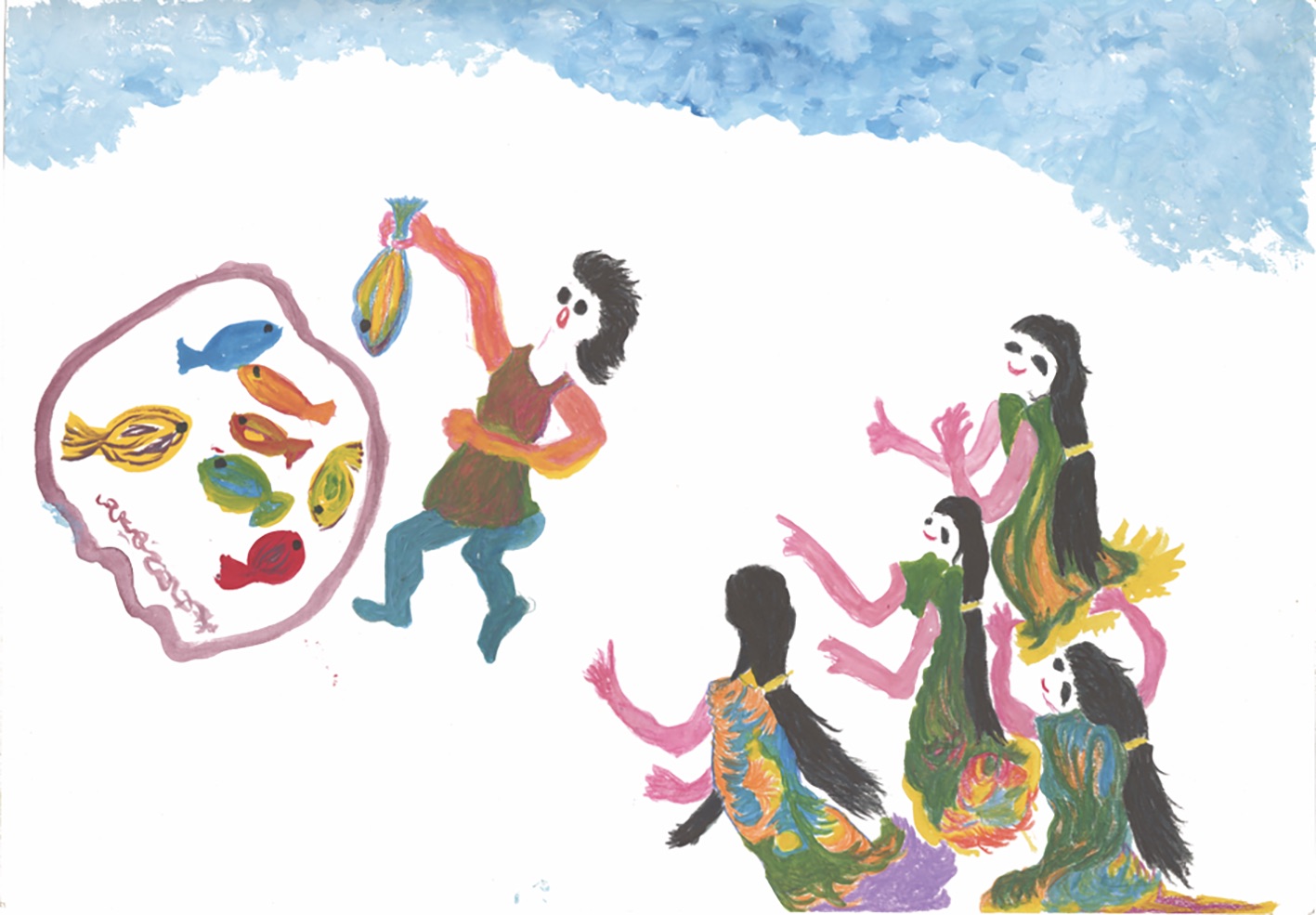
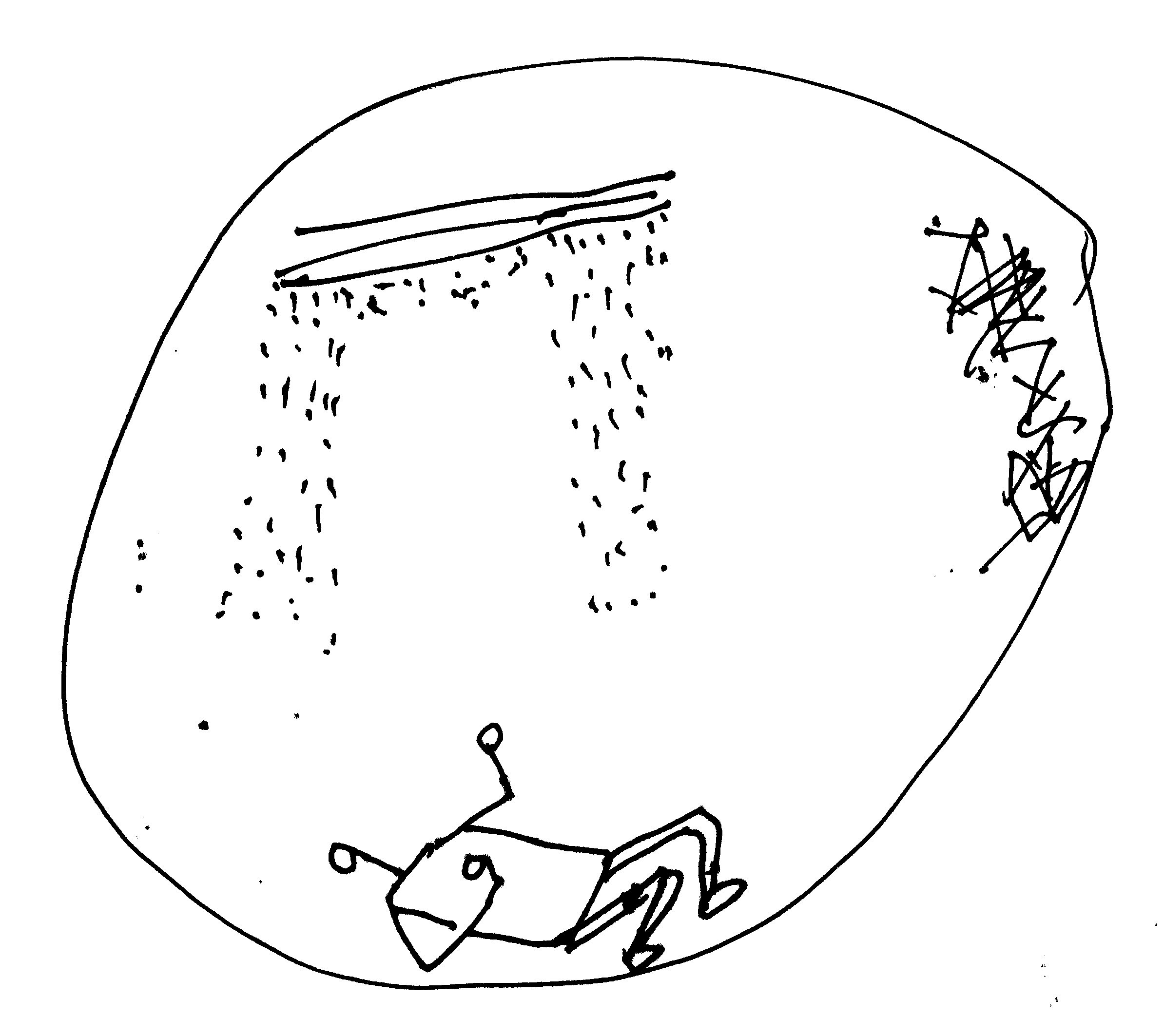
They taught us how to cook ingredients from the sea and the land together in a single pot. They complained that the clay pots broke easily and taught us how to improve them. We were amazed by the deliciousness of their pickles made with fish and spices. They taught us new cooking methods that made use of fruit juice and peels. They taught us the deliciousness of bean sprouts and fermented foods. They taught us a new method of mashing fish and spicing it. They taught us how to enjoy the aroma by adding mandarin orange leaves to fish soup. The Fuganutu were dissatisfied because they were not allowed to eat beef or poultry. They tried to catch and eat wild birds, for which they were severely punished by Muranuuya until they cried. They were only allowed to return home when people came to ask her to forgive them. When we gave them mice to eat, they played with them and let them escape. We held hands with them to surround the escaping mice.[10]
They showed us how to take fiber from wild bananas that grew in Aganni [near today’s airport]. It later became a trade commodity. They taught us how to weave ropes from straw. They also showed how to make elastic baskets using vines of itu [Flagellaria indica] to add to the ones we used to make from bamboo. They invented three new types of brooms, bamboo knives, and bamboo skewers, and gave them to us. They played happily with the children and built a swing for them. Amiragu, a mesh-cradle unique to Yonaguni, was also their invention. One day, they drew a girl’s outfit on the ground and asked her name. She was an orphan we had just brought from Taiwan who could not yet speak the island’s language.[11] They taught the children many competitive games, which even the adults became engrossed in. They taught the children an easy counting method by treading. They were a cheerful company, skilled at singing and dancing.
3.4. The rice harvest season and their departure
They were remarkably skilled at rice harvesting, despite having no prior experience as they said. They worked on rice fields as Taburu, Kumma, and Mantaburu. They could distinguish between rice planted the previous year and regrown rice. They could tell the difference between last years and this year’s harvest by the aroma of the cooked rice and its cakes. They worshipped the rising sun, just as we did. They also learned to pray to the setting sun and to the fish they caught. During funerals, we looked after them and sang a lullaby until they slept. This was a precaution to keep them from wandering off and being taken away by disembodied spirits. They followed our custom and prayed to the stone bidiri erected in their garden. In the presence of Muranuuya, the young men and the Fuganutu formed a bond of sworn brotherhood when they were bathed in the spiritually potent moonlight, utuntu. After preparing the boat and ropes, Muranuuya selected thirteen crews to send them. Muranuuya advised Fuganutu to pray for the cats for their protection. We sent them off cheerfully from Tuguru-hama beach, hiding our sadness at parting. Later, a shipwrecked Yonaguni Islander was reunited with them on Iriomote. Muranuuya stopped and scolded the young men who were about to set out in a boat to follow their sworn brothers to their unknown homeland. Muranuuya advised the young men to plant a tree. As it grew, it would receive and tell us the good news of their return home. After preparing to meet Fuganutu’s parents in the afterlife, Muranuuya passed away.
4. Comparison: The two narratives from 1479 and the narratives from 2007 to 2025
Based on the results presented in the above sections 2 and 3, which included excerpts from the sources, we are now able to conduct a detailed comparison between written history and oral history. Specifically, we can compare and examine the Chinese-language records of the testimonies regarding the drifting experiences of three Jeju Islanders, taken during interrogations conducted in Korea on May 17 and June 10, 1479, with the narratives about three ancient drifters that have been independently passed down on Yonaguni Island.
The Yonaguni Island materials are the result of a historical co-creation project with Wakaranko, consisting of Yonaguni language audio and text, their Japanese translations, and illustrated explanations, which we received between March 2007 and February 2025.
We will present the results of this comparison in the following order: 4.1 Numerical correspondence, 4.2 Correspondence in details, 4.3 Discrepancies in descriptions, 4.4 Descriptions found only in the Veritable Records of the Joseon Dynasty, and 4.5 Descriptions found only in the Fuganutu tradition. The reference numbers for the episodes are 2.1 in the King Seongjong’s Volume 104 of the Veritable Records of the Joseon Dynasty, 2.2 in Volume 105 of the same work, and 3.1–3.4 in the Fuganutu tradition.
4.1. Coincidence of numbers and date
Three men were adrift and saved at sea [2.2 and 3.1] They survived by clinging to the shore of an island [2.1]. Their five crewmates died [2.1, 2.2 and 3.1]. One of their companions starved to death, and the remaining four drowned when their boat broke [2.1]. All five drowned simultaneously [2.2].
The three survivors were rescued by two fishing boats [2.2]. They were taken aboard two of the four fishing boats [3.1]. After various experiences on the island, the three drifters were sent to the next island on a single boat manned by thirteen islanders [all of 2.1, 2.2, and 3.4 agree on this number].
The elders not only began teaching two-year old Wakaranko to memorize the Fuganutu tradition but also made her perform various prayer rituals for Fuganutu on Shiki-hama beach, which were originally conducted by the Muranuuya. Since childhood, it was Wakaranko’s duty to eat five small rice balls every day [for the five drowned crews, see 3.1]. Further, on the first day of the eighth month of the lunar calendar, she was made to hang three millet cakes from the roof eaves. Then, it was her role to eat these cakes. It was a custom in Yonaguni Island to pray for the safe journey of beloved people. One cake was made for each traveler. We suggested to her that the hanging of three millet cakes on the 1st August might have indicated that the departure of the three travelers [presumably Fuganutu] was on the last day of July, as was exactly written in the Veritable Records of the Joseon Dynasty [2.2].
4.2. Consistency in the details of episodes and in the proper nouns
After the ship was wrecked, the three drifted while straddling a plank in the water [2.2], and the three drifters were found clinging to a plank resembling the bow of a wrecked boat [3.1]. Their first proper meal on the island consisted of rice, dried fish, and wine made by chewing rice [2.2], and millet, yams, and vegetable soup were also added to these [3.1]. They placed balls of rice on top of leaves [2.2 and 3.1]. Their appearance resembled each other’s [2.2 and 3.1]. The islanders had long hair and beards [2.1], while the drifters had short hair and no beards [3.1]. The islanders’ ornaments consisted of strings of beads [2.1 and 3.1]. Clothing consisted of ramie woven into tunics and dyed with plants [3.1], and further, they were indigo-dyed [2.2]. Houses had thatched roofs sloped down to the ground, with no back wall [2.2 and 3.1]. The fish were all unfamiliar to them [2.2], and they looked at the fish with great curiosity [3.3]. There were rats, cats, cows, and chickens [2.2 and 3.1]. Rats were for food [3.3]. Cows and chickens were not eaten, and the islanders laughed at the drifters when they suggested eating a cow [2.2]. They complained about not being able to eat cows or chickens and were punished for secretly catching and trying to eat wild birds [3.3]. Rice was planted once and harvested twice by utilizing the regrowth [2.2 and 3.4]. A period of abstinence and noises like flutes were banned before the rice harvest [2.2], whereas Fuganutu had made many bamboo flutes, and they were confiscated for abstinence [3.3]. Green mandarins bloomed year-round [2.2], and they broke down in tears upon seeing the flowers of wild lemons [3.2]. There were mulberry trees and bamboo [2.2], and they squeezed mulberry fruits for juice and made various tools from bamboo [3.3]. The islanders used old and new rice ears to announce the drifters' departure [2.2], while they used cooked rice and rice cakes to have Fuganutu distinguish between the old and the new [3.4]. The islanders did not know how to read or write [2.1, 2.2, and 3.3]. The islanders lived in harmony with one another and treated infants with great care [2.2 and 3.4]. The island to which they were sent was Sone-Shima [2.1, 2.2]. Later, one of the Yonaguni Islanders reunited with the Fuganutu on Iriomote Island, which is now also called Sune-Shima [3.6].
4.3. Inconsistent accounts
We can find a few cases of inconsistencies between the written record and the oral tradition. There were five types of vegetables [2.2], but Wakaranko said that the islanders primarily ate wild plants during this period [3.1]. Except for Okinawa Island, the Jeju drifters saw no pigs on any of the other islands [2.2], whereas Fuganutu were said to be startled by the high voices of pigs that they did not know of [3.3]. As part of their customs, they had no chieftain [2.2]. An elderly woman called Muranuuya [village’s parent] provided guidance on all matters occurring on the island, including politics, religion, and resource utilization [3.1–3.4].
4.4. Descriptions found only in the Veritable Records of the Joseon Dynasty
There existed very few cases, such as making round hats from palm leaves and setting sails on boats [both in 2.2], that did not appear in the Fuganutu tradition.
4.5. Descriptions found only in the Fuganutu tradition
Compared to King Seongjong’s Volume 105 of the Veritable Records of the Joseon Dynasty on Yonaguni Island, which consists of 1,600 Chinese characters, the Fuganutu tradition compiled and written by Wakaranko reaches 80,000 characters in katakana; naturally, the Fuganutu tradition is far more detailed. Consequently, it includes many details that were not recorded in the Veritable Records of the Joseon Dynasty. As space does not permit a full enumeration here, we will focus in a later section on examples of the fauna of the time and how animals were utilized.
5. An excerpt from the dialogues with Wakaranko
While editing her second picture book (Wakaranko, 2025), we asked her questions based on the description in the Veritable Records of the Joseon Dynasty. It was the last stage of co-creation during our eighteen years of collaborative work on her Fuganutu tradition. During the eighteen years, she had recalled details about various versions and isolated oral narratives from her memory. As a result, when asked about the existence of specific material culture from the Fuganutu era, she was able to answer almost instantly, saying that such and such items had never appeared in the Fuganutu tradition she had been taught. The following is an excerpt from our dialogues with Wakaranko, which were mainly exchanged by phone calls and are supplemented by her letters and emails.
Yuji Ankei & Takako Ankei: Were palm-leaf hats and sails on the boats [2.2] already in use during the time of Fuganutu?
Wakaranko: They didn’t appear in the Fuganutu tradition, so I cannot tell you whether they existed.
Ankei & Ankei: The Veritable Records of the Joseon Dynasty states that Yonaguni Islanders ate almost exclusively rice and did not like to plant millet [2.2].
Wakaranko: It was a complete misunderstanding [laughs]! The islanders at that time loved fox-tail millet and would have eaten plenty of it if we could. But millet was a vital commodity for trade with Taiwan and southern islands or to obtain timber from Iriomote Island. So, we simply restrained ourselves and tried not to eat too much of it. As for other trade goods, besides millet and glutinous rice, banana fibers became highly valued after the Fuganutu era.
Ankei & Ankei: The Veritable Records mentioned that when they wished to eat a dead cattle, the islanders laughed at them and spat [2.2]. On Yonaguni Island, people didn’t eat chicken either. What about other birds?
Wakaranko: There was a bird called sumihatu [a type of wagtail] that chirps with a high-pitched voice. There is a story that Fuganutu were caught because they secretly set a trap and caught one. Since they were going to kill and eat it, they were considered to have committed a double offense. So, Muranuuya summoned and scolded them severely until they ended up crying. We begged Muranuuya for forgiveness, and she eventually let them go. In a version you included in my book, they were scolded by an old man [3.3].
Ankei & Ankei: Please explain to us the 14 types of ‘insects’ [虫] listed in the Veritable Records of the Joseon Dynasty [2.2]: Turtles, snakes, toads, frogs, mosquitoes, bats, bees, butterflies, mantises, dragonflies, centipedes, earthworms, fireflies, and crabs.
Wakaranko: OK. Damami (land tortoise) was cooked in a pot and shared among us. We told them that frogs with thick legs tasted better, and they happily bowed in thanks and prepared a delicious, steamed frog dish to share with us.
Ankei & Ankei: Toads and frogs were distinguished using different Chinese characters [2.2]. Were there different species of them?
Wakaranko: I found that there were four species of frogs on Yonaguni Island. According to folklore, some came from the south, and others from Taiwan. In my time, only one species of frog was eaten. The species said to have come from the south was also roasted and eaten in the past. Nkadi (centipedes) were dried and tied in bundles of six for consumption. I would roast it over the hearth to cook. Ubabu (snakes) were also eaten. There was a type of snake that we weren’t allowed to eat: black, thin and short. We used to eat kadanku (mosquito larvae). We put them in soup for better than nothing. We also ate fly maggots by boiling them. Kubuya (bats) were not consumed because they’re divine beings. We don’t eat either the big ones or the small ones. We ate the beehives filled with honey, but Fuganutu said they didn’t like them. Habiru (butterflies) were not food. They are messengers of the deities. Isatumai (praying mantis) is edible, but it isn’t tasty. There’s a story about when Fuganutu was here, when the rice harvest was so good, Muranuuya said, “We have to borrow the sickles of the Isatumai.” Fuganutu come upon us roasting agidan (dragonflies) over an open fire. We offered them, but they just stared at the dragonflies and didn’t eat any. Dimimi (earthworms, meaning ground’s ears) are messengers of niraganaci [ground deities], but they have been consumed. Fuganutu invented to dry them using them little by little to make broth. Fireflies don’t appear in the stories about Fuganutu. I’ve never heard of anyone eating them. Crabs are for food.
Ankei & Ankei: Thank you. The following didn’t appear in the Veritable Records of the Joseon Dynasty, but what about snails, lizards, and the ‘stink bugs’ mentioned on another island? Coconut crabs aren’t mentioned either.
Wakaranko: In Fuganutu’s time, there were plenty of snails, so we used to eat them boiled or grilled. Muranuuya set a limit on how many could be collected at one time and made everyone follow it. According to that rule, snails were limited to a heaping handful. One time, it was discovered that Fuganutu had collected a huge number of snails. When Muranuuya investigated them, she learned that they were drying them and using them little by little to make broth [as was the case with earthworms]. Muranuuya decided this method was acceptable and did not punish them. From then on, we began to imitate Fuganutu’s method of drying the snails and using them little by little. Muranuuya did not allow us to feed coconut crabs to Fuganutu. The reason wasn’t mentioned in the story, but they may become poisonous when they eat plants like cycads and bin’gui [Alocasia odora] in winter. There were plenty of lizards on Yonaguni. In the era before Fuganutu, we had refrained from eating them daily. We reserved them for drought. Stink bugs didn’t appear in Fuganutu tradition, but in my time, we used to skewer them and roast them over a fire to eat.
Ankei & Ankei: So Muranuuya was the one who decided how animals and insects were used on Yonaguni Island back when Fuganutu people were with you.
Wakaranko: Yes. Aside from the wild birds, we weren’t allowed to catch lizards smaller than a span between your thumb and index finger spread apart, or snakes thinner than the loop formed by your thumb and index finger. We’d take just one claw as food from a coconut crab and release it. If we encountered a coconut crab whose claw was regenerating, it was customary to clasp our hands together and give thanks to it. We were only allowed to eat a whole one when we were eating together.
Ankei & Ankei: To put it broadly, the creatures the drifters referred to as ‘insects’ [2.2] were food except for bats, butterflies, and fireflies.
Wakaranko: Yes. We have eaten most of them from Fuganutu’s time right up to my own. For example, since the age of seven, I was regularly made to chew rice for the ceremonial wine all by myself for four days. To help my strength, my grandmother prepared a special nourishment for me. It consisted of a broth made by steaming dried centipedes, turtle legs, Irabu (Erabu black-banded sea kraits), lizards, and so on, mixed with honey, lard, and flaxseed oil (Wakaranko, 2023).
Ankei & Ankei: Muranuuya kept Fuganutu from consuming coconut crabs, cycads, and Alocasia taro for their risk of intoxication. Therefore, they weren’t mentioned in the account of their drifting. What other creatures do you know didn’t appear in Fuganutu’s story?
Wakaranko: I have wondered if there might have been no ducks on Yonaguni Island back then. They don’t appear in the Fuganutu tradition.
Ankei & Ankei: The drifters reported only pigeon and yellow ‘sparrow.’ They reported that cats and chickens were kept at home [2.2].
Wakaranko: In the Fuganutu tradition, both cats and chickens play very important roles even before they arrived. They had sensed that something was about to go wrong and raised a huge commotion to warn the humans. Before their departure, Muranuuya told them, “Since you are about to set out on a journey and will face the waves and winds, pray here with all your heart for your journey ahead. Be sure to thank Mayunganaci (the cats as deities) and never forget to show them respect.” Then, Fuganutu wept and prayed all night until morning, and they were so exhausted it took them days to recover.
Ankei & Ankei: The account of the drifters stated that there were no thieves on the island, people did not dispute loudly or fight, they cherished young children, and even if babies cried, they never hit them [2.2].
Wakaranko: I believe that has been precisely the true nature of human relationships on Yonaguni Island since ancient times. In the days of the Fuganutu, there was a single Muranuuya (village elder) on the island, and under her were the Kyadunainuuya, who acted as her right-hand women, and the younger girls known as the Kyadunainuubani. They were constantly vigilant to ensure that no theft or fighting occurred, that no one went hungry or was left alone, and that children were cherished.
Ankei & Ankei: Both the account of the drifters [2.2] and the Fuganutu tradition [3.4] agree that the drifters were sent from Yonaguni to Iriomote Island, but wasn’t there an option to send them to Taiwan instead?
Wakaranko: Of course, Muranuuya considered sending Fuganutu people to Taiwan, where food was more plentiful. However, although I didn’t include it in the picture book (Wakaranko 2025), a group of Taiwanese people once landed at night and tried to kill Fuganutu to rob them of their food and belongings. They were captured thanks to the vigilant cats. She judged that if they should be attacked, her thirteen crews to fit on a single boat from here would be insufficient in number to defend against an attack from some people there.
Ankei & Ankei: Was there any tradition that made you wonder, ‘Is this true?’ even if you were yet a young child?
Wakaranko: Yes, there were some. Specifically, when one person’s story differed from everyone else’s. For example, one grandmother said her mother was a child of Fuganutu. I thought, ‘That’s just too recent.’ Also, an elder talked about a game, in which boiled sōmen [sūmin in Okinawan pronunciation] noodles were thrown like in a mochi-maki [rice-cake throwing] festival, and everyone races to pick them up. She said Fuganutu had participated and enjoyed it with us. I wondered if sōmen noodles already existed back in those ancient times.
Ankei & Ankei: We see. Jeju drifters saw barley planted in the low islands of Yaeyama like Hateruma, but wheat, needed for thin noodles like sōmen, was not cultivated then.
6. The trajectory of Fuganutu tradition and its contemporary significance
Many of the Fuganutu traditions preserved on Yonaguni Island corresponded with the oral accounts of the drifters who arrived from Jeju Island in 1477. The Fuganutu oral tradition added a case to the historical records of the Veritable Records of the Joseon Dynasty, demonstrating how oral traditions can have exact dates for events that occurred more than five centuries ago. The overwhelming detail of the Fuganutu tradition has revealed background information that was not apparent in the Veritable Records of the Joseon Dynasty.
First, it has clarified the methods by which the Jeju Island drifters confirmed, shared, and recorded their memories before bringing them back. Second, it has revealed elements missing from historical records due to the deliberate concealment by the people of Yonaguni Island, who hid these things from the drifters to protect them. Third, there exists a vast body of oral traditions that were not recorded in history because the Joseon Dynasty had no interest in them. These traditions describe how, through the Jeju Islanders’ five-and-a-half-month stay, innovative and systematic knowledge regarding the utilization of natural resources was transferred to Yonaguni Island. Through these accounts, we learned that in the late 15th century on Yonaguni Island, strict rules regarding the quality and quantity of resource harvesting were established to enable sustainable resource use, and that a social system centered on a female leader known as Muranuuya was formed to enforce these rules and punish violators. Thus, we have been able to demonstrate that the origins of Yonaguni Island’s environmental governance—which, as shown in Wakaranko (2023), has been passed down to the present day—date back to at least the late 15th century.
The following summarizes the history passed down among the people of Yonaguni Island regarding their encounters with drifters from ancient times.
- February 15–July 30, 1477: Fuganutu’s arrival and stay on Yonaguni Island. Eyewitness accounts began to emerge.
- 1500: The Ryukyu Kingdom began its invasion of the Yaeyama Islands. A transition from eyewitness to hearsay accounts of Fuganutu oral history.
- 1609: The Satsuma Domain took control of the Ryukyu Kingdom.
- 1879: The Meiji government abolished the Ryukyu Kingdom and established Okinawa Prefecture.
- 1945: Yonaguni Island, along with the other islands of Okinawa and Amami, became a territory of the United States. The oral tradition of Fuganutu faced a crisis of survival due to the drastic economic and social changes caused by its separation from Taiwan.
- 23 March 1954: Wakaranko was born on Yonaguni.
- 1956: The elders decided to raise Wakaranko to be the future Mutukkahamai, a shaman responsible for weather and food production to succeed a part of the ancient Muranuuya’s role. As a part of her special training, they began teaching her the Fuganutu tradition, composed of personally different versions of each elder (Fig. 10).
- Around 1963, Wakaranko was allowed to perform the Fuganutu tradition at gatherings. The elders instructed Wakaranko to pass these traditions and the method to make appá on to a ‘trustworthy person’ in the future. However, because she was ridiculed by people of her parents’ generation who were unacquainted with these traditions, she sealed away the Fuganutu tradition.
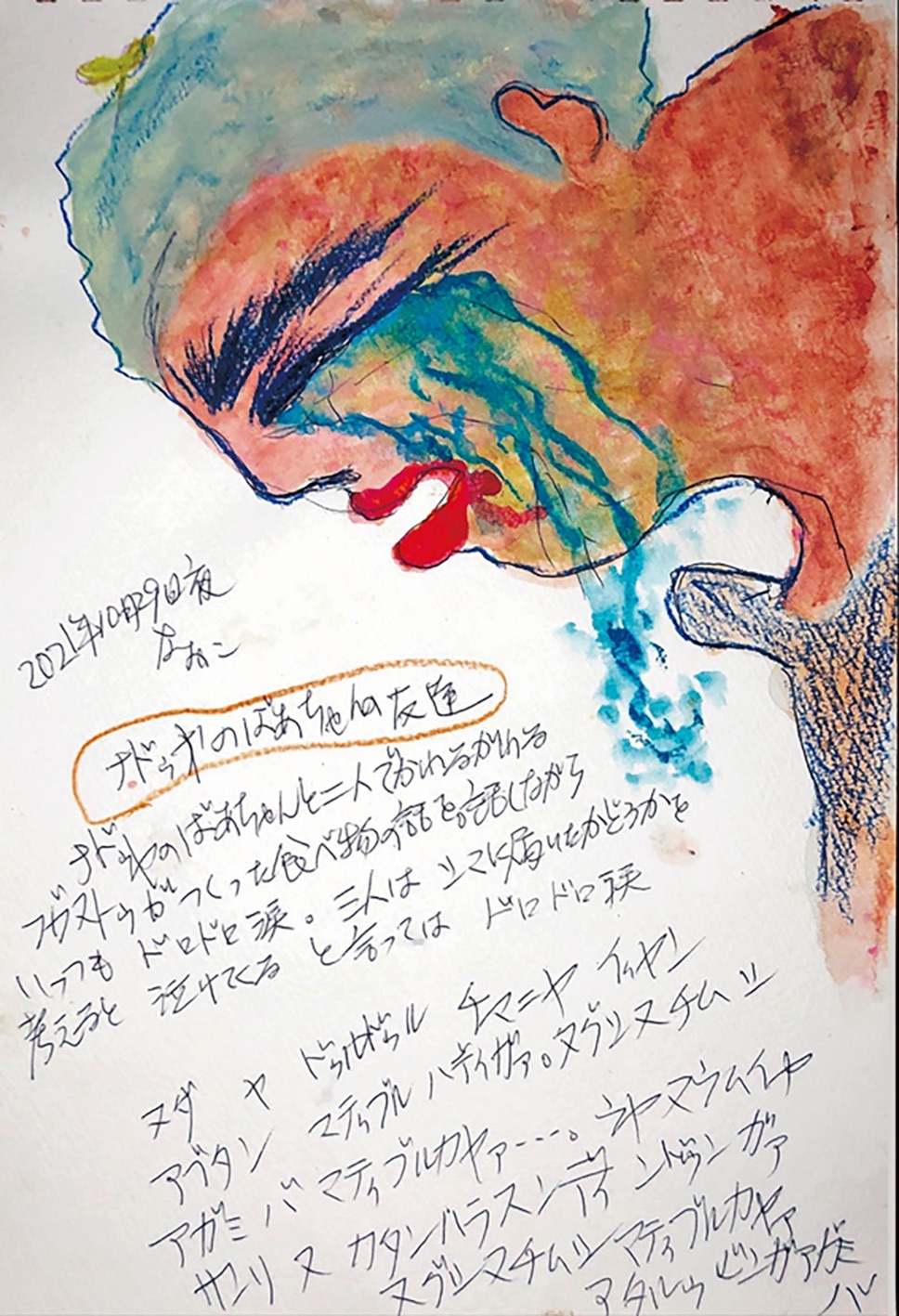
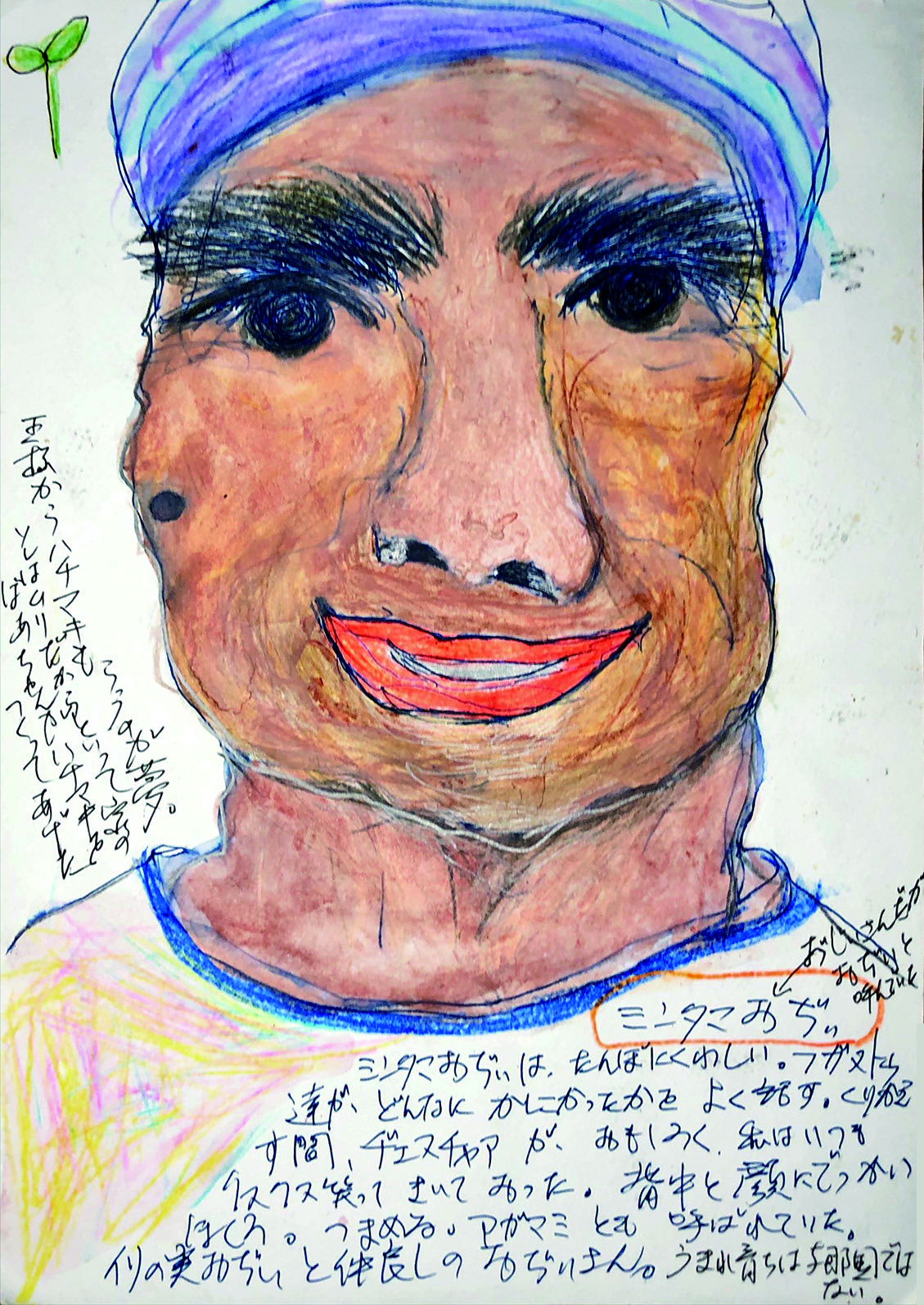
- 1989: Wakaranko met Takako Ankei & Yuji Ankei. A remote co-creation of Island ethnography began.
- 2007: Wakaranko began telling us the Fuganutu tradition in Japanese. We encouraged her to recall and tell us as many episodes in it as possible.
- 2011: First reports on the Fuganutu tradition in Japanese (Ankei & Ankei 2011a, 2011b).
- 2020: Recording in the Yonaguni language, its transcriptions, and their word-to-word Japanese translation of the Fuganutu tradition corpus were nearly completed.
- March 2023: A picture book on Yonaguni Cosmology was published (Wakaranko 2023).
- February 2025: ‘Fuganutu: Yonaguni Oral History of the Drifters from Jeju Island’ was published (Wakaranko 2025).
- March 2025: The Fuganutu Symposia were held on the Yonaguni, Iriomote, and Ishigaki Islands. Copies of her picture books were distributed to each school in the Yaeyama.
- 3 July 2025: Wakaranko passed away from an unexpected illness.
7. Addressing questions regarding the testimonies of Jeju Island drifters in the Veritable Records of the Joseon Dynasty
Looking at the chronology of the Fuganutu tradition described above, it appears that the stories of the roughly 100 people on Yonaguni Island who directly encountered the three drifters from afar—each family recounting their own distinct experiences—were transmitted over five centuries with surprisingly little loss of details.
Since Iha (1927), many scholars (Takasaki 1970 was an early case) have acknowledged that the testimonies of Jeju Island drifters in The Veritable Records of the Joseon Dynasty—introduced in Section 2 of this article—constitute a unique historical record. However, they have also raised numerous questions. Many of these questions can now be answered by comparing the records with the Fuganutu tradition, as explained in Sections 3 to 6.
Kobayashi (1996: 164–165) wrote as follows:
Engaged in the official task of transporting tribute mandarin oranges, they possessed a high level of intelligence, as well as keen observational skills and a capacity for memory. Some among them were literate and had a clear understanding of the calendar. [our translation]
Seki (2021: 211), however, while agreeing with Kobayashi, raised doubts about the accuracy of the records:
These records should be viewed not as the drifters’ own actual statements, but as a compilation of the information gathered by the Records Office. The drifters themselves did not keep records to serve as the basis for their testimony; rather, the accounts rely solely on their memories. It was impossible for them to accurately recall every detail of their experiences spanning one and a half years [sic; actually, two years and three months] from their departure from Jeju Island until their return to Korea, and it must be assumed that the accounts contain a significant number of errors. ...Therefore, it is necessary to view the drifters’ records as containing inaccuracies, errors, and biases. Regarding the customs and natural features of each island, these are not based on a comprehensive survey covering the entire island; rather, it should be assumed that a considerable amount of information is missing from these records [our translation].
We agree with the first part of Seki’s arguments, as the results of interviews with different officials in King Seongjong’s Volumes 104 and 105 of The Veritable Records of the Joseon Dynasty differ in both quantity and quality. However, we believe the second part of his argument is based on modern prejudice regarding the memory of the common, mostly illiterate people. In Wakaranko’s (2025) account of the Fuganutu tradition, they shared their daily experiences by drawing sketches on the ground every day and adding written explanations to them. They counted the days by hanging a tree leaf a day, counted the number of times the moon’s shapes repeated, and likely jotted things down on cloth to aid their memory. They were strong and energetic, and there was no corner of Yonaguni Island they had not visited. Furthermore, whenever they encountered something that they did not understand, they would use the drawings on the ground to ask questions until they were fully satisfied. They were extremely wise, and the innovations the Fuganutu taught the islanders in their daily lives were countless: measuring the tides, using written symbols to count numbers, predicting the weather by watching the morning clouds, drying food for later use, and so on.
When viewed in this light, what is missing from the historical records is the fact that they forged human connections with the people of the islands they visited and made significant contributions to improving island life. Furthermore, what they were unable to learn was knowledge that had been kept secret through Muranuuya’s care, like the cycad, which they were not allowed to eat because it is poisonous if not properly processed.
Regarding their statement that there was ‘no chieftain,’ Tokunō (2011) noted that this could mean there was no powerful clan leader to unite the island and command its military forces, or that a chieftain existed but did not come before the drifting people. Seki (2021) pointed out the possibility that, when using the term “chieftain,” they had in mind the local bureaucrats of the Joseon Dynasty. Muranuuya, a figure who frequently appears in the Fuganutu tradition, was, in modern terms, the island’s sole leader and shaman, issuing decisions and orders spanning the legislative, executive, judicial, and religious spheres. Her purview included diplomacy, preparations for battle, the protection and quarantine of outsiders, and the punishment and detention of rule-breakers. The people of Jeju Island lived daily under the Muranuuya’s protection and supervision, and direct meetings often took place during important occasions. However, we believe that because Muranuuya and all her subordinates were women at that time, the drifters did not regard her as a ‘chief.’ In this sense, we agree with Seki (2021).
8. Conclusions
The Fuganutu tradition was, at the same time, an oral history of an era in which Muranuuya played a central role in securing the island’s autonomy. The following are examples of rules established by Muranuuya that were to be observed within the community. These rules also applied to the orphans from Taiwan and to Fuganutu.
Prohibition of violence on the island and protection of children was the most important. Designation and enforcement of foods prohibited for spiritual reasons: cattle, chickens and all wild birds, bats, butterflies, and moths, etc. Refusal to feed certain foods to outsiders who did not fully understand the language, and prohibition of teaching them that these foods were edible if prepared properly: cycads and coconut crabs. Specifying the minimum size for lizards and snakes that could be eaten. Setting a maximum limit on the amount that could be collected at one time: the limit for snails, slugs, and earthworms was one handful per collector. For coconut crabs, it was permitted to take only one claw.[12] Fox-tail millet, a favorite food of the islanders, were saved as an important commodity for trade with other islands.
The era in which Muranuuya served as a leader came to an end when the Ryukyu Kingdom began to exercise direct rule over the Yaeyama Islands, including Yonaguni early in the 16th century. We believe that from that time on, the Fuganutu tradition became a secret passed down only within the island community. The mission entrusted to Wakaranko was to become a Mutukkahamai, a shaman governing weather and food resources.[13] Mutukkahamai succeeded some roles previously fulfilled by Muranuuya. The intensive on-the-job-training for Wakaranko that began at the age of two included mastering the Fuganutu tradition and making of their underwear appá. The reason for this was to ensure she gained a thorough understanding of the governance regarding environmental stewardship, its origins, and innovations brought from outside.
Wakaranko (2025: 4) concluded her Fuganutu tradition in the following words. She vividly conveyed how this tradition serves as a lesson for the future of humanity living in an era of war and hunger.
When I learned that the three drifters had returned safely to their home island, even though there was no one left to rejoice at the news, I felt that the long, heavy burden we have carried for so long had finally been lifted. I believe there is a great treasure within this Fuganutu tradition for all of us. I want to convey the human kindness, warmth, and thoughtful consideration that fill this story. Through my interactions with the Fuganutu, I have learned that we must not neglect, exclude, bully or kill someone just because they are different from us. As a holder of the Fuganutu tradition, I have adopted the following two pillars as the guiding principles for life: ‘Never leave anyone hungry,’ and ‘Never leave anyone alone.’ These are the wisdoms of Yonaguni Island that have been passed down to this day. I sincerely hope that you will all join me in promoting these messages of peace and sharing them with the world. [our translation]
Acknowledgments
We would like to express our profound gratitude to the late Wakaranko and her family and friends. During fieldwork on Jeju Island, we were guided by Mr. Go Gwan-min. Fieldwork, publication, and symposia were supported by the LINKAGE Project at the Research Institute for Humanity and Nature and the Yonaguni Island Project at the Jeju Studies Institute. Database creation was funded by JSPS Kakenhi No. 20HP8006. We extend our gratitude to Ms. Chie Takahashi, Ms. Mari Nakai, Ms. Marisa Yonabaru, and all the people of Yonaguni Island. We are also indebted to Professor Emeritus Chun Kyung-soo of Seoul National University, Professor Han Changhun of Chonbuk National University, Professor Kim Changmin of Chonju University, and Professor Hong Sun-Kee of Mokpo National University for joint fieldwork in the Yaeyama.
Conflicts of Interest
The authors declare no conflicts of interest in relation to this article.
Endnotes
References
- Ankei, Y., T. Ankei, 2021. Biocultural Database of Yonaguni Island, https://dunanmunui.wixsite.com/my-site (retrieved 10 Feb. 2026)
- Ankei, T., Y. Ankei, 2011a. ‘Memories of Jeju Islanders drifted 530 Years Ago,’ in Ankei, T., M. Moriguchi (eds.) Memories Handed Down by Singing, Boda Inku, Naha (in Japanese).
- Ankei, Y., T. Ankei, 2011b. ‘Memories of the 1477 Interchange Between Jeju Island Drifters and Yonaguni Islanders,’ In Ankei, Y., M. Tōyama (eds.), Amami Okinawa Environmental History Sources Collection, Nanpou Shinsha, Kagoshima (in Japanese).
- Ankei, Y., T. Ankei, 2023. ‘An Illustrated Cosmology of Yonaguni Island, Ryukyus: A collection of daily prayers and songs for biocultural diversity and island sustainability,’ Journal of Marine and Island Cultures 12(3): 76-95. https://doi.org/10.21463/jmic.2023.12.3.06
- Iha, F., 1969. ‘Southern Islands in the End of 15th century Found in the Korean Drifters’ Record,’ Wonarigami no Shima, Heibonsha, (The first published in 1927) Tokyo (in Japanese).https://doi.org/10.11501/3450936
- Ikeya, M., A. Uchida, K. Takase, 2005. Corpus of Ryukyu History in the Veritable Records of the Joseon Dynasty, Yōju Shorin, Ginowan (in Japanese).
- Kobayashi, S. 1996. ‘Land tenure and landscape of southern Southwestern Islands during the later 15th century: An analysis of drifters’ accounts in the Veritable Records of the Li Dynasty’ Maruyama, Y. ed. The Southwestern Islands and Kyushu during pre-modern era: A study on their relationship. Taga Publishing, Tokyo (in Japanese).
- Seki, S. 2021. ‘Amami Islands and Sakishima Islands as seen in the Veritable Records of the Joseon Dynasty,’ Bulletin of the National Museum of Japanese History, 226: 197-230 (in Japanese). https://rekihaku.repo.nii.ac.jp/records/2407
- Takasaki, A. 2020, first published in 1971. Akahachi: In search of the Yaeyama Hero Oyake Akahachi, Hagazussa Books, Tokyo (in Japanese).
- The Veritable Records of the Joseon Dynasty, http://sillok.history.go.kr/ (retrieved 10 Feb. 2026)
- Tokunō, T. 2011. ‘An Era of Rival Warlords and the Oyake-Akahachi Incident’ The History of Taketomi Town, Vol. 2, Taketomi Island, Taketomi Town, Ishigaki (in Japanese).
- UNESCO, 2010, Atlas of the World's Languages in Danger, https://unesdoc.unesco.org/ark:/48223/pf0000187026
- Wakaranko, Ankei, Y., T. Ankei, K. Toguchi (eds.), 2023.’ Nu’tinu Kaara Dunan (The Source of Lives, Yonaguni Island),’ Research Institute for Humanity and Nature, Kyoto (in Japanese, Dunan munui, and English). Downloadable from https://ankei.jp/yuji/?n=3010
- Wakaranko, Ankei, T., Y. Ankei (eds.), 2025. ‘Fuganutu: Oral Tradition on the Drifters from Jeju to Yonaguni Island in the Ryukyu Arc,’ The Research Institute for Humanity and Nature, Kyoto (in Japanese). Downloadable from https://ankei.jp/yuji/?n=3010
- Yonaguni Town’s website, https://www.town.yonaguni.okinawa.jp/ (retrieved 10 Feb. 2026)