
Revitalization at a Price? Intermittent Art Festivals on Peripheral Archipelagos
 10.21463/jmic.2026.15.1.07
Abstract
This study examines the role of Community-engaged Art Festival Tourism Revitalization (CAFTR) in the sustainable development of peripheral archipelagos, using Japan’s Setouchi Triennale as a primary case. While large-scale art Triennale festivals are promoted as catalysts for rural revitalization, this research critically addresses a key question: how can the intermittent cultural energy of these events be converted into long-term resilience? Drawing on ten years of mixed-methods fieldwork (2015–2025), including 128 business surveys and extensive interviews, the findings reveal a fundamental dilemma. The "intermittent festivalness" creates a precarious commercial structure that strains limited insular resources—a "socio-economic price" often overlooked in official narratives. While relational exchange satisfies the psychological needs of elderly residents, it simultaneously risks "social over-interaction" and the erosion of local autonomy, particularly where private art developers exert dominant influence. The study concludes that sustainable revitalization requires an "archipelagic perspective" that transcends temporary tourism spikes. By harnessing social entrepreneurship as a structural buffer, communities can internalize the side effects of "creative destruction" and foster endogenous resilience. This research provides a critical framework for evaluating art-based interventions in depopulated regions, shifting the focus from urban-centric growth to localized spatial justice and structural adaptability.
Keywords
Intermittent Festival Tourism, Community-engaged Art Festival Tourism Revitalization (CAFTR), Peripheral Archipelagos, Social Entrepreneurship, Rural Revitalization
Introduction
Large-scale contemporary art festivals have emerged as a global phenomenon, extending their reach to remote rural settings or peripheral island territories (Quinn, 2006; Franklin, 2018; Qu, 2020; Prince et al., 2021). While such events offer a strategic pathway to revitalize peripheral islands through socio-economic stimulation and communal rejuvenation, they simultaneously trigger critical sustainability concerns inherent in insular tourism development (Qu et al., 2022). The management of such large-scale events can be challenging for peripheral archipelagos lacking the resources and manpower necessary to host masses of tourists (Qu et al., 2022; Qu and Zollet, 2023).
Consequently, a key question arises: How can large-scale art festivals be organized to yield sustainable benefits for these peripheral island communities? Specifically, what tourism processes do these festivals engender, and how can these mechanisms be harnessed to support remote insular regions? Many peripheral islands in the Global North face severe depopulation and limited development alternatives. In this context, art-based tourism can reframe these areas as vibrant spaces for living and promote a tourism model anchored in cultural resonance and social exchange (Prince et al., 2021; Qu et al., 2022; Qu and Zollet, 2023). Therefore, a detailed study of their unique dynamics is highly relevant.
This study uses Setouchi Triennale as a research context for peripheral archipelagos in Japan. It is a large-scale contemporary-art festival intended for rural revitalization. This festival lasts a hundred days on 12 islands, attracting millions of tourists to peripheral islands facing severe depopulation. Using grounded theory, we explore the experiences of small tourism businesses in the intermittent mass tourism environment produced by the Triennale. By doing so, we seek to understand the relation between the staging of mega art festivals and the management of mass tourism for the revitalization of small communities. The study focuses on perceptions of the Triennale stakeholders, including festival officials, community residents, and local businesses’ experiences of their intermittent festival tourism. Findings are based on a mixed-methods approach deployed on 5 core islands in the Triennale Archipelago that includes researcher-administered questionnaires aimed at local businesses (n=128), semi-structured interviews with local entrepreneurs and residents (n=33), and festival officials (n=12), official data analysis (2010-2019), and participatory observations spanning ten years (2015-2025).
Findings show variations in perceptions among entrepreneurs and residents of different island communities. The influx of tourists during the Triennale is mostly believed to be positive for the patronage of the art, social interaction, and cultural enhancement. Significant to revitalization is the role that the small businesses under investigation play in servicing tourists during the Triennale. Small businesses provide space in the community for tourists to enjoy island culture. They absorb tourists in the community by ensuring that these have more than contemporary art venues to experience during their visit and as such are significant drivers of revitalization on the smaller islands in the wake of the Triennale. However, the Triennale’s intermittency means that these businesses are without stable income afterwards. Ultimately, the specific needs and available resources of island communities should be considered in conjunction with the Triennale’s goals of bringing visitors and contemporary art to Japanese islands.
To ensure that rural communities benefit from large-scale contemporary-art festivals, residents, entrepreneurs, and community leaders must be involved in their planning. The large-scale character of art festivals such as the Setouchi Triennale brings new challenges to rural communities who must accommodate masses of tourists for a short period and negotiate new cultural identities. In contexts of population decline and limited development opportunities, tourism entrepreneurs find themselves balancing goals of social entrepreneurship with economic sustainability to guarantee the revitalization of communities. Festival organizers should consider the structural changes and revitalization opportunities that their events bring to rural areas, and work with local populations to foster a form of tourism development around them that supports local businesses, social activities, and rural culture long-term.
Art Festival Tourism and Islands
Festival tourism is often categorized under event tourism, yet as Quinn (2006) argues, the term implies a "problematic" naturalness in the relationship between festivals and tourism. While festivals are typically seen as periodic outside-community visits, assuming them as tourism attractions automatically links festival growth to tourist needs. There is no doubt that the rapid growth of art festival tourism is connecting the concepts of island-based art tourism (Funck and Chang, 2018; Qu, 2020), festival tourism, event tourism (Getz, 2008; Quinn, 2006), and art festivals, or so-called Triennale Tourism (Klien, 2010) into one social phenomenon.
Art festivals have the power to shape destinations into creative places by promoting cultural tourism (Prentice and Andersen, 2003) and packaging creative experiences as attractions to draw festivalgoers to rural areas (Richards and Wilson, 2006). Festivals provide not only leisure and recreation for tourists but also improve destination infrastructure for residents, improve social development, and foster exchanges of ideas and information (Cudny, 2013). Oftentimes, the explicit aims are to attract young urban tourists to rural areas, and these are considered to be effective community capacity-building strategies (Crawshaw and Gkartzios, 2016). Art festivals thus present a relational or participatory model of rural development, contributing to the tourism economy while also foregrounding and even strengthening community relations (Crawshaw and Gkartzios, 2016).
Art and allied events are often initiated by the organization’s and/or individuals with artistic zeal, well-established networks, and entrepreneurial capacities (Borrup, 2016; Mahon and Hyyryläinen, 2019). From a population retention point of view, festivals and creative industries have been shown to lure out-migrants, or former residents with a link to the community (Duxbury and Campbell, 2011). Art events also help establish a stage to help retain and reproduce localized knowledge and creative expressions (Quinn, 2006), as well as helping to expand creative networks (Anwar McHenry, 2011; Duxbury et al., 2009; Richards, 2011). Insofar as cultural tourism development is concerned, festivals can stimulate creative tourism (Richards, 2011) and innovative placemaking (Borrup, 2016). Such destinations comprise complex experiential experiences that attract tourists with global predilections (Prentice and Andersen, 2003). In some cases, they also have the potential to trigger a rural community’s creative energies and to attract creative lifestyle in-migrants (Woods, 2012; Zollet and Qu, 2024).
The number of art festivals worldwide has surged in recent years, especially in developed countries (Cudny, 2013). However, Quinn (2010) argues that the surge in art festivals has not always resulted in corresponding local prosperity. The price of such revitalization often manifests as an overwhelming strain on limited local resources during peak periods. Alongside the potential and actual benefits of these festivals, observers have pointed to negative impacts to host communities and sites, including damage to natural environments, disruptions to daily life and local infrastructure, and conflicts between locals and tourists (Cudny, 2013). The creative outcomes in rural transformation must acknowledge the tensions between creative destruction (Mitchell, 2013; Woods, 2011) and creative enhancement that can often emerge simultaneously (Mitchell, 2013).
As distinct from festivals run in urban settings, non-urban and island-based art festivals and arts-based projects are highly constrained both in terms of human capital, funding, and policy support at the community level (Anwar McHenry, 2011; Higham and Ritchie, 2001; Qu, 2020), and in terms of the novelty and cutting-edge nature of creative outputs (Qu, 2019). From a community revitalization and creative rurality perspective, art and creative economy initiatives in rural contexts generally do not align with urban-centered economic development theories (Duxbury and Campbell, 2011; Woods, 2012). The economic benefits of rural creativity may be indirect rather than direct, because of its small scale, given that there are fewer people involved, and because the overall contribution to regional GDP is limited (Woods, 2012). Moreover, urban and rural contexts when it comes to the creative economy differ in terms of social network and interaction flows, innovation, connectivity, and creators (Duxbury and Campbell, 2011). What seems clear is that in evaluating the success and/or unsuccess of art festivals in rural contexts, assessments that transcend economic development are essential because the non-economic outcomes can contribute greatly to revitalization efforts (Crawshaw and Gkartzios, 2016).
Rural art festival tourism is considered a potential vehicle for rural revitalization through global/urban/rural cultural exchange and human interaction, and is evidenced in the Japanese context (Cwiertka and Machotka, 2018; Klien, 2010; Koizumi, 2016; Qu, 2019, 2020), through so-called socially engaged art festivals (Hawkins, 2013; Tagore-Erwin, 2018; Qu, 2019) or community-engaged art festivals (Qu and Cheer, 2021). In peripheral Japanese islands, which are almost universally aging and depopulated, the unifying characteristic has been an emphasis on the potential of art festival tourism to spur community revitalization (Yamashima, 2014). Also, Japanese rural art festivals tend to take the form of outdoor gallery-style exhibitions within communities, often using unoccupied old houses as installation sites. Such festivals have the potential to offer a point of departure from (or even outright resistance to) the commercial, hyperglobal art market by re-situating contemporary art on unconventional rural soil, commissioning artists to create site-specific artworks within host communities (Tagore-Erwin, 2018). The Setouchi Triennale typifies this art festival model in the regional context, offering cultural exchanges (Nakashima, 2012, p. 86) between locals and non-locals through creative, relational, and interactive experiences.
Island art festivals create spaces of flow for tourist-local interaction. The fluid relationship between urban and rural areas blurs and reshapes the traditional concept of the local (Massey, 2004). Local communities define themselves by generating heterogeneity (Massey, 2004), a process that ensures their unique characteristics stand out against a standardized urban perspective. The corresponding concept of anti-heterogeneity was also adapted by the Setouchi Triennale general director to design the Setouchi Triennale’s rural intervention in ways that differ from the urban context (Fukutake and Kitagawa, 2016). Setouchi Triennale’s emphasis on community participation suggests that it can be viewed as a large-scale relational (you jump from heterogeneity to relational – the connection is not clear) art site. The rural art festival aims to promote a “culture of exchange” (Nakashima, 2012, p. 48) between locals and tourists through providing creative, relational, and interactive experiences.
In the Setouchi Triennale, art acts as a medium for cultural exchange through interactions between tourists and residents within the festival period (Qu, 2019). Rather than just coming to the island to ‘see’ art, visitors have the chance to ‘celebrate’ with locals. Interaction between locals and tourists can be considered a “creative experience” (Richards and Wilson, 2006, p. 1221). Regarding interaction, this research combines the idea of relational aesthetics from art theory (Bourriaud, 1998) with the concept of Integrated Relational Tourism from creative tourism scholarship (Richards, 2013). This allows for a clearer focus on the three-way interaction among local people, art, and tourists, and for the creation of the new concept of Community-engaged Art Festival Tourism Revitalization (CAFTR) to combine the idea of relational art site, creative/relational tourism, and urban-rural festival interaction. As a strategic approach for rural revitalization, this implies the imperative to build understanding between residents and visitors (Kondo, 2012) from different cultural backgrounds.
Within Seto Inland Sea island communities, locals point out the festival artworks that link to island landscapes, local histories, and collective memories (Qu, 2019), suggesting that the characteristics of individual artworks are important to communities. On the other hand, organizers prioritize interactions, not artworks themselves, as the vehicle for revitalization, describing how visitors celebrate with locals rather than just coming to islands to see art (Tagore-Erwin, 2018). Some authors writing about rural Japanese art festivals have attempted to reinforce such ambiguous links between urban-rural interactions (whether tourist interactions or participatory artist-resident activities) and community revitalization, particularly as an aspect of placemaking initiatives (Nakashima 2014, Koizumi 2016).
However, efforts to measure cultural exchange have yielded incomplete and ambiguous data that do little to either prove or disprove revitalization claims. For example, a report on the island of Teshima carried out during the 2013 Setouchi Triennale revealed that only 8.3 percent of festival tourists said they were interested in interacting with locals (Yamamoto et al., 2014). Furthermore, this report failed to establish what interactions did occur, or how long and how deep such local-visitor interactions were. Even if this data were present, such an evaluation would leave unanswered the critical questions of whether and how those interactions translated to specific revitalization outcomes. Furthermore, it also shows the limitation of conducting a quantitative method to measure qualitative influences – cultural exchange.
Unlike urban centers, that benefit from permanent creative clusters and robust infrastructure, peripheral archipelagos and rural areas lack the foundational resources to sustain continuous creative economies. When art festivals are staged as biennial or triennial events in these resource-constrained settings, they inevitably create an intermittent commercial structure within the local tourism sector. This "ebb and flow" of visitors produces a precarious economic environment where small-scale local businesses must endure long periods of stagnation between brief spikes of mass tourism. Consequently, from a community revitalization perspective, the success of these festivals cannot be measured by urban-centric economic metrics. The intermittent nature of rural festivals demands a shift in evaluation—from looking at steady GDP growth to understanding how communities manage structural instability and whether the "soft impacts" of the festival can survive the long intervals between events.
Therefore, the soft outcome of social interaction through CAFTR can be evaluated from the destination community satisfaction as well as people who engage with tourism-related businesses. For further discussion on the outcome of community-level revitalization brought by interaction, which can fit the gap of the current socially engaged issues (Borrup, 2016; Klien, 2010), whether or not those can be considered as a key for regional revitalization is another aspect that needs further research attention. While the proposed CAFTR framework emphasizes the ideal of archipelagos interaction, existing literature often overlooks the socio-economic costs and structural vulnerabilities of peripheral archipelagos, particularly the tension between the intermittency of mass tourism and the limited resource capacities of depopulated island communities. Therefore, the core research question is: how can the intermittent cultural energy of large-scale art festivals be converted into sustainable revitalization through social entrepreneurship and deep relational exchange, ensuring that the benefits transcend temporary tourism spikes to foster long-term archipelagos resilience?
Methodological Frameworks
The research method for this chapter is also based on the explanatory sequential type of mixed method design (Creswell and Clark, 2017). This mixed method design utilizes quantitative data analysis first, followed by qualitative methods. In this chapter, the questionnaire data of small tourism businesses (STBs) have a considerable emphasis on the interactive window to perceive the tourism impact between tourists and residents, and the interview data with both residents and STBs are used as follow-up to help explain the questionnaire results. Although fieldwork with similar research questions has been done on Shodoshima (Qu and Funck, 2021), which is a large island with existing tourism development and limited depopulation issues, this can’t be used to evaluate the Triennale’s impact on small-scale islands under much worse shrinking population conditions. Therefore, this chapter tries to evaluate the effects of the Triennale on non-tourism island communities.
The questionnaires and interview surveys on n=128 STBs were based on the grounded theory findings from Shodoshima (Qu and Funck, 2021), with more detailed questions about the Setouchi Triennale’s positive influence and negative impacts added. This phase of the research focused on all businesses that remain open during the non-Triennale period, and examined STBs’ performance during the non-Triennale period. Doing fieldwork outside of the Triennale period can also help to avoid the busy season when respondents have less time for answering the survey and to improve the effectiveness and quality of the responses. This study aims to examine the STBs but also would follow Krippendorf’s category of four groups of community members: 1) tourism-related members, 2) non-tourism-related members, 3) residents who love the tourism development, and 4) residents who do not care about it (Krippendorf, 1987) in qualitative methods. Overall, 60 semi-structured and unstructured interviews were conducted on five islands within two years.
The data analysis for the quantitative STB questionnaire includes Exploratory Factor Analysis (EFA) to identify tourism impacts (Stylidis et al., 2014) from the local STB perspective and Cluster Analysis through SPSS to understand the types of influences or impacts by factors and groups. This method helps to explore small businesses’ perceptions of positive influences and negative impacts. Accordingly, through conducting content analysis for qualitative data, it tries to examine both the community's and STB members’ perceptions of the art festival impact. Unlike grounded theory, framework analysis is highly suitable for research with specific and pre-designed research questions with a repeatable procedure (Srivastava and Thomson, 2009).
Mixed data analysis through a framework analysis of interviews, combined with the quantitative findings from STBs, provides further information to explain the reasons behind the Triennale’s impacts. A further axial and selective coding of the qualitative finding by island, impacts, and the change of Setouchi Triennale periods were conducted by comparing the data from this fieldwork with the official reports' findings. Therefore, the EFA and mixed findings that combine survey, interviews, and field observation will be presented in two different parts. The second part of the findings was also compared with the findings from the Setouchi Triennale official general report to demonstrate the gap between community perception and the official report.
Regarding methodological research limitations, one issue is that it was not possible to apply the same methods during the same period, but the research had to be conducted in three stages focused on different islands: Teshima and Inujima from December 2017 to April 2018, Ogijima and Megijima from December 2018, and Naoshima from June to August 2019.
Case Studies (Teshima, Inujima, Naoshima, Ogijima and Megijima Islands)
Except for Shodoshima, the largest and most socioeconomically advantaged island among the Setouchi Triennale sites (Qu and Funck, 2021), the impacts of the festival on smaller islands and communities remain unexamined. This research assumes that if Shodoshima has the best conditions in terms of scale, population, well-established tourism industry, and carrying capacity for tourism as well as other developed industries, then the rest of the Setouchi Triennale-hosting case study islands would have more serious problems and impacts than Shodoshima, except for Naoshima with its long-term art tourism development. The rest of the islands have no intrinsically exogenous development or endogenous efforts. Therefore, this chapter aims to examine the rest of the five major Triennale hosting islands – Naoshima, Teshima, Inujima, Ogijima, and Megijima systematically. Due to its status as a well-established tourism hub, Shodoshima is omitted from the scope of this research. Consequently, this study focuses on the other major Triennale destinations that experience significant visitation spikes yet face more precarious development conditions.
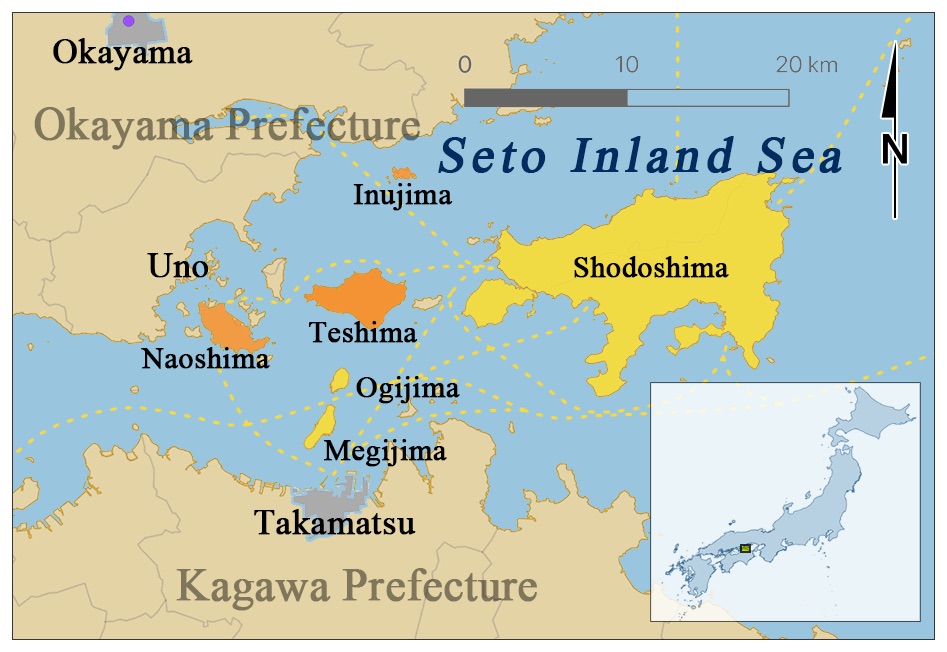
From the geographical distribution of the festival, these islands balance visitor flows from not only the Takamatsu port in Kagawa Prefecture but also Uno port located in Okayama Prefecture. For Ogijima and Megijima, the Takamatsu port is one of the most convenient ports. On the Okayama side, Uno port provides better access to Naoshima, Teshima, as well as Hōden port to Inujima. Although the number of ST hosting communities on Shodoshima is much more than the other communities within those five Triennale islands, Naoshima and Teshima, as much smaller islands, received close to double or almost the same level of visitors as Shodoshima. Therefore, the positive Triennale influences and negative impacts would cause different results which differ from Shodoshima, thus requiring this research to explore.
Mixed Finding
Positive influences and negative impacts perceived by STBs
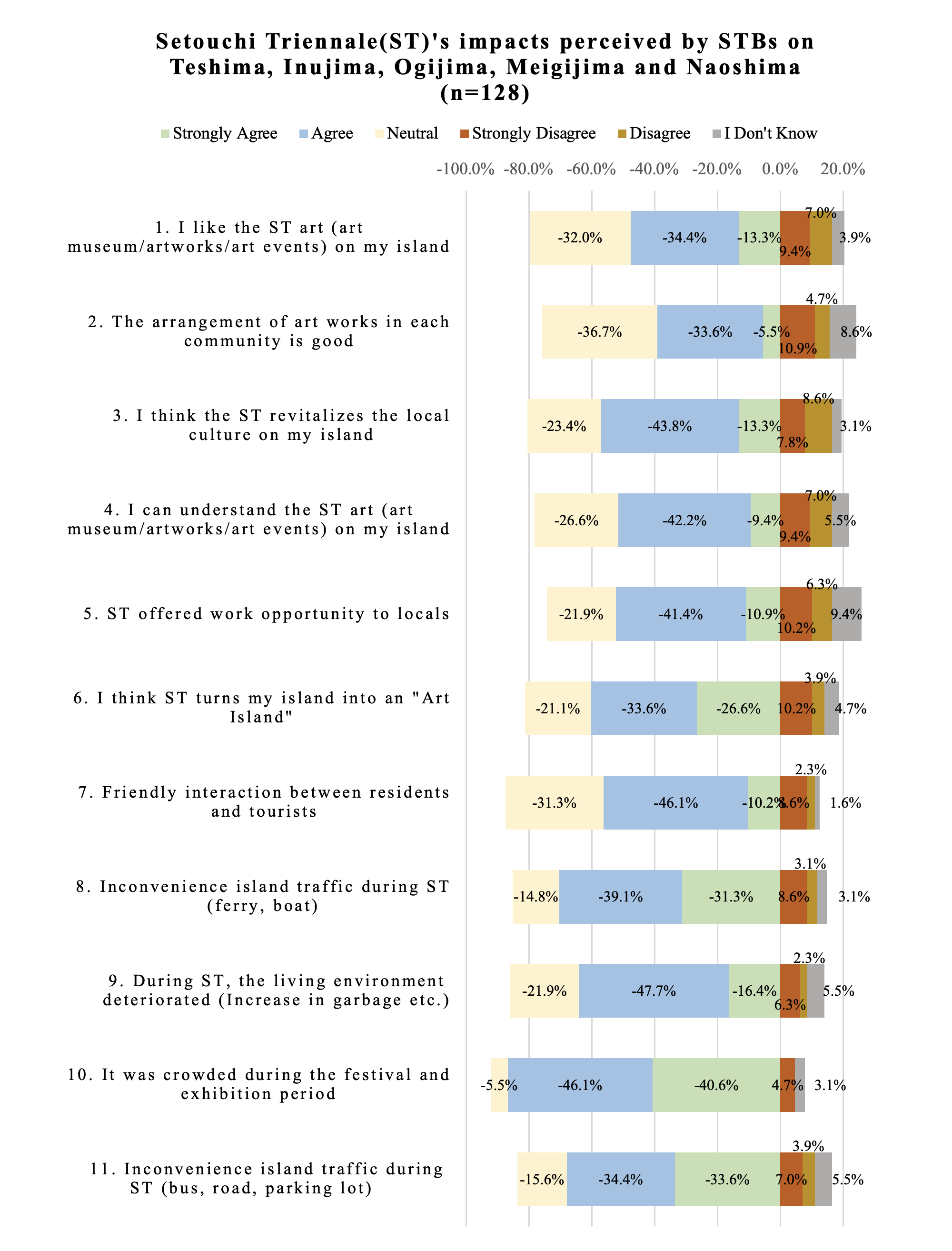
From the questionnaire survey with STBs, this chapter collected 128 samples that represent more than 80-90 percent of local businesses that remained open after the 2016 Setouchi Triennale period. According to Figure 1, the respondent profile (Table 1) shows Teshima and Naoshima have larger numbers of STBs compared with other smaller islands. As shown in Figure 2, the author used 11 Likert scale questions to evaluate the Setouchi Triennale’s various impact on STBs through art, tourism as well as the community. The art-related questions include the perception of art and artwork arrangement from STBs. The tourism-related questions include the tourist interaction, tourism impacts on internal and external transportations, and daily living environment. Questions related to community changes included the CAFTR culture revitalization, job creation, regenerating an art island image. More than 56.3 percent of respondents agree and strongly agree that the good outcomes reflect on Setouchi Triennale brought friendly interaction between residents and tourists. Also, 60.2 percent of them believe Setouchi Triennale brought an art island image to their island. However, the highest results of the negative impacts concentrate among questions 8 to 11, which emphasize the tourism side. This general questionnaire result proves that Setouchi Triennale did bring different type of positive influences, negative impacts, and interaction between residents – tourists.
| Type of Local businesses (n = 128) | Classification | Number of Questionnaires | Percentage of Total (%) |
|---|---|---|---|
| Island | Teshima | 49 | 38.3 |
| Inujima | 14 | 10.9 | |
| Ogijima | 15 | 11.7 | |
| Megijima | 14 | 10.9 | |
| Naoshima | 36 | 28.1 | |
| Non-response | 0 | 0.0 | |
| Gender | Male | 60 | 46.9 |
| Female | 68 | 53.1 | |
| Non-response | 0 | 0.0 | |
| Age Groups | 10-19 | 0 | 0.0 |
| 20-29 | 11 | 8.6 | |
| 30-39 | 32 | 25.0 | |
| 40-49 | 16 | 12.5 | |
| 50-59 | 10 | 7.8 | |
| 60-69 | 28 | 21.9 | |
| 70 and above | 31 | 24.2 | |
| Non-response | 0 | 0.0 | |
| Type of Residency | Local long-term residents (10 years or more) | 59 | 46.1 |
| In-migrant (I-turn) | 35 | 27.3 | |
| Return migrant (U-turn) | 9 | 7.0 | |
| Commuter | 25 | 19.5 | |
| Non-response | 0 | 0.0 | |
| Type of Business | Souvenir shop | 4 | 3.1 |
| Restaurant/Café | 39 | 30.5 | |
| Daily shop | 10 | 7.8 | |
| Tourist Facilities | 5 | 3.9 | |
| Accommodation | 21 | 16.4 | |
| Transportation | 5 | 3.9 | |
| Mixed | 44 | 34.4 | |
| Non-response | 0 | 0.0 |
Further statistical analysis, which includes EFA combined with Cluster Analysis, helps to classify the type of impact as well as identify and divide the respondent into groups by different opinions. As shown in Table 2, EFA was executed using the Principal Component Analysis (PCA) method with Varimax Rotation to measure the positive influence and negative impact of Setouchi Triennale from STBs. This method is used to shorten the factor structure as well as help to interpret the identified factors (Choi and Murray, 2010). The Kaiser–Meyer–Olkin (KMO) measure of sampling adequacy value is 0.744, and Bartlett's Test of Sphericity value is significant (p =.000), which is acceptable to conduct EFA. The factor extraction criterion is based on 1.0 of Eigenvalue. Also, the item inclusion was set loadings of 0.50. The EFA results revealed two distinct factors, which explained 74.4 percent of the total variance. Both factors have Cronbach’s alpha values above the suggested benchmark of 0.6 (Stylidis et al., 2014). All factor loadings are greater than the value 0.5 cut off, and most of them are greater than 0.7 (Choi and Murray, 2010). Factor one (F1) demonstrates the positive influences on art, tourism opportunity and community culture, interaction, and branding outcomes. Factor two (F2) pointed out all the negative impacts that result mainly from tourism on community daily lives. All factor scores were saved as variables through regression for further use in the Cluster Analysis.
| Factors/items | Factor loading | Eigenvalue | % of variance explained | Cronbach's alpha |
|---|---|---|---|---|
| F1 Positive Influences | 3.40 | 30.88 | .82 | |
| 1. I like the Setouchi Triennale art (art museum/artworks/art events) on my island | .80 | |||
| 2. The arrangement of artworks in each community is good | .79 | |||
| 3. I think the Setouchi Triennale revitalizes the local culture on my island | .73 | |||
| 4. I can understand the Setouchi Triennale art (art museum/artworks/art events) on my island | .71 | |||
| 5. Setouchi Triennale offered work opportunity to locals | .62 | |||
| 6. I think Setouchi Triennale turns my island into an 'Art Island' | .61 | |||
| 7. Friendly interaction between residents and tourists | .53 | |||
| F2 Negative Impacts | 2.58 | 23.46 | .67 | |
| 8. Inconvenience island traffic during the Setouchi Triennale (ferry, boat) | .82 | |||
| 9. During Triennale, the living environment deteriorated (Increase in the garbage, etc.) | .82 | |||
| 10. It was crowded during the festival and exhibition period | .78 | |||
| 11. Inconvenience island traffic during the Triennale (bus, road, parking lot) | .76 |
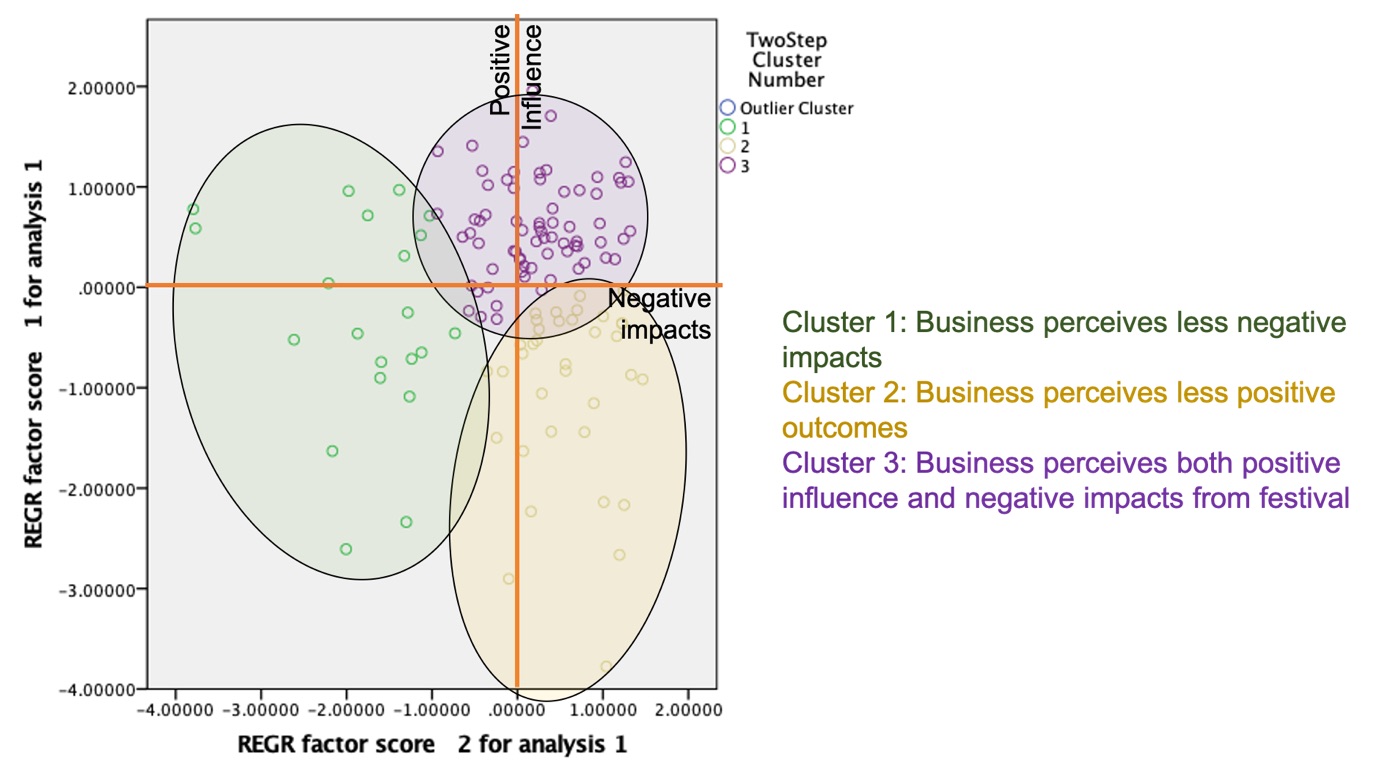
After conducting the Two-Step Cluster Analysis, the results identified three distinct clusters as shown in Figure 3. Cluster 1 (C1), displayed in green, includes 16.4 percent of the overall respondents and is located above 0 on the x-axis, which can be interpreted as those STBs perceiving less negative impacts. Therefore, C1 tends to treat Setouchi Triennale with a positive attitude. On the contrary, Cluster 2 (C2) which includes 28.1 percent of respondents (shown in yellow) is located below the x-axis, which can be interpreted as the STBs who perceive no positive influences. The C2 group therefore has a negative opinion of Setouchi Triennale. Finally, Cluster 3 (C3), displayed in purple, represents 55.5 percent of STBs’ opinions; this group of respondents has mixed opinions, perceiving both positive influence and negative impacts from the Setouchi Triennale.
The STB survey and further statistical results identified that both positive influences and negative impacts co-exist within Setouchi Triennale, with few respondents having only positive or only negative perceptions. The positive influences and changes are reflected in the art, tourism, as well as the community itself in multiple ways. The negative impacts are mostly in the domain the tourism-related issues, but are perceived as having a much deeper impact compared with the positive outcomes.
Mixed methods findings about the ST’s interaction among islands through the perceptions of both community member and STB
Comparison between the official reports with the fieldwork findings
After comparing the official reports with this study’s fieldwork data, a few issues are revealed by the quantitative data from the official survey with community residents (Setouchi Triennale Executive Committee, 2010; 2013; 2015; 2017a; 2017b; 2020) and the author’s own STB survey (Figure 2). A similar question pertained to respondents’ opinion on whether they thought the arrangement of Setouchi Triennale artworks is good for their community. From the Setouchi Triennale 2019 survey, more than 68.4 percent of locals believed the artwork is ‘very’ and ‘moderately’ good for their community. From the author’s survey, only 39.1 percent of local STBs strongly agree and agree that the arrangement of artworks in each community is good. After comparing those two results, it appears that the community STBs have a much lower perception of the quality of artwork than the community members who answered the Setouchi Triennale survey during the residents’ meeting.
The comparison of coding results reveals that while the fieldwork findings align with some aspects of the official Triennale reports, there are notable divergences that challenge the accuracy of the official narrative. According to the official reports, the positive influences – such as local-visitor or local-artist interactions, community revitalization, increasing local sense of pride, enhancing island image, and generating a lively atmosphere – were mentioned by most of the islands, which also matches the findings from the author’s mixed data of STB survey, interviews, and observation. Regarding the negative impacts, issues such as tourist manner (littering, illegal parking, being noisy, and crowding public transportation), concerns with the intermittent festival structure, and the communication with the increasing number of foreign tourists also match with the author’s mixed findings. The improvements made by the Setouchi Triennale’s organization can be seen in the adjustment of the festival period into three sessions after ST 2013 and the gradual scheduling of in-festival transportation (in-island and out-island bus services, ferry line and schedules, as well as limitation of visitor number by each ship). The new STB growth on Teshima and new in-migrants growth on Ogijima also be identified as two special island cases which are not mentioned in the other islands.
New gaps can be identified after comparing the author’s findings with the official report. For Naoshima, all reports mentioned that locals are concerned about security issues, which reflect on the lack of community-level exchange of opinions and the lack of safety measures during a natural disaster. Although the Setouchi Triennale 2013 and 2016 reports mentioned there is an improvement about “no major security issues”, they cannot claim this issue has been solved. From the fieldwork data on Naoshima, the community level of concern with social security remains with tourists’ safety instead of concern about the residential side.
Recently, the new way of allowing people to have a local house for living one night is increasing (AirBnB). So, we saw different faces every night. Sometimes, the tourists have parties until midnight. We cannot fall asleep and don’t feel safe. So, it has become much worse than before [the art tourism development]. (resident on Naoshima)
The lack of a sense of security can be found in multiple interviews from Naoshima, in different locations. Official reports say that there were no major security issues, emphasizing no tourists getting injured during the festival, but security issues for the community, which caused a major impact on local life, are not mentioned in the official report.
On Teshima, the official reports only mentioned that there were "no big accidents" in a positive tone. An interview with the local police, however, revealed the Triennale’s impact on local traffic:
We [police] just recorded a few major traffic accidents on file during the festival. But in reality, there are countless bicycle accidents every week. If no one gets hurt badly, we normally would not count that as an accident. (policeman on Teshima)
I saw a lady fall off from the downhill very fast after losing control of her bicycle, then she hit a big rock on the side of the road. She passed out and shed a lot of blood without moving. After the Ambulance sent her away, we were not able to tell if she dead or just injured. (long-term resident on Teshima)
The official reports mention the bicycle accidents from Setouchi Triennale 2013 and 2016, yet there are no major bicycle accidents in 2019 reports. During the field observation, it should be noted that there were no new or added security measures between the Setouchi Triennale 2016 and 2019 concerning cycling.
Another gap in the 2016 Ogijima Triennale report lies in its failure to distinguish the target audience of new commercial facilities. While the report highlights the opening of new restaurants by in-migrants, it overlooks the fact that these establishments—often serving Western-style dishes like pizza and herbal tea—primarily cater to tourists. Fieldwork observations reveal that while a diverse range of food exists (from traditional octopus rice to modern Italian), the newer options are largely oriented toward visitor consumption rather than local residents' needs, making the official narrative on community integration unobjective.
For Megijima, the 2010 Triennale report mentioned there is a lack of STB. However, there was no follow-up on this aspect mentioned in the following reports. This study found that the growth of new STB is not driven by residents but by commuters.
Shining a spotlight on the process of turning shrinking islands into the art islands
Interview findings from STBs, people who engage in non-tourism industries, and residents, further demonstrated that the respondent’s perception of changes varied, including how the Triennale brought a considerable number of visitors to smaller islands. Most of the communities on these islands had never been tourism destinations before. For aging communities, the Setouchi Triennale did show a good outcome by bringing vitality to the community through interaction with younger tourists or even just letting locals enjoy this enlivened atmosphere.
This village has a lot of elderly people. When they see so many young people coming to visit, they feel like their grandchildren came back. (elderly resident on Teshima)
Every community-level intervention, no matter from art or tourism, must be done moderately. Evidence of perceived excessive social interaction in some cases is considered as interfering with local people's daily life. The fact that the Setouchi Triennale’s festival periods are intermittent brought different impacts for islands in different ways. For those islands that had no tourism development or attractions before the Triennale arrived, local issues mainly concerned the difference between the Triennale period, characterized by over-tourism, and the following period with under tourism issues. The STB respondents wish to maintain a balanced tourism flow for their businesses. The local elderly residents wish to enjoy the balance between the active atmosphere of festival celebration and have a quiet living environment after the festival. However, the long-term plan including both Setouchi Triennale and Art Setouchi periods will bring tourists into the island not only within, but also outside the festival period.
The only thing I expect is that you can come to this island and enjoy the Seto Inland Sea and Setouchi Triennale [only during the Triennale period]. I don't want tourists to come to see the island for sightseeing [in normal times], and after all, I don't want tourists to enter my life. (elderly resident on Megijima)
With the overall opinions about the negative impacts and positive interactions on the islands, the interview findings with community members match the questionnaire survey from STBs. The mixed findings on one hand reveal that the community is enjoying the benefit of CAFTR, such as increased visitors, tourism opportunities, interaction, and cultural exchanges. In particular, from the EFA result on community-tourist interaction (Table 2), the ‘7. Friendly interaction between residents and tourists’ is also considered as a positive outcome of Triennale. On the other hand, however, the locals are also facing the side effects of both festival tourism’s periodic impact with different tourist flows as well as private art development issues. Among all five fieldwork islands, the community members agree that in terms of tourism planning with artwork quality, the BAS (Benesse Art Site Naoshima) did provide better quality art compared with STEC (Setouchi Triennale Executive Committee) and AFG (Art Front Gallery) selected artworks. This caused an un-even tourist distribution as more ST tourists were attracted to the BAS based islands – Naoshima, Teshima, and Inujima.
The power shift between locals’ island and “art foundation’s island”
A critical gap in local perception involves whether residents view their islands as corporate-owned territories rather than community spaces. In islands heavily impacted by private art foundations, the permanent nature of these facilities—functioning as institutional properties long after the Triennale—creates a lasting sense of spatial privatization that shapes local identity.
From the official interview, Triennale officials emphasized their goals and roles in regional revitalization. BAS has its core concept of Naoshima Methods through the medium of art and STEC has their idea of facilitating Cultural Exchanges through festival celebration. As a private art corporation, the BAS emphasizes that their essential role is trying to improve community quality of life, and many of their art projects seem to be aiming for this goal. For example, Naoshima Hall was established as a community theatre and facility for local public use rather than for the tourists. Besides this, the rest mainly aims at the tourist market. Corporations like BAS try to benefit community members by developing public spaces that everyone can enjoy within their tourism economic development.
Some evidence suggests that BAS declares their “community-centered” development guidelines are meant to profit the community members, although the members from Naoshima, Teshima, and Inujima do not perceive these benefits from a community development aspect. Some residents did mention that BAS provides new public infrastructures and jobs for locals. However, the community level of complaints concentrates on the concerns that the private art business development would gradually seize control of the island’s industry, land, and community planning. Therefore, for Naoshima, Inujima, and Teshima, the double impacts are coming from private art corporations in long-term development as well as the art festival’s periodic tourism cycle.
The keyword of “Benesse’s island” constantly appears in unstructured interviews among those three islands.
If Benesse owns this island, they should buy their own boats and open their own ferry lines for tourism purposes! ... During the peak of the festival, when so many tourists occupied the ferry, I was unable to go to the hospital [near Takamatsu port]. (elderly resident on Teshima)
Community members believed BAS brought more direct visible outcomes as well as negative impacts on those islands, compared to the Setouchi Triennale. For them, the Triennale just brought extra impacts based on BAS. Some BAS-specific issues have been found in this study. One is related to the Art House Project (AHP) on both Naoshima and Inujima. Unlike other art museum and facilities that are mainly located in the private land owned by BAS, AHP focus on renovating several vacant houses into artworks inside of the community neighborhoods. This caused a direct impact as it allows tourists into the aging community living environment in sudden bursts.
Since our [community] houses are old, a lot of them have no air conditioning inside. In the past, we usually opened our windows to keep the fresh cool air flows. But this situation cannot continue after the Art House Project. Tourists keep coming and make our living environment much noisy than before. Therefore, a lot of elderly people have to shut the windows off in summer. Many people are sick or get heat stroke. (elderly resident on Naoshima)
I don't feel happy about the increased number of tourists. I don't think [tourism] needs to be increased. Besides, the bad manners of tourists are noticeable. They even enter gardens or homes. (resident on Naoshima)
The AHP on Inujima also had a different background related to the government policy of Okayama Prefecture, which has a different land policy compared to Kagawa Prefecture. This caused a third source of impacts on the island society after BAS and Setouchi Triennale.
For normal people, it’s difficult to rent a house from Okayama City, because the private property is registered, I mean, that belongs to Okayama City. There are many unregistered vacant houses on Inujima. That's why I borrow. There is also a portion that you can lend. However, I asked Okayama City to use it, and if the registration was not done properly, Okayama City would not handle it. (elderly resident on Inujima)
However, BAS brought a lot of available land from Okayama into their private art development. The locals are worried about the loss of control over their island.
Originally, Benesse decided where to move [the artworks or facilities] to this place or to that place, or even went into the farm field. So, they can do things like that. (local business staff on Inujima)
In the three Benesse islands, many community members agree that their community is reaching the limits of tourists carrying capacity. Especially during the Triennale periods, not enough people and efforts are available to help to handle the tourist flow and congested roads, public places, and public transportation. Respondents perceived the increasing service of public transportation such as buses and ferries, but they also mentioned that with the rapid growth of tourists, the public services remain inconvenient for locals. For Inujima, the disappearing population indicated another possible transition of ownership shift towards a private art corporation island.
Pure Setouchi Triennale islands: experiencing co-existence between over-tourism and under tourism
Most of the STBs who experienced the Setouchi Triennale peak period did mention that there are not enough human resources in their business to take care of the festival visitors. However, the bigger challenges concentrate on the smaller islands without any art museum facilities from BAS. On Megijima and Ogijima, several respondents pointed to the inconsistent flow of tourists between the Setouchi Triennale’s on- and off-seasons as creating a condition where there were alternately either too many or too few tourists on the island.
I felt that it [Triennale tourist numbers] was really crazy. There were 1,700 visitors in May of this year [2019], and it started to feel like a war. Originally, [our facility] the library was designed for [local] people who came here to read books and maybe have some snacks at the same time. [Now it's mostly tourists coming for lunch.] (residents’ association leader on Ogijima)
During the festival period, the increase of foreigners on the island was also a challenge for long-term residents operating businesses, who struggled to communicate with them.
The most obvious thing for me was opening my front gate and startling tourists taking photos in our front gateway…. During non-festival times, the majority of the faces you encounter on the streets are familiar and will always greet you warmly. During Setouchi Triennale, it can be difficult because I assume people are Japanese, but they don’t respond to my greetings and then I hear them speaking another language (to my untrained ears, it regularly sounds like Mandarin). (self-employed worker on Ogijima)
The Triennale impacts the island community throughout different periods. For islands, there was no tourism development or attractions. Local concern mainly ranged between the Triennale’s festival period with over-tourism and after the period with the under-tourism issue. The STB respondents wish to maintain a balanced tourism flow for their businesses even after the Triennale period, as currently, the lack of continuous tourism flow cannot maintain their businesses sustainably. However, long-term elderly residents wish to have a much quieter living environment. This is an ongoing issue accompanied by the CAFTR development at the community level.
Island Art Festival’s Positive Influences, Interaction, and Negative Impacts
The Setouchi Triennale brought considerable visitation that cannot be created by the shrinking islands themselves at the community level. Art creates new types of experience that combine artistic creation and regional elements into one tourism product. The creative experience of the Triennale shows its power to bring art and festival lovers (Richards and Wilson, 2006) through innovative placemaking (Borrup, 2016). CAFTR, like other types of festival tourism, has been examined to prove that it has the power to improve community building by bringing new hard-type changes for infrastructures and soft-type changes through cultural exchanges (Nakashima, 2012). However, from the residents’ perspective, this study also found that the island infrastructural changes are still mostly limited to tourism-related improvements. The official reports mainly focus on festival tourism-related aspects rather than on community development.
Under the same CAFTR umbrella, islands with the pure Setouchi Triennale model show different challenges compared with other islands where a private art foundation partners with the Triennale. The impact from the ST’s CAFTR is mainly reflected in the intermittent ‘festivalness’ dilemma between over-tourism and under-tourism. Especially for small destinations like Megijima and Ogijima, this impact was perceived more directly by community residents. The findings show that most of the STBs are not overly optimistic about the Setouchi Triennale. They recognize that both positive influences and negative impacts co-exist. Naoshima, Teshima, and Inujima – but especially Naoshima and Inujima – are also facing double challenges from both CAFTR and private art developers as partners of the Triennale. Negative impacts are mainly concentrated in the artistic intervention accompanied by excessive tourism flows into the community living environment. A case like the AHP can be found on both islands. Both community members and STBs highlighted this issue from their perspectives.
The positive interactions between locals and tourists were identified by community members, especially elderly members. This conclusion has been widely discussed (Cwiertka and Machotka, 2018; Klien, 2010b; Koizumi, 2016; Qu, 2019, 2020). This chapter supports this view on social interaction, and the lively community atmosphere did touch the locals. It did meet the psychological needs of social interaction for elderly people (Klien, 2010b). On the other hand, the visitation and interaction also brought some negative impacts on the locals’ living environment (Cudny, 2013). For most of the community members and STBs, CAFTR can be considered as a good medicine even with side effects. In smaller communities, local elderly people also wish to maintain a quiet and lively balance of social interaction instead of excessive social interaction.
Under the CAFTR framework, the impact on peripheral islands is primarily reflected in the intermittent "festivalness"—a systemic dilemma between seasonal over-tourism and chronic under-tourism. As observed in smaller destinations like Megijima and Ogijima, this volatility is perceived directly by residents as a strain on the community living environment. While the official discourse often highlights tourism-related infrastructure improvements, this study finds that such "revitalization" frequently overlooks non-tourism-related community development. For smaller islands like Ogijima, Megijima and Inujima, the challenge is twofold: they must negotiate the pressures of both the intermittent Triennale mass tourism and the permanent intervention of private art developers. This synergy, while catalyzing a "lively atmosphere," often acts as a "good medicine with side effects," where the psychological benefits of social interaction for elderly residents are weighed against the creative destruction of their quiet, localized way of life.
Conclusion: Revitalization at a Price
The intermittent cultural energy of large-scale art festivals can only be converted into sustainable revitalization (Qu and Zollet, 2023) when the Community-engaged Art Festival Tourism Revitalization moves beyond exogenous tourism spikes to internalize the socio-economic price and structural vulnerabilities of peripheral archipelagos. While social entrepreneurship and deep relational exchange offer pathways for resilience, their success depends on balancing the "festivalness" with the community’s limited resource capacities and social thresholds.
This study provides a critical lens to examine CAFTR as a dual-edged sword for shrinking islands. By transforming depopulated archipelagos into global art tourism spotlights, CAFTR injects vital "cultural energy" into rural destinations, enhancing tourism-related infrastructure, social interaction, and destination branding. However, this "good medicine" comes with significant side effects. As Qu (2020) and Klien (2010) suggest, the "Triennale Tourism" model often forces rural/islands into a precarious intermittent commercial structure, where the "ebb and flow" of mass tourism creates a war-like intensity during festival periods followed by long-term stagnation.
A pivotal finding of this research is that the core selling point of CAFTR—facilitating cultural exchanges (Nakashima, 2012)—frequently leads to social over-interaction and the invasion of residential living space. While interactions satisfy the psychological needs of elderly residents, the "price" paid includes the erosion of quietude and the straining of limited island resources. This reflects the tension between creative enhancement and creative destruction (Mitchell, 2013): the very artistic interventions (such as the Art House Project) that revitalize community aesthetics can simultaneously deteriorate the daily living environment by encroaching on private gateways and public lifelines like ferries.
Furthermore, this study identifies a significant gap between official narratives and local perceptions. While official reports often highlight "zero major accidents," the lived experience of residents reveals a lack of control over tourism in the islands—manifested in frequent traffic accidents and a diminished sense of security. The findings suggest that the negative impacts are disproportionately concentrated on the tourism side, creating extra burdens for shrinking communities. For islands like Naoshima and Inujima, this is compounded by a power shift, where private art developers potentially seize control over island industry and land, leading to a transition from a "local island" to an island managed by an art-foundation.
While CAFTR facilitates temporary vitality, long-term archipelagos resilience requires a shift from urban-centric economic metrics toward a model that values moderate interaction and spatial justice. Instead of relying solely on exogenous factors brought by art intervention, the central role of CAFTR must be examined through the community-level response and endogenous efforts. At the same time, the conclusions of this study imply that the revitalization of similar 'art island' models requires an archipelagic perspective of evaluation, rather than focusing on a single island community as a perfect, isolated case.
Acknowledgments
Part of this study was financially supported by the JSPS KAKENHI (Grants-in-Aid for Scientific Research) No. 25K15694, 23H03639, 23H03644, and by the National Natural Science Foundation of China No. 42271207. Part of this research is derived from Chapter 7 of the author’s doctoral dissertation, which remains hitherto unpublished. The author wishes to express profound gratitude to all the individuals who contributed to this study.
References
- Anwar McHenry, J. 2011. Rural empowerment through the arts: The role of the arts in civic and social participation in the Mid West region of Western Australia. Journal of Rural Studies, 27(3): 245–253. https://doi.org/10.1016/j.jrurstud.2011.03.001
- Borrup, T. 2016. Creative Placemaking: Arts and Culture as a Partner in Community Revitalization. In D. Boyle-Clapp (Ed.), Fundamental of Arts Management.(Org) University of Massachusetts (6th Edition, pp. 1–22). Arts Extension Service.
- Bourriaud, N. (1998). Relational Aesthetics (Les Presse). Les Presse Du Reel.
- Crawshaw, J., Gkartzios, M. 2016. Getting to know the island: Artistic experiments in rural community development. Journal of Rural Studies, 43: 134–144. https://doi.org/10.1016/j.jrurstud.2015.12.007
- Creswell, J. W., Clark, V. L. P. 2017. Designing and Conducting Mixed Methods Research (Intergovernmental Panel on Climate Change (ed.)). Cambridge University Press.
- Cudny, W. 2013. Festival Tourism – the Concept, Key Functions and Dysfunctions in the Context of Tourism Geography Studies. Geographical Journal, 65(2): 105–118.
- Cwiertka, K. J., Machotka, E. 2018. Consuming Life in Post-Bubble Japan - A Transdisciplinary Perspective (N. Avieli, K. Cwiertka, A. Doron (eds.)). Amsterdam University Press. https://doi.org/10.5117/9789462980631
- Duxbury, N., Campbell, H. 2011. Developing and Revitalizing Rural Communities through Arts and Culture. Small Cities Imprint, 3(1): 111–122.
- Duxbury, N., Campbel, H., Elizabeth, K. 2009. Developing and Revitalizing Rural Communities Through Arts and Culture: a Literature Review - Summary Overview. Creative City Network of Canada.
- Franklin, A. 2018. Tourism: A new field for tourist studies. Tourist Studies, 18(4): 399-416.
- Fukutake, S. Kitagawa, F. 2016. “Naoshima kara setouchikokusaigeijutsusai e - bijutsu ga chiiki o kaeta” [From Naoshima to the Setouchi International Art Festival: Art Has Changed an Area]. Gendaikikakushitsu.
- Getz, D. 2008. Event tourism: Definition, evolution, and research. Tourism Management, 29(3): 403–428. https://doi.org/10.1016/j.tourman.2007.07.017
- Hawkins, H. 2013. Geography and art . An expanding field : Site , the body and practice. Progress in Human Geography, 37(1): 52–71. https://doi.org/10.1177/0309132512442865
- Higham, J. E. s., Ritchie, B. (2001). The Evolution of Festivals and Other Events in Rural Southern New Zealand. Event Management, 7(1):39–49. https://doi.org/10.3727/152599501108751461
- Ihara, Y. 2007. A Study on the Characteristics of the Art Projects and their Influence on the Regional Environment at the Islands in the Seto Inland Sea. Journal of The Japanese Institute of Landscape Architecture, 70(5): 625–630. https://doi.org/10.5632/jila.70.625
- Klien, S. 2010. Contemporary art and regional revitalisation: selected artworks in the Echigo-Tsumari Art Triennial 2000-6. Japan Forum, 22(3–4):513–543. https://doi.org/10.1080/09555803.2010.533641
- Koizumi, M. 2016. Creativity in a shrinking society: A case study of the Water and Land Niigata Art Festival. Cities, 56: 141–147. https://doi.org/10.1016/j.cities.2015.10.002
- Kondo, J. 2012. Revitalization of a Community, Site-Specific Art and Art Festivals A Case of Art Site Naoshima [University of Jyväskylä]. https://jyx.jyu.fi/bitstream/handle/123456789/37928/1/URN%3ANBN%3Afi%3Ajyu-201205301764.pdf
- Krippendorf, J. 1987. The Holiday Makers: Understanding the Impact of Leisure and Travel. In Holiday Makers: Understanding the impact of leisure and travel. William Heinemann. https://doi.org/10.4324/9780080939032
- Mahon, M., Hyyryläinen, T. 2019. Rural Arts Festivals as Contributors to Rural Development and Resilience. Sociologia Ruralis, 59(4): 612–635. https://doi.org/10.1111/soru.12231
- Massey, D. (2004). Geographies of responsibility. Geografiska Annaler, Series B: Human Geography, 86(1): 5–18. https://doi.org/10.1111/j.0435-3684.2004.00150.x
- Mitchell, C. J. A. 2013. Creative destruction or creative enhancement? Underastanding the transformation of rural spaces. Journal of Rural Studies, 32: 375–387. https://doi.org/10.1016/j.jrurstud.2013.09.005
- Nakashima, M. 2012. Community Involvement and Quality of Life with Setouchi International Art Festival. Hiroshima Journal of International Studies, 18: 71–89.
- Nakashima, M. 2014. Community Regeneration of Aging Society and an Art Festival on a Remote Island. Hiroshima Journal of International Studies, 20: 93–104.
- Prentice, R., Andersen, V. 2003. Festival as creative destination. Annals of Tourism Research, 30(1): 7–30. https://doi.org/10.1016/S0160-7383(02)00034-8
- Prince, S., Qu, M., Zollet, S. 2021. The making of art islands: A comparative analysis of translocal assemblages of contemporary art and tourism. Island Studies Journal, 16(2): 235-254.
- Quinn, B. 2006. Problematising ‘festival tourism’: Arts festivals and sustainable development in Ireland. Journal of sustainable tourism, 14(3): 288-306.
- Quinn, B. 2010. Arts festivals, urban tourism and cultural policy. Journal of Policy Research in Tourism, Leisure and Events, 2(3):264–279. https://doi.org/10.1080/19407963.2010.512207
- Qu, M., Zollet, S. 2023. Neo-endogenous revitalisation: Enhancing community resilience through art tourism and rural entrepreneurship. Journal of Rural Studies. 97: 105-114. https://doi.org/10.1016/j.jrurstud.2022.11.016
- Qu, M., McCormick, A. D., Funck, C. 2022. Community resourcefulness and partnerships in rural tourism, Journal of Sustainable Tourism 30 (10): 2371-2390. https://doi.org/10.1080/09669582.2020.1849233
- Qu, M., Cheer, J. M. 2021. Community art festivals and sustainable rural revitalisation. Journal of Sustainable Tourism, 29(11-12):1756-1775. https://doi.org/10.1080/09669582.2020.1856858
- Qu, M., Funck, C. 2021. Rural art festival revitalizing a Japanese declining tourism island. Nancy Duxbery (Eds). In Cultural Sustainability, Tourism and Development (Re)articulations in Tourism Contexts, 51-68. Routledge. https://doi.org/10.4324/9780367201777-6
- Qu, M. 2020. Teshima - from Island Art to the Art Island. Shima14(2): 250–265. https://doi.org/10.21463/shima.14.2.16
- Qu, M. 2019. Art Interventions on Japanese Islands: The Promise and Pitfalls of Artistic Interpretations of Community. The International Journal of Social, Political and Community Agendas in the Arts, 14(3): 19–38. https://doi.org/10.18848/2326-9960/CGP/v14i03/19-38
- Richards, G., Wilson, J. 2006. Developing creativity in tourist experiences: A solution to the serial reproduction of culture? Tourism Management, 27(6): 1209–1223. https://doi.org/10.1016/j.tourman.2005.06.002
- Richards, G. 2011. Creativity and tourism. The state of the art. Annals of Tourism Research, 38(4): 1225–1253. https://doi.org/10.1016/j.annals.2011.07.008
- Setouchi Triennale Executive Committee. 2010. Setouchikokusaigeijutsusai 2010 sokatsu hokoku [Setouchi Triennale 2010 General Report]. https://setouchi-artfest.jp/files/about/archive/general-report2010.pdf
- Setouchi Triennale Executive Committee. 2013. Setouchikokusaigeijutsusai 2013 sokatsu hokoku [Setouchi Triennale 2013 General Report]. https://setouchi-artfest.jp/seto_system/fileclass/img.php?fid=press_release_mst.201610281720295a02f5ca4a432e15cc6dc445da533834
- Setouchi Triennale Executive Committee. 2015. Setouchikokusaigeijutsusai 2016 Jigyo Betsu Shosai Keikaku [Setouchi Triennale 2016 Detailed Plans by Business]. https://setouchi-artfest.jp/seto_system/fileclass/img.php?fid=press_release_mst.201610281720295a02f5ca4a432e15cc6dc445da533834
- Setouchi Triennale Executive Committee. 2017a. Setouchikokusaigeijutsusai 2016 sokatsu hokoku [Setouchi Triennale 2016 General Report]. https://setouchi-artfest.jp/seto_system/fileclass/img.php?fid=press_release_mst.20170217195217a6457f2b91cb302fa36db1fae1083e73
- Setouchi Triennale Executive Committee. 2017b. Setouchi Triennale 2016 General Report. https://setouchi-artfest.jp/seto_system/fileclass/img.php?fid=press_release_mst.20170217195218ace09533ffebc6fe19970cb32faed335
- Setouchi Triennale Executive Committee. 2020. Setouchi Triennale 2019 General Report. https://setouchi-artfest.jp/files/about/archive/report2019.pdf
- Srivastava, A., Thomson, S. B. 2009. Framework Analysis: A Qualitative Methodology for Applied Policy Research. Journal of Administration Governance, 4(2): 72–79.
- Stylidis, D., Biran, A., Sit, J., Szivas, E. M. 2014. Residents’ support for tourism development: The role of residents’ place image and perceived tourism impacts. Tourism Management, 45: 260–274. https://doi.org/10.1016/j.tourman.2014.05.006
- Tagore-Erwin, E. 2018. Contemporary Japanese art: between globalization and localization. Arts and the Market, 8(2): 137–151. https://doi.org/10.1108/aam-04-2017-0008
- Woods, M. 2011. Rural. Routledge.
- Woods, M. 2012. Creative Ruralities. ‘Creativity on the Edge’ Symposium Moore Institute, National University of Ireland Galway, June.
- Yamashima, T. 2014. Naosima - the island of ART in Setonaikai. Utsunomiya Kyowa University Annual Report on Urban Economics, 14: 90–96.
- Yamamoto, A., Kawahara, S., Hara, N. 2014. Role and Influence of Art and Culture Activities in Regional Development 2013 Setouchi International Art Festival Visitors’ Survey Report. “Kanko Kagaku Kenkyu” (Tourism Science Research), 7: 59–64.
- Zollet, S., Qu, M. 2024. Revitalising rural areas through counterurbanisation: Community-oriented policies for the settlement of urban newcomers. Habitat International 145, https://doi.org/10.1016/j.habitatint.2024.103022